Words in the Wind: Four Voices from the Sky
"20 miles"
Words in the Wind: Four Voices from the Sky
Before checklists and glass cockpits, four pioneers wrote what they saw—and what they believed the sky could become.
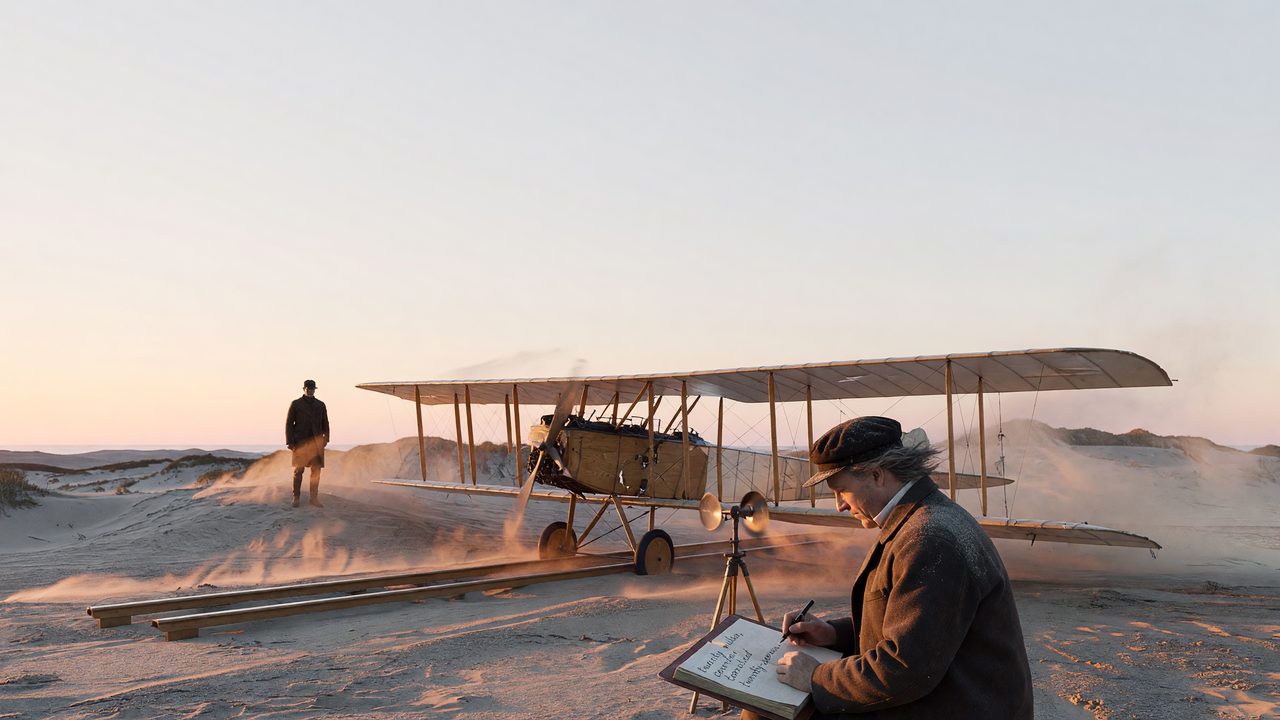
On the morning of 17 December 1903, at Kill Devil Hills near Kitty Hawk, North Carolina, Orville Wright made the first sustained, powered flight in a heavier-than-air machine. When he returned to camp, he did not reach for grand rhetoric. He opened his diary and recorded what his instruments said. The wind, he noted, blew a little over twenty miles per hour according to the brothers’ own anemometers; corrected to twenty-seven miles by the Government anemometer at Kitty Hawk. Numbers first. Wind speed, time, distance. The entry reads like a laboratory notebook from a man who had spent years turning speculation into measurement—and who understood that history would ask for evidence, not applause.
That habit of precision ran through the Wright family’s work long before the Flyer left the rail. On 18 September 1901, Wilbur Wright presented "Some Aeronautical Experiments" to the Western Society of Engineers in Chicago, summarizing the aeronautical experiments he and Orville had conducted on the dunes; the paper appeared in print in December 1901. He framed their effort in terms older than engineering itself: the desire to fly, he said, was an idea handed down by ancestors who had looked enviously at birds soaring freely through space along what he called the infinite highway of the air. Wilbur was not selling romance. He was explaining motive—the same human restlessness that built ships and bridges, now applied to wings and propellers. Deeds would follow; but the speech made clear that flight began as a question asked in language, not merely as a machine assembled in a shed.
Three decades later, another pilot-poet answered the question from a different altitude. Antoine de Saint-Exupéry flew mail routes across deserts and seas before he vanished over the Mediterranean in 1944. In Wind, Sand and Stars (Terre des Hommes), published in 1939, he described what only an aviator could see: the airplane had unveiled the true face of the earth. For centuries, he argued, highways had deceived travelers. Roads bent to human convenience, running from stream to stream, hiding the contours of the land. From the cockpit, coastlines, mountains, and empty quarters appeared as they were—not as commerce had drawn them. Saint-Exupéry’s prose turned navigation into philosophy. The sky was not escape from the world; it was a clearer way of reading it.
Charles Lindbergh’s words carried a different weight: public expectation. In May 1927, after his solo flight from New York to Paris, he stood before the American Club of Paris while journalists and dignitaries pressed a practical question—what good had the flight accomplished? Lindbergh, recorded in his book We and reported in contemporary press accounts including the St. Louis Post-Dispatch of 25 May 1927, answered by reaching back 132 years. Benjamin Franklin, he reminded his audience, had been asked what good his balloon was, what it would accomplish. Franklin had replied: What good is a newborn child? Lindbergh adopted that logic. He believed his flight was the forerunner of a great air service between America and France—not a stunt sealed in May, but an infancy. The analogy was deliberate. Infants do not justify themselves by immediate utility; they promise capacity. Lindbergh was asking his listeners to measure aviation by what it might grow into.
Together, these four voices trace a single arc. Orville documents. Wilbur explains longing. Saint-Exupéry interprets the view. Lindbergh defends the future. None of them relied on engines alone to make their case. The Wrights’ hardware is museum pieces now; Saint-Exupéry’s Lockheed disappeared; Lindbergh’s Spirit of St. Louis hangs suspended in the Smithsonian. The sentences remain—plain, lyrical, argumentative—carved into the culture pilots inherit whether they have read the originals or not.
Why it matters to you
When you brief a weather report or copy winds aloft into your logbook, you are standing in Orville’s tradition: the sky yields to observation before it yields to story. When you feel the pull of the runway on a clear morning, you touch Wilbur’s ancient envy of birds—not as poetry, but as the honest motive behind every certificate you earn. When you climb through haze and the grid of roads falls away, Saint-Exupéry’s lesson applies directly to airmanship: the airplane shows terrain and weather as they are, not as maps simplify them; judgment depends on seeing truly. And when someone asks whether general aviation still matters, Lindbergh’s Franklin analogy is worth remembering. A flight that looks small today—your first solo, a cross-country, a charity run—may be the forerunner of skill and service you cannot yet name. The great aviators were men of deeds, but their words have outlasted the engines. In training, treat language with the same care you give airspeed and fuel: what you say in the cockpit, on the radio, and in your own notes becomes part of the highway they opened. The sky was never a wall. It was, and remains, a place where precise words and precise flying belong together.