Wings That Wiggled, Hope That Fell
"The airlift pilot who dropped candy instead of bombs."
Wings That Wiggled, Hope That Fell
When a young Air Force lieutenant broke the rules at Tempelhof, he taught Berlin’s children — and the world — that an airlift could carry more than coal.
In the summer of 1948, Second Lieutenant Gail S. Halvorsen arrived in occupied Germany with a transport pilot’s ordinary expectations: long shifts, tight schedules, and endless runs of coal and flour into a city the Soviet Union had chosen to strangle. Beginning that June, Moscow had sealed every road, canal, and rail line into West Berlin. More than two million civilians faced hunger behind a new Iron Curtain geography. The Western Allies answered with Operation Vittles — a round-the-clock conveyor of C-47s and C-54s threading into Tempelhof under General William H. Tunner’s exacting control. Halvorsen’s job was logistics, not legend.
One July afternoon, after filming aircraft on the ramp, Halvorsen walked to the airport perimeter fence. Roughly thirty Berlin children had gathered to watch the landings. In interviews preserved by the Veterans History Project at the Library of Congress and the National WWII Museum, Halvorsen recalled how they spoke to him in the English they had pieced together from the crews overhead. They did not beg. They asked whether the Americans would keep coming when the weather turned foul — whether the West would stay. Their composure struck him harder than any complaint could have. He reached into his pocket and found two sticks of chewing gum.
Halvorsen handed over what little he had. The children tore the wrappers into strips so each could smell or taste a fragment. No one fought over the prize. In his papers held at Brigham Young University’s L. Tom Perry Special Collections, Halvorsen described that moment as the hinge of everything that followed. He promised to return with sweets they could actually eat, and told them he would identify his airplane by rocking its wings — a pilot’s improvised signal that earned him the nickname Onkel Wackelflügel, Uncle Wiggly Wings. A girl at the fence asked the obvious question: how would they know his plane among hundreds? Wiggle the wings, he said. She believed him.
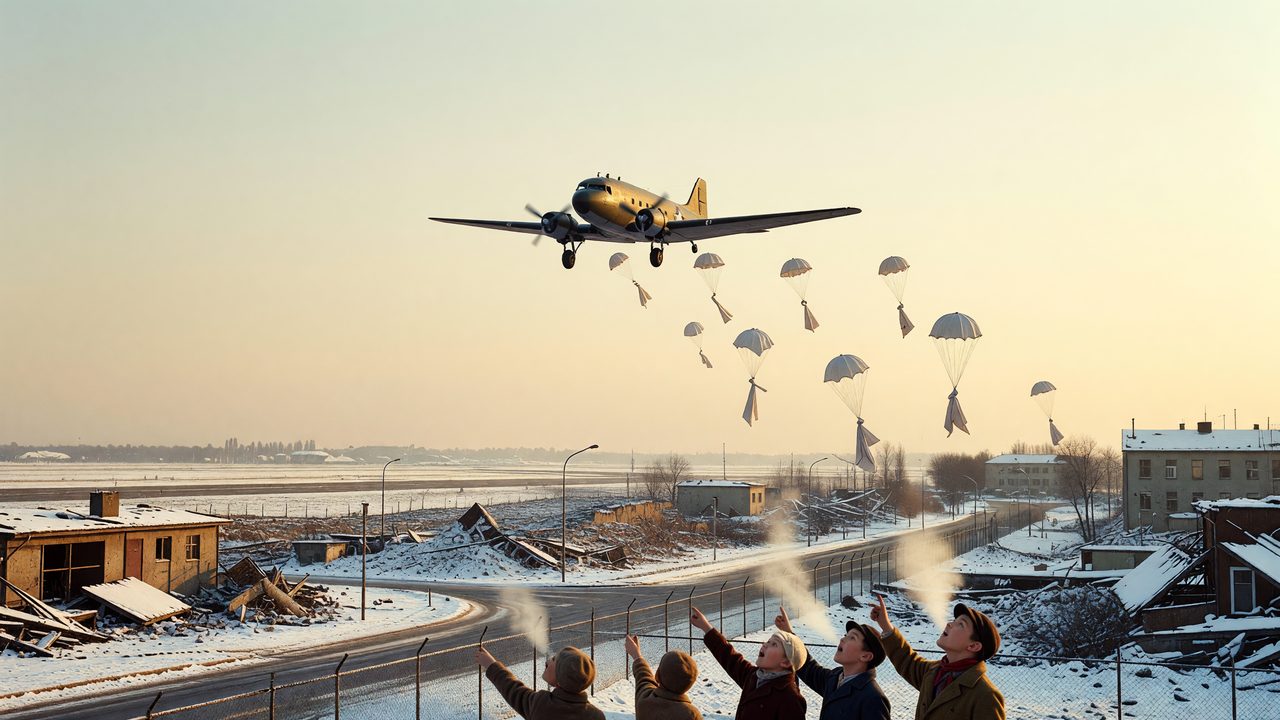
The next day he did exactly that. From the cockpit of his C-54, Halvorsen dipped the wings over the city and released handkerchief parachutes weighted with his own candy rations — simple bundles improvised from what a transport crew could spare. Children raced through the rubble to catch them. Letters soon arrived addressed to “Uncle Wiggly Wings,” requesting drops in neighborhoods the air corridors crossed but the supply manifests ignored. What began as one lieutenant’s private gesture was, by military standards, unauthorized. Tunner initially looked the other way. Then, reading the morale on the ground and in the headlines, he folded the effort into the airlift as Operation Little Vittles. Donations of candy and handkerchiefs poured in from stateside families; crew members tied parachutes on their own time between coal sorties. By January 1949, Halvorsen and the airmen who joined him had delivered an estimated 250,000 candy parachutes over West Berlin — a rain of chocolate and gum alongside the flour that kept the city alive.
The blockade lifted in May 1949; the airlift itself continued into September. Soviet propaganda had painted the West as conquerors indifferent to German suffering. Little Vittles offered a counter-image no briefing room could manufacture: American aviators as careful, almost familial guardians of children who had endured war and now endured siege. Years later, a Berliner told Halvorsen what those drops had meant. It was not chocolate, the man said. It was hope.
Why it matters to you
Halvorsen’s candy runs violated the tidy boundaries of a regulated military operation — unauthorized cargo, non-standard drops, improvised procedures over a congested terminal area that Tunner ran like a factory floor. Yet the airlift’s strategic success depended on more than tonnage. Student pilots today train inside rigid operational rules for good reason: airspace discipline, load compliance, and chain-of-command exist to keep people alive. Halvorsen’s story is the exception that clarifies the rule. Grassroots humanitarian action inside a massive logistics machine reshaped Cold War propaganda in real time, proving that how you fly can matter as much as what you haul. The professional lesson is not to treat regulations as optional. It is to recognize that judgment, empathy, and clear communication — the same skills you drill in crew resource management and ADM — can turn a lawful mission into something people remember long after the coal is gone. Adding a natural reference to the Truman Presidential Library source.
Wings That Wiggled, Hope That Fell
When a young Air Force lieutenant broke the rules at Tempelhof, he taught Berlin’s children — and the world — that an airlift could carry more than coal.
In the summer of 1948, Second Lieutenant Gail S. Halvorsen arrived in occupied Germany with a transport pilot’s ordinary expectations: long shifts, tight schedules, and endless runs of coal and flour into a city the Soviet Union had chosen to strangle. Beginning that June, Moscow had sealed every road, canal, and rail line into West Berlin. More than two million civilians faced hunger behind a new Iron Curtain geography. The Western Allies answered with Operation Vittles — a round-the-clock conveyor of C-47s and C-54s threading into Tempelhof under General William H. Tunner’s exacting control. Halvorsen’s job was logistics, not legend.
One July afternoon, after filming aircraft on the ramp, Halvorsen walked to the airport perimeter fence. Roughly thirty Berlin children had gathered to watch the landings. In interviews preserved by the Veterans History Project at the Library of Congress and the National WWII Museum, Halvorsen recalled how they spoke to him in the English they had pieced together from the crews overhead. They did not beg. They asked whether the Americans would keep coming when the weather turned foul — whether the West would stay. Their composure struck him harder than any complaint could have. He reached into his pocket and found two sticks of chewing gum.
Halvorsen handed over what little he had. The children tore the wrappers into strips so each could smell or taste a fragment. No one fought over the prize. In his papers held at Brigham Young University’s L. Tom Perry Special Collections, Halvorsen described that moment as the hinge of everything that followed. He promised to return with sweets they could actually eat, and told them he would identify his airplane by rocking its wings — a pilot’s improvised signal that earned him the nickname Onkel Wackelflügel, Uncle Wiggly Wings. A girl at the fence asked the obvious question: how would they know his plane among hundreds? Wiggle the wings, he said. She believed him.
The next day he did exactly that. From the cockpit of his C-54, Halvorsen dipped the wings over the city and released handkerchief parachutes weighted with his own candy rations — simple bundles improvised from what a transport crew could spare. Children raced through the rubble to catch them. Letters soon arrived addressed to “Uncle Wiggly Wings,” requesting drops in neighborhoods the air corridors crossed but the supply manifests ignored. What began as one lieutenant’s private gesture was, by military standards, unauthorized. Tunner initially looked the other way. Then, reading the morale on the ground and in the headlines, he folded the effort into the airlift as Operation Little Vittles. Donations of candy and handkerchiefs poured in from stateside families; crew members tied parachutes on their own time between coal sorties. By January 1949, Halvorsen and the airmen who joined him had delivered an estimated 250,000 candy parachutes over West Berlin — a rain of chocolate and gum alongside the flour that kept the city alive.
The blockade lifted in May 1949; the airlift itself continued into September. Soviet propaganda had painted the West as conquerors indifferent to German suffering. Little Vittles offered a counter-image no briefing room could manufacture: American aviators as careful, almost familial guardians of children who had endured war and now endured siege. Years later, a Berliner told Halvorsen what those drops had meant — a sentiment echoed in curriculum materials at the Harry S. Truman Presidential Library. It was not chocolate, the man said. It was hope.
Why it matters to you
Halvorsen’s candy runs violated the tidy boundaries of a regulated military operation — unauthorized cargo, non-standard drops, improvised procedures over a congested terminal area that Tunner ran like a factory floor. Yet the airlift’s strategic success depended on more than tonnage. Student pilots today train inside rigid operational rules for good reason: airspace discipline, load compliance, and chain-of-command exist to keep people alive. Halvorsen’s story is the exception that clarifies the rule. Grassroots humanitarian action inside a massive logistics machine reshaped Cold War propaganda in real time, proving that how you fly can matter as much as what you haul. The professional lesson is not to treat regulations as optional. It is to recognize that judgment, empathy, and clear communication — the same skills you drill in crew resource management and ADM — can turn a lawful mission into something people remember long after the coal is gone.