Wind Alone: Breitling Orbiter 3 and the Last Great First
"16 feet"
Wind Alone: Breitling Orbiter 3 and the Last Great First
On March 1, 1999, two men left a Swiss ski village in a red carbon egg and returned nineteen days later having closed the final unconquered loop of atmospheric flight.
Departure at Château d'Oex
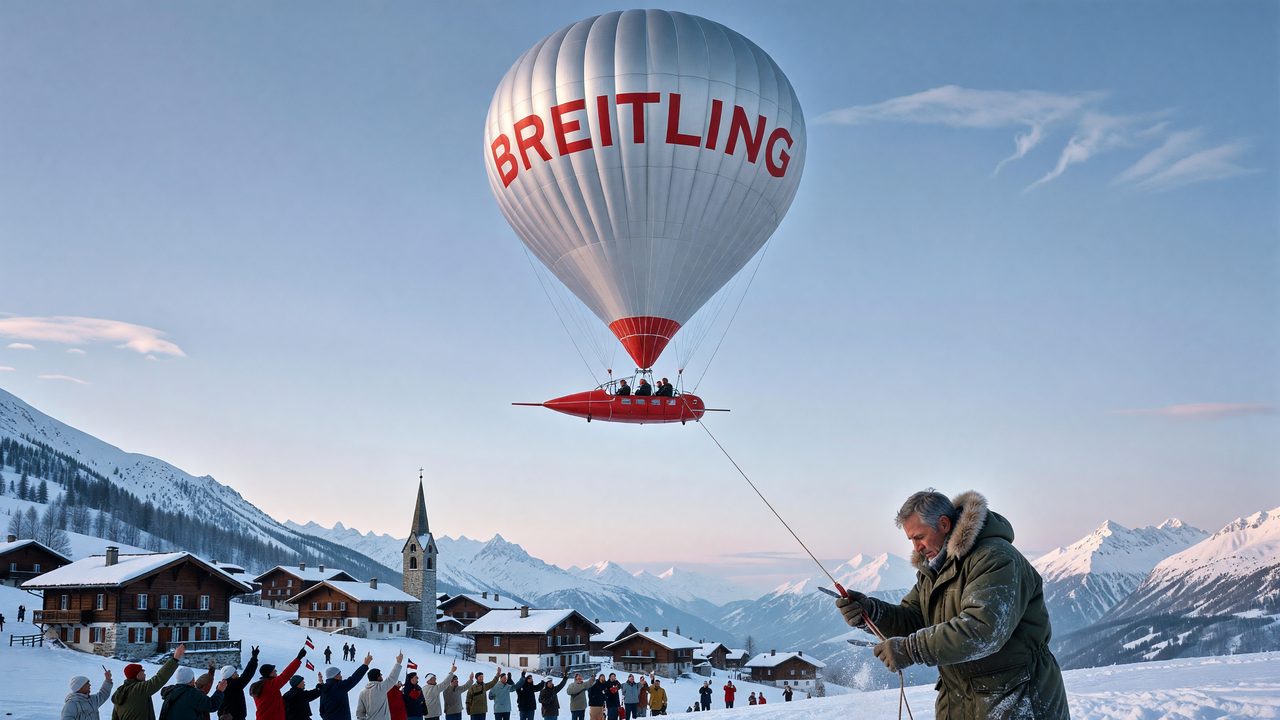
At 9:05 a.m. on March 1, 1999, church bells rang across Château d'Oex as thousands cheered in the snow. The crew chief drew a Swiss Army knife across the last rope holding Breitling Orbiter 3, and the enormous Rozière balloon rose above the Swiss ski village. Suspended beneath it hung an elongated red gondola—roughly 18 feet long and about 10 feet in diameter—shaped like a carbon-composite egg and built to survive weeks aloft.
Inside rode Bertrand Piccard, a Swiss psychiatrist and the grandson of Auguste Piccard, who had pioneered stratospheric ballooning in the 1930s, and Brian Jones, a British balloonist whose technical skill complemented Piccard’s temperament. Their Rozière design stood roughly 180 feet tall, combining helium for lift with a hot-air envelope for altitude control. The balloon held the equivalent of seven Olympic swimming pools of gas. No aircraft engine would push them forward. Only the wind could carry them around the planet—a challenge that had defeated six prior Breitling-sponsored attempts and a century of adventurers before them.
Riding the Jet Stream
For nineteen days, twenty-one hours, and fifty-five minutes, Piccard and Jones lived inside that narrow capsule, trading altitude for direction as jet streams shifted beneath them. The Breitling Orbiter 3 official mission log, maintained by the Geneva control center with timed daily position reports from March 1 through March 21, 1999, charts a path dictated almost entirely by meteorology. The pilots faxed forecasters in Geneva, parsing upper-air data to decide when to climb into a favorable current and when to descend to avoid a dead headwind.
Over the Sahara they jettisoned spent titanium propane tanks, lightening the craft as fuel dwindled. Above the Pacific they drifted in near silence, the enormity of the ocean unfolding below a basket no wider than a small bedroom. In their account Around the World in 20 Days (John Wiley & Sons, 1999), Piccard and Jones describe the flight as equal parts endurance test and navigation puzzle—each hour requiring the discipline to conserve propane, the patience to wait for wind, and the judgment to act when opportunity appeared.
Crossing the Line
The Anheuser-Busch Corporation had offered one million dollars to the first team to circumnavigate the globe nonstop in a balloon, stipulating that the voyage exceed the length of the Tropic of Cancer and cross all meridians. On March 20, 1999, Breitling Orbiter 3 met that standard. The balloon crossed its starting longitude at 9°27′ west over Mauritania, completing the circuit. Scientific American reported the milestone in its March 1999 article “Riding High,” noting that the finish-line crossing and the subsequent landing in Egypt closed a quest that had consumed the ballooning community for more than a decade.
Fuel reserves were nearly exhausted. On March 21, the gondola touched down in the Egyptian Sahara near Mut, having covered 29,055 miles. Piccard and Jones had become the first human beings to circle the Earth in a balloon without stopping. For many observers, it was the last great aviation “first”—the final major milestone in unpowered atmospheric flight, joining the ranks of Lindbergh’s ocean crossing and Yeager’s supersonic run.
The Hidden Engineering
The flight’s success rested on innovations invisible from the launch field. The New York Times reported on March 22, 1999, that Don Cameron of Cameron Balloons, the craft’s builder, had revealed a secret after landing: a foam-insulation system that dramatically reduced propane consumption by limiting heat loss from the hot-air envelope. In a Rozière balloon, every degree of saved heat translated into miles of range. Cameron’s insulation gave Piccard and Jones the margin they needed to survive doldrums, endure headwinds, and still reach Egypt with empty tanks rather than empty hope.
The Anheuser-Busch prize was theirs. So was a permanent place in aviation history—two pilots who proved that patience, weather literacy, and meticulous engineering could accomplish what no engine alone had achieved.
Why it matters to you
The operational principles demonstrated on March 1, 1999, amid the ringing of church bells and the cheers of thousands, still shape how pilots operate today. Piccard and Jones did not command the wind; they studied it, briefed with specialists on the ground, committed to a plan, and adjusted when the atmosphere changed. Every rated pilot practices the same discipline: fuel—or endurance—is finite; favorable conditions are temporary; and the decision to climb, descend, hold, or divert must rest on current data, not wishful thinking. Whether you are planning a cross-country in a Cessna or interpreting a terminal aerodrome forecast before a dawn departure, you are exercising the same chain of judgment that carried two men around the world on the wind alone. Breitling Orbiter 3 did not eliminate uncertainty from flight. It showed how preparation, communication, and calm adherence to procedure turn uncertainty into arrival.