Where the Pylons Still Roar: Reno’s Sixty Years of Closed-Course Thunder
"In 1966, the races moved to Stead Airfield, the former military base named for Bill's brother, 1st Lt."
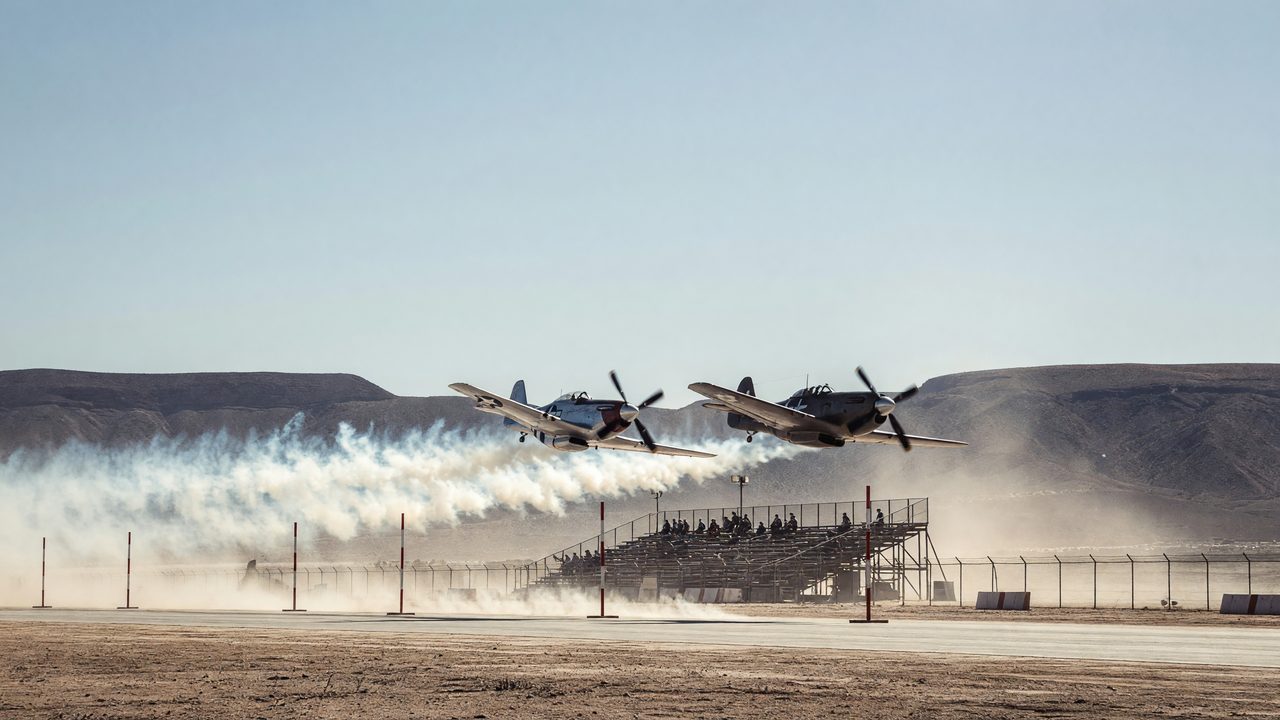
Where the Pylons Still Roar: Reno’s Sixty Years of Closed-Course Thunder
From a dirt strip in the high desert to the fastest motorsport on Earth—and back through tragedy—the National Championship Air Races carried a century of speed into the modern cockpit.
A Name Written in Silver and Loss
Long before the first pylon fell at Reno, the story began with a Mustang and a brother’s grief. First Lieutenant Croston Stead of the Nevada National Guard was killed in 1949 when his P-51 crashed—one more casualty in the long shadow cast when Bill Odom’s modified P-51 augered into a Berea, Ohio, neighborhood that same year, effectively ending the National Air Races at Cleveland. When Stead Air Force Base was decommissioned in 1966 and turned over to the city, it was renamed for Croston Stead. The airfield that bears his name would become the permanent home of the only closed-course pylon championship the world would know for generations.
Bill Stead, Croston’s brother—a Nevada rancher, hydroplane champion, and accomplished pilot—revived the dormant tradition in 1964 to help mark Nevada’s statehood centennial. He persuaded Reno businessmen and ABC Television to back an ambitious September spectacle at Sky Ranch, a crude 2,000-foot dirt strip northeast of town. Duane Cole, who had literally invented modern precision aerobatics, helped plan the debut. The opening act was a transcontinental dash from St. Petersburg, Florida, won by Wayne Adams in a P-51 averaging 319 mph. On the ground, Mira Slovak took the first Unlimited championship at 356 mph—though Bob Love had flown faster, penalized for cutting pylons under a powerboat-style points system abandoned the following year.
Sky Ranch to Stead: The Course Takes Shape
Those first two years were dusty, improvised, and glorious. Pilots chafed at Bill Stead’s insistence that they land on Sky Ranch’s rocky strip so ABC could film takeoffs and landings; Lockheed test pilot Darryl Greenamyer was disqualified in 1964 when his modified Bearcat could not safely use the runway. The board finished $13,000 in the red yet pressed on, and by 1966 the races had moved to Stead—wider runways, sagebrush, and Peavine Mountain framing an oval course of painted oil drums atop telephone poles that would grow into a nine-mile circuit where Unlimited machines now lap in just over a minute.
The Smithsonian’s National Air and Space Museum documents what followed: Greenamyer’s Bearcat Conquest I—today enshrined at the Udvar-Hazy Center—dominated the Unlimited class; Clay Lacy, Steve Hinton, Lyle Shelton, and a procession of engineers and crew chiefs pushed piston fighters toward 500 mph. The museum’s racing collection, from Roscoe Turner’s Meteor to Jon Sharp’s record-setting Nemesis, situates Reno inside a continuum stretching to Glenn Curtiss’s 1909 triumph at Reims. By the early 1970s, as Photorecon’s race reporting notes, cross-country and rival closed-course events had faded. Reno stood alone.
Calamity, Conviction, and the Call to Race
No honest history of Stead skips September 16, 2011. During the Unlimited Gold race, Jimmy Leeward’s highly modified P-51 The Galloping Ghost experienced a violent upset; the NTSB found trim-tab flutter at racing speed, incapacitating the pilot within a second. The airplane struck the ramp in the spectator boxes, killing Leeward and ten people on the ground and injuring dozens more. Reno Air Racing Association president Mike Houghton later told Smithsonian magazine that he questioned whether the event could reach its fiftieth anniversary—until injured fans and survivors urged him personally to continue. The races returned in 2012.
Through financial crises, insurance battles, and FAA-imposed course changes, the spectacle endured: Formula One Continentals, T-6 Texans, Sport-class kitplanes, and the Unlimited Gold final that still sends modified P-51 Mustangs and Hawker Sea Furies around Peavine at speeds approaching 500 mph, wingtip to wingtip, fifty feet above the desert floor. Above them, the pace aircraft orbits as it has since Bob Hoover led the warbird formation in his P-51 Ole Yeller and invented the phrase every pilot still waits to hear before the throttle goes wide: “Gentlemen, you have a race!” Steve Hinton carries that call forward from the T-33, and formation breaks into combat.
The Last Lap at Stead
For more than six decades, the National Championship Air Races at Reno-Stead were the last closed-course pylon air-racing event of their kind anywhere on Earth—a distinction the museum’s curators and decades of reporting confirm as rival venues vanished. Insurance costs, encroaching development, and dwindling Unlimited entries finally brought the checkered flag to Stead in 2023, when a midair collision in the T-6 class on the final Sunday ended that year’s racing early. Yet the lore outlives the geography: Section 3’s orange-clad faithful, the September family in the pits, and the engineering obsession Pete Law described after his first race in 1966—“love at first sight”—remain part of American aviation’s emotional vocabulary.
Why it matters to you
Croston Stead’s 1949 P-51 crash did not end the story; it inscribed it into the landscape where generations of pilots would learn what closed-course racing demands—precise energy management, wake awareness, formation discipline, and the humility to know that a trim tab, a pylon cut, or a half-second of inattention at 400 knots leaves no room for improvisation. Whether you fly a Cessna 172 or a turboprop, Reno’s history is a case study in structured risk: briefings, course knowledge, crew coordination, and the decision to continue only when the airplane—and the pilot—are genuinely ready. The pylons at Stead are gone, but the standard they set for preparation, judgment, and respect for the machine still belongs in every training syllabus. That is why a lieutenant’s name on a Nevada airfield remains a cornerstone of aviation culture—and why the thunder, even when distant, still has something to teach.