When the X-45A Flew, the Cockpit Stayed on the Ground
"The X-45A's flight test program accumulated a string of historic firsts."
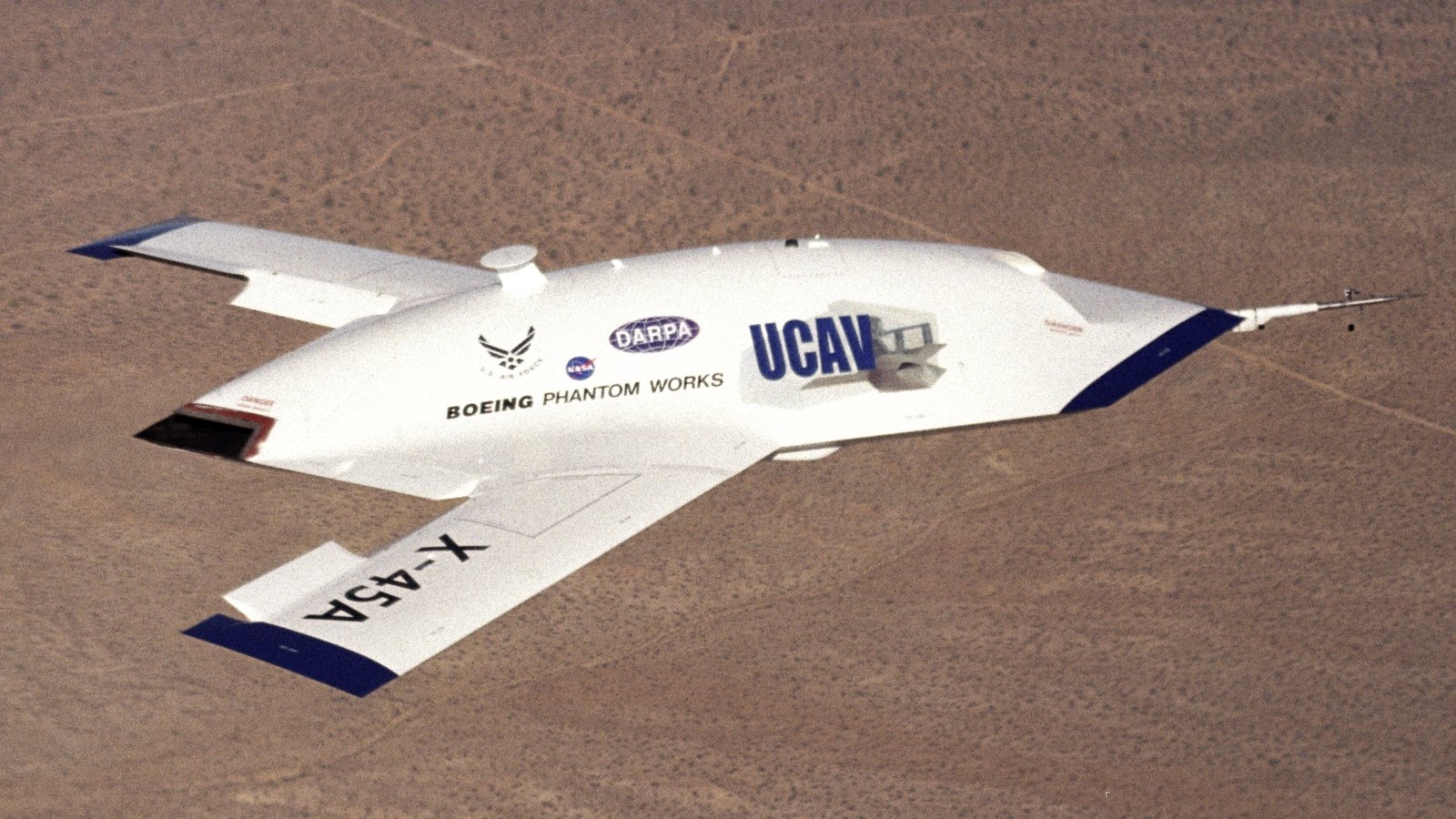
When the X-45A Flew, the Cockpit Stayed on the Ground
In 2002, a tailless jet took off over the Mojave Desert without a pilot aboard — and within three years proved that machines could find targets, drop weapons, and adapt to threats on their own.
Designed to Fight, Not Just to Watch
Long before today's armed drones patrolled distant battlefields, reconnaissance unmanned aircraft had already rewritten aerial surveillance. The Boeing X-45A was something different: from its first metal cut, it was meant to strike. Developed under the Defense Advanced Research Projects Agency and U.S. Air Force Joint Unmanned Combat Air Systems program — with the Navy folded in later — the aircraft was conceived as a networked combat node, not a camera platform with missiles bolted on afterward.
Only two X-45A demonstrators were built. The National Air and Space Museum's collection record describes a stealthy, swept-wing jet with retractable landing gear, composite skin, and twin internal weapons bays — the silhouette of a small bomber shrunk to technology-demonstrator scale. One of them, nicknamed The Elsie May, would accumulate a remarkable list of firsts before flight testing ended in 2005.
On May 22, 2002, the first X-45A lifted off from NASA's Dryden Flight Research Center at Edwards Air Force Base, California. Boeing's announcement of the flight the following day noted a fourteen-minute hop to 7,500 feet and 195 knots, validating the command-and-control link between the aircraft and its ground-based mission station. NASA, which provided range support and flight-research infrastructure throughout the program, later documented how the demonstrator progressed from basic handling to gear-retraction flights by the end of that year. For the first time, an unmanned system built from inception for combat was flying in controlled airspace alongside the same test culture that had matured the X-planes.
The Bay Doors Open
Weapon carriage defined the X-45A's purpose. Internal bays kept the radar signature clean and proved that an autonomous aircraft could manage the same mechanical choreography a human weapons officer coordinates — doors, release sequence, separation safety — without anyone in the ejection seat.
On April 18, 2004, that engineering became history. NASA's photographic record of the event captures the moment an X-45A released an inert GPS-guided munition against a ground target over the Edwards range — the first precision-guided weapons release from an autonomous unmanned combat aircraft. The image is clinical, almost understated: a jet no larger than a trainer, a weapon falling away, and the Mojave stretching to the horizon. Yet the implication was enormous. An aircraft with no onboard crew had autonomously carried a guided store to a target and released it on command.
One Operator, Two Aircraft, No Script
The program's next leaps concerned not hardware but authority — who, or what, decides what happens next.
On August 1, 2004, a single ground-based pilot controlled two X-45As simultaneously in flight, a demonstration that one human could supervise multiple combat-capable unmanned aircraft in the same airspace. The milestone foreshadowed a battlespace where a flight lead's span of control might extend across several robotic wingmen.
The most striking test came on February 4, 2005. Both X-45As launched into a patrol pattern over Edwards. Without following a predetermined attack path, they autonomously evaluated which aircraft held the better position and fuel state to prosecute a simulated target. One attacked. Then, as the scenario evolved, a previously undetected threat appeared mid-mission — and the second aircraft engaged it. No pre-briefed script dictated the sequence; the pair reasoned through the problem in flight.
That February mission was the clearest preview of autonomous combat decision-making the program produced: machines allocating roles, executing strikes, and reallocating when the tactical picture changed.
A Short Flight, a Long Shadow
Flight testing concluded in 2005. The Joint Unmanned Combat Air Systems effort was eventually superseded, and the Navy's carrier-landing X-47B carried the baton toward operational unmanned strike. Yet the X-45A's record stands in the Smithsonian's archives and in NASA's Edwards imagery: first autonomous flight of a high-performance combat-capable UAV, first precision-guided weapons release from such an aircraft, and first autonomous multi-vehicle coordinated attack.
Why it matters to you
You will never hand an autonomous system your logbook, but the logic the X-45A pioneered is already in the cockpit you train in. Mission computers weigh fuel and geometry when suggesting reroutes. Autopilots and flight management systems execute profiles you approve, then adapt when ATC amends the clearance. Traffic and terrain awareness tools prioritize threats while you manage the broader picture. The skill is not memorizing one automation state — it is maintaining supervisory command: knowing what the aircraft is doing, what it will do next, and when to intervene. The X-45A proved that machines could release precision weapons and reassign roles in flight without a predetermined script. Your training asks the same question in human terms: stay ahead of the aircraft, keep authority over the mission, and never let the system fly the pilot. That discipline separated a successful test program over the Mojave from a cautionary tale — and it remains the dividing line in every cockpit you will ever occupy.