When the World Flies to Wittman Field
"By the late 1950s, the convention had outgrown Milwaukee ..."
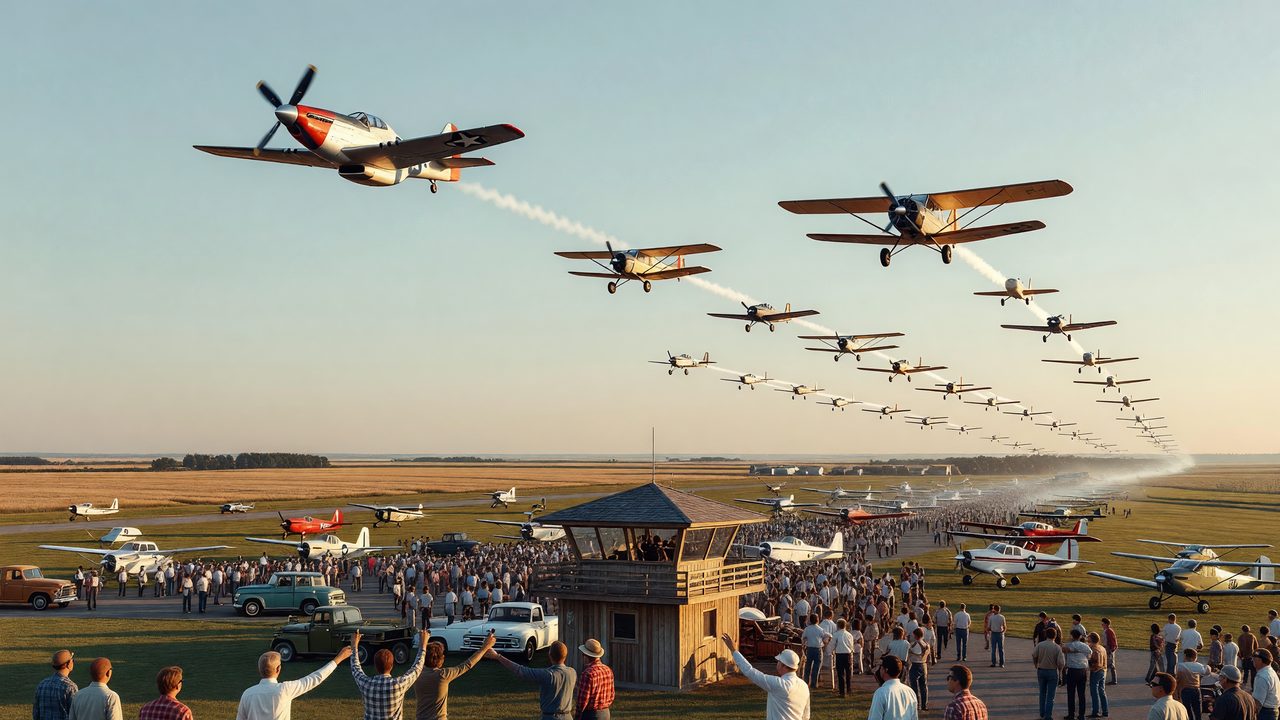
When the World Flies to Wittman Field
From a Milwaukee parking lot to the busiest control tower on Earth — how a homebuilt fly-in became aviation’s defining pilgrimage.
In September 1953, a handful of amateur aircraft builders gathered in Milwaukee for the first annual fly-in of the Experimental Aircraft Association. What began as a modest meeting of enthusiasts sharing shop-floor wisdom would, within two decades, reshape the calendar of American aviation. The EAA’s own historical record documents that inaugural convention as the seed of something far larger than its founders could have imagined: not a spectacle staged for spectators, but a congregation of people who believed that flight belonged to anyone willing to learn the craft.
By the late 1950s, the event had outgrown Milwaukee’s confines. In 1959, organizers relocated to Greater Rockford Airport in Illinois, where the convention would spend eleven formative years. EAA Chapter 22’s chronicle of those Rockford years captures a period of rapid maturation. The fly-in developed the rhythms and rituals that still define AirVenture today — camping under wings, dawn formations of fabric-covered aircraft, forums where designers debated structure and airflow long before the crowd arrived. Rockford was the adolescence of the event: big enough to demand serious planning, still intimate enough that a builder might taxi beside the airplane he had riveted in his garage the winter before.
The permanent home arrived through the counsel of a man who embodied the association’s ethos. In 1970, aviation legend Steve Wittman — racer, designer, and longtime Oshkosh fixture — urged the association to consider Wittman Regional Airport. The field bore his name and his fingerprints; he understood its capacity, its geography, and its place in the Midwestern flying community. The move proved decisive. Oshkosh offered room to grow without surrendering the event’s soul.
Through the 1970s and 1980s, attendance climbed into six figures as the Jet Age reshaped commercial aviation and military procurement. AirVenture did not chase those trends so much as absorb them. Warbirds shared ramp space with homebuilts. Jet teams appeared overhead while craftsmen in SportAir workshops taught composite layups and weld inspection. The convention became a living cross-section of flight’s full timeline — piston and turbine, military and civil, factory and experimental — all converging on one Wisconsin grass and pavement mosaic.
The scale of the modern gathering defies casual description. According to EAA’s AirVenture Oshkosh 2024 Annual Report, the most recent convention drew approximately 686,000 visitors, with more than 10,000 aircraft arriving on the field. Supporting that influx requires a flight operations regime without parallel in general aviation. The special AirVenture arrival procedures — published in a NOTAM that runs to dozens of pages — route aircraft of every category through colored-dot approaches, rock-your-wings radio discipline, and Fisk arrival gates staffed by volunteers who become, for one week, the most consequential traffic directors in the sky. Wittman’s control tower earns its reputation as the busiest in the world during the event, a title earned not by airline schedules but by the relentless stream of single-engine experimentals, vintage biplanes, turboprops, and jets all seeking the same runways.
Yet Oshkosh remains something other than an airshow. Veterans call it a pilgrimage — an annual return to a place where the culture of flight is practiced, not merely displayed. It is a reunion of chapters and families, of mentors and students, of builders who spend years on a project and then, impossibly, fly it to the greatest aviation gathering on the planet. That act — leaving a home field in an airplane you built yourself, merging into the arrival flow, finding your campsite among thousands — is the event’s quiet thesis. Ordinary people can build wings in ordinary spaces and earn a place on the world’s most crowded ramp.
Why it matters to you
The Rockford years matter because they forged the operating culture every AirVenture pilot still trains for: high-density, mixed-traffic environments where clear communication and disciplined procedures keep chaos at bay. If you ever plan to fly the arrival, you will study that multi-page NOTAM the way instrument students study approach plates — not as trivia, but as the grammar of survival in crowded airspace. The history of Milwaukee, Rockford, and Oshkosh is not nostalgia; it is the foundation of a skill modern aviators need. AirVenture proves that with preparation, humility, and respect for procedure, a single pilot in a single airplane can join the busiest aerial ballet on Earth — and that is why the world keeps flying to Wittman Field.