When the Wires Went Silent
"The pilot moves the stick. The computer decides what the control surfaces actually do."
When the Wires Went Silent
Fly-by-wire did not merely replace cables with electrons—it handed part of the pilot’s authority to software, and aviation has been negotiating that bargain ever since.
From Pulleys to Processors
For most of aviation’s first century, the path from stick to elevator ran through steel. Pull the yoke, tug a cable, deflect a surface. The pilot felt the aircraft’s temperament through direct mechanical linkage. That simplicity came at a cost: weight, maintenance, and the physical limits of what a human arm could manage at high speed or extreme attitude.
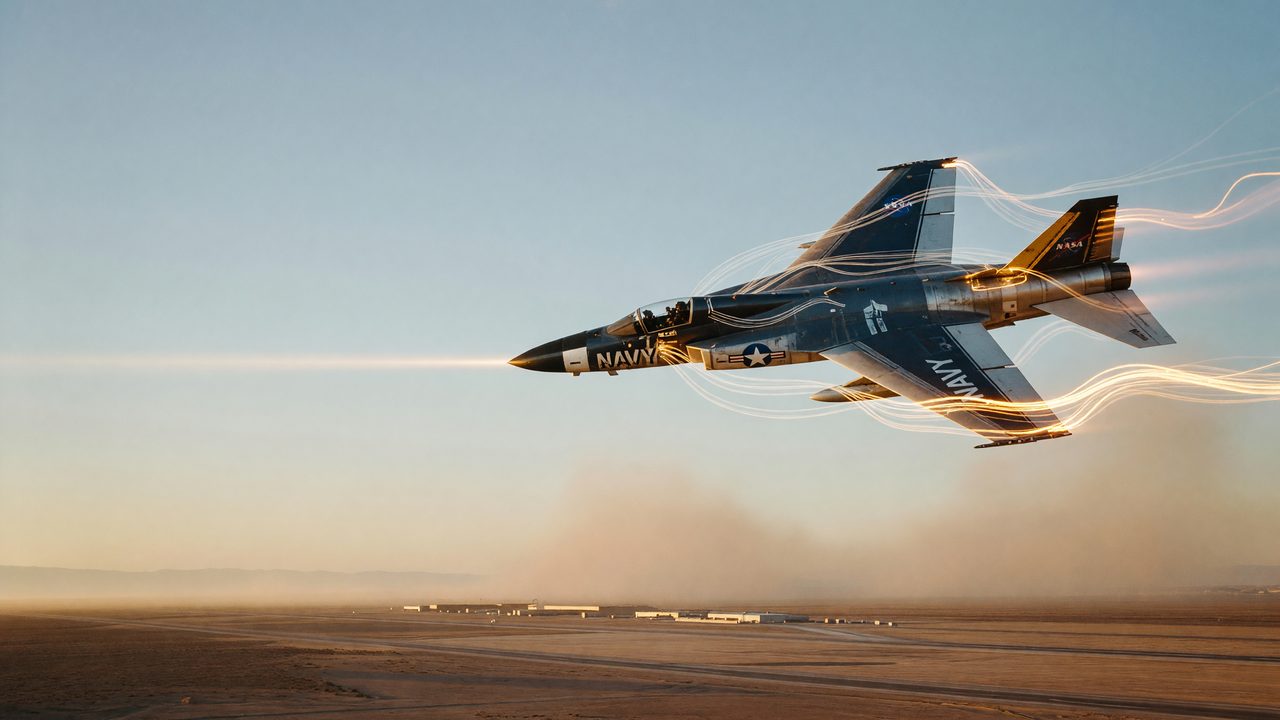
The breakthrough arrived in the research hangars of what is now NASA’s Armstrong Flight Research Center. In 1972, engineers fitted a production Vought F-8 Crusader with the Digital Fly-by-Wire program’s computers and actuators, replacing conventional control runs with electronic commands. When test pilot Gary Krier lifted off on May 25, 1972, the Crusader became the first aircraft to fly under fully digital fly-by-wire control. NASA’s program proved that software could interpret pilot intent, command hydraulics, and—crucially—reshape handling characteristics in real time. The control cable had not vanished; it had been translated into voltage.
The Sidestick Revolution
Sixteen years later, the technology crossed from experimental fighters into the airline cabin. The Airbus A320, which entered commercial service in 1988, was the first airliner designed from the outset with full fly-by-wire flight controls. Airbus technical documentation describes a architecture in which sidestick inputs pass through multiple flight-control computers before reaching the actuators, with no mechanical backup to the primary surfaces. The payoff was envelope protection: software could refuse a command that would stall the wing, overstress the airframe, or exceed certified limits. Airlines gained consistency; designers gained freedom to optimize weight and aerodynamics without asking pilots to compensate for every quirk.
The same digital logic enabled aircraft that conventional stability rules would have grounded. The Lockheed F-117 Nighthawk’s faceted stealth shaping produced aerodynamics so marginal that the jet could not be flown safely by human reflex alone. A quadruple-redundant digital fly-by-wire system continuously corrected the unstable airframe, making flight possible only because computers worked faster than any cable-and-pulley arrangement ever could.
When the Computer Said No
Fly-by-wire’s promise carried a shadow that accident investigators would soon document in detail. On June 26, 1988, an Air France Airbus A320 on a low-altitude flyover at the Habsheim airshow struck trees and crashed. France’s Bureau d’Enquêtes et d’Analyses (BEA), in its investigation of the event, examined how the aircraft entered high-angle-of-attack protection—alpha protection—as the crew attempted a steep climb at low height. Under normal flight-control law, the system limited further pitch-up command even as the captain applied full aft sidestick input. The BEA report became a landmark case study in what human-factors researchers call mode confusion: the pilot believed he was commanding maximum pitch; the automation was executing a different, protective interpretation of that command.
The Habsheim tragedy crystallized a design schism. Airbus built its philosophy around the premise that the computer should guard the envelope even against a determined human input. Boeing’s later fly-by-wire airliners, including the 777 and 787, generally preserve greater pilot override authority, allowing the crew to push closer to—and sometimes through—software-imposed limits. Neither approach is purely right. Envelope protection has undoubtedly prevented countless excursions; pilot authority has saved aircraft when automation misread the situation. The tension between those priorities remains one of the jet age’s defining engineering debates.
Why it matters to you
You may never hand-fly an A320 at treetop height, but you almost certainly fly behind digital intermediaries. The Garmin G1000 NXi integrated flight deck in the Epic E1000GX—a turboprop many general-aviation pilots now train on—still uses mechanical flight controls, while its avionics and autopilot add automation and envelope awareness analogous in training value—but not architecture—to airline fly-by-wire systems. When you engage an autopilot, interpret a stick shaker, or wonder why the aircraft resists a control input near the edge of the envelope, you are experiencing the same fundamental question Habsheim posed: who is flying, you or the software? Training that builds explicit awareness of flight-control laws, protection modes, and automation state is no longer airline-captain specialty work. It is baseline airmanship for anyone operating advanced avionics—and the skill that keeps digital fly-by-wire an ally rather than a surprise.