When the Target Flew Itself: Britain's Queen Bee and the Birth of the Drone
"Developed at Britain's **Royal Aircraft Establishment**, ..."
When the Target Flew Itself: Britain's Queen Bee and the Birth of the Drone
In 1935, a Tiger Moth–shaped biplane with nobody in the front seat taught Royal Navy gunners to hit a moving aircraft—and gave the world a new word for unmanned flight.
A Problem Worth Solving
By the mid-1930s, naval anti-aircraft gunnery had outgrown the classroom. Fleet gun crews firing from rolling decks faced attackers that banked, climbed, and twisted across the sky. Static sleeves towed behind manned aircraft could teach trigger timing, but they could not reproduce the evasive geometry of a hostile bomber. What the Royal Navy needed was an aircraft that maneuvered like an enemy—and could be expended, recovered, or flown again without putting a human target pilot at risk.
British researchers at the Royal Aircraft Establishment had been pursuing radio guidance since the Great War, building on the pioneering work of engineer Archibald Low and his wartime "Aerial Target" program. Earlier Royal Navy experiments between 1927 and 1929 proved the basic idea of guiding aircraft from a distance, yet those trials remained laboratory curiosities. The breakthrough came when the requirement shifted from building a flying weapon to building a flying quarry.
Tiger Moth Silhouette, Drone Soul
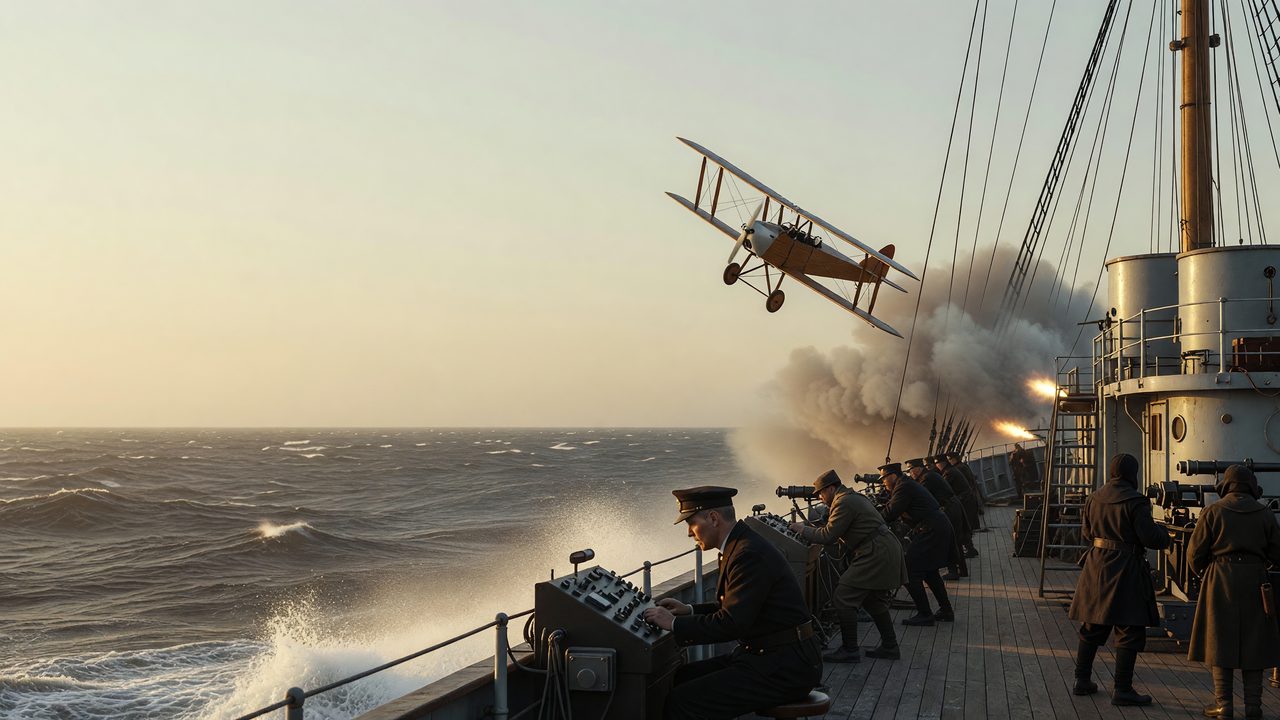
The answer was the de Havilland Queen Bee, designated DH.82B, which first flew in 1935. From a distance it looked like the Tiger Moth trainer every RAF cadet knew—same biplane lines, same open-cockpit familiarity—but the resemblance was deliberate deception. Engineers stripped away the metal-frame fuselage of the standard trainer and substituted a lighter structure of spruce and plywood. The change served two purposes at once: it reduced cost for an aircraft meant to be shot at, and it made the airframe buoyant if operations carried it down over open water.
The forward cockpit stayed empty. In the enclosed rear cockpit, technicians installed radio-control equipment connected to pneumatically operated servo units that moved the elevator and rudder on command. A naval operator on a warship's deck—headphones on, transmitter in hand—could send the Queen Bee through turns and climbs that mimicked an attacking aircraft, giving gun crews a target that fought back with its flight path rather than with guns.
As curator Roger D. Connor of the Smithsonian's National Air and Space Museum has noted, it was this training requirement that "really drives the drone industry and establishes it as a viable aerospace niche during the '30s." The Queen Bee was not a laboratory demonstration. It was production hardware built for fleet use.
Returnable, Reusable, and Real
PBS NOVA's survey of unmanned aerial vehicle history describes the Queen Bee as the first returnable and reusable UAV—a distinction that mattered enormously to budgets and logistics. The aircraft could launch from an airfield on wheels or from the sea on floats, climb to altitudes reported around 17,000 feet, and cover distances up to roughly 300 miles at speeds exceeding 100 mph. When a gunnery exercise ended, crews could recover the machine if it survived the engagement. That cycle—launch, maneuver, shoot, salvage—turned remote control from a parlor trick into a training system.
Roughly 380 Queen Bees entered service with the Royal Air Force and Royal Navy, soldiering on as aerial targets until retirement in 1947. The name itself seeded the lexicon: the male honeybee that cannot sting is called a drone, and the Queen Bee gave that term its aviation meaning. American observers took notice. U.S. Chief of Naval Operations William Standley watched the system at work and concluded the fleet had an urgent need for its own radio-controlled targets—an endorsement that helped push drone development across the Atlantic even as the British guarded some of their technical details.
From Gunnery Lanes to the Modern Sky
The Queen Bee arrived on the eve of a war that would multiply unmanned aircraft in every direction—target drones, assault drones, and eventually the long lineage of surveillance platforms that fill today's timelines. Yet its immediate legacy was humbler and more durable: proof that a pilotless airplane could be built in quantity, operated routinely at sea, and trusted to behave predictably enough that crews could learn from its flight.
The Smithsonian's Air & Space Quarterly and the RAF Museum's early-drone exhibitions both frame the Queen Bee as the first viable military application of a concept that had spent two decades lurching between crash landings and cancelled programs. Where the Kettering Bug swerved toward reviewing stands and French remote-aircraft experiments reached flight before budget and strategic cuts canceled them, the Queen Bee simply went to work.
Why it matters to you
The engineering choices behind the Queen Bee—lightweight wooden structures, direct linkage between control inputs and surface response, and flight paths designed to stress an observer's tracking skills—are the same fundamentals you manage in every training sortie. When you practice coordinated turns, anticipate how your aircraft will roll and pitch before the horizon catches up, or fly defensively to deny another pilot a stable sight picture, you are exercising the same aerodynamic logic that made a Queen Bee convincing as a hostile target. Remote-control servos have given way to fly-by-wire, and gunnery exercises have given way to traffic-pattern awareness and scenario-based training. But the core insight remains: an aircraft's maneuverability is a language. Learning to read it—and to speak it fluently from the left seat—is still what separates pilots who merely fly from pilots who truly handle the airplane.