When the Sky Went Jet: Comet, 707, and the Window That Changed Aviation
"The Comet flew first. The 707 flew longest. The reason was square windows."
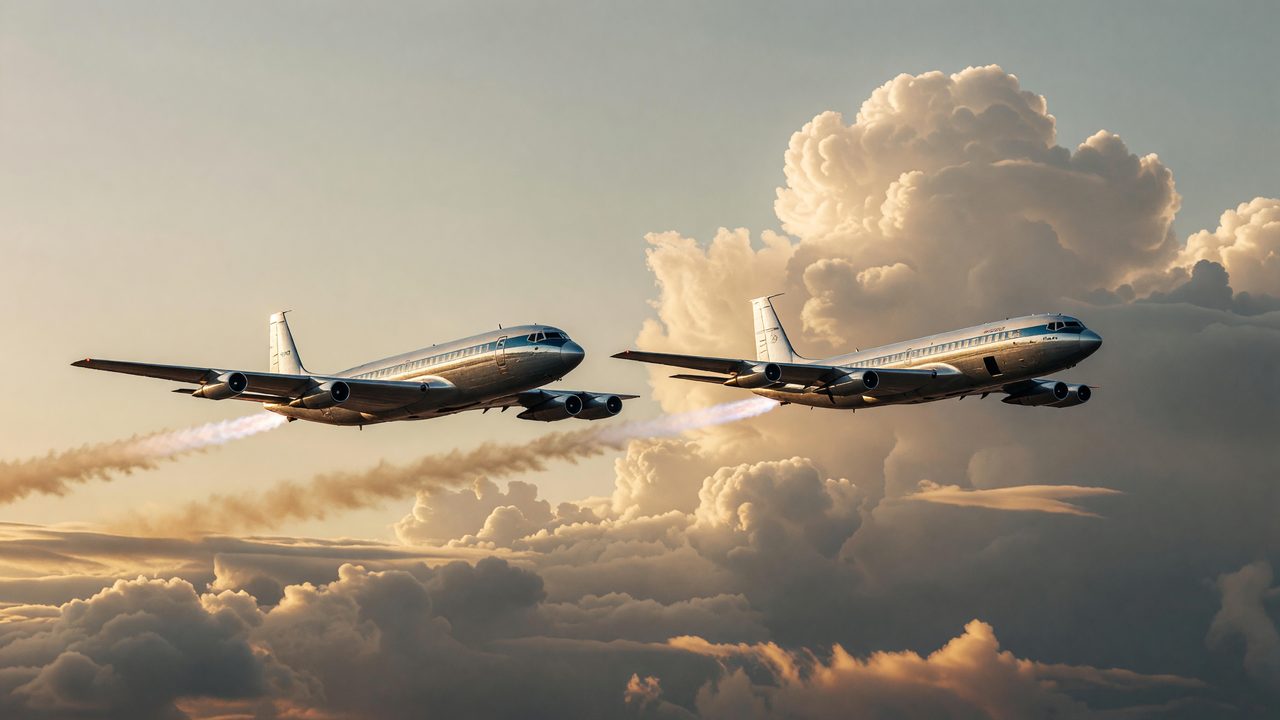
When the Sky Went Jet: Comet, 707, and the Window That Changed Aviation
Two airliners opened the jet age within years of each other. One proved that speed was possible; the other proved that speed could be safe—and taught every pilot and engineer a lesson still written into every certificate.
The Comet Arrives
On 27 July 1949, the de Havilland Comet lifted from Hatfield on its maiden flight and slipped aviation past the piston era in a single afternoon. When British Overseas Airways Corporation (BOAC) placed the Comet 1 into scheduled service in May 1952, it became the world’s first commercial jet airliner—faster, quieter inside the cabin, and able to cruise in smoother air far above the weather that battered propeller transports. Pressurization let passengers cross continents without the ear-popping climbs and droning vibration that defined long-range flying in the 1940s. For a brief moment, Britain looked as though it owned the future.
Museum records at the National Air and Space Museum and Britain’s aviation collections preserve that optimism in the Comet’s clean lines: four Ghost turbojets buried in the wing roots, a fuselage sized for roughly three dozen passengers, and a cockpit aimed at routine airline operation rather than military dash.
Three Breakups, One Cause
The future hardened into tragedy. In 1953 and 1954, three Comets broke apart in flight. BOAC Flight 781 disintegrated near Elba in January 1954; a South African Airways Comet was lost near Naples in April. Earlier losses had already shaken confidence. Accident investigation records compiled by the Aviation Safety Network and the UK Air Accidents Investigation Branch (AAIB) converged on a cause that had little to do with jet engines and everything to do with structure.
Square-cornered passenger windows and certain cornered cutouts in the pressure hull acted as stress concentrators. Each pressurization cycle loaded the fuselage skin in tension; at sharp corners the local stress multiplied. Fatigue cracks grew from rivet holes and window edges until the cabin could no longer contain the pressure differential. A jet that had been cleared by contemporary certification standards was, in effect, testing itself to destruction on every flight.
Redesign—and a Reputation Broken
de Havilland responded with a redesigned fuselage. The Comet 4, with oval windows and a strengthened shell, returned to airline service and even flew the first jet-powered transatlantic passenger service for BOAC in October 1958. Technically, the fix worked. Commercially, the story was already written. Airlines and passengers had watched the world’s first jetliner fall from the sky; rivals who had been studying the Comet’s misfortune were not about to wait politely at the gate.
The lesson, however, outlived the aircraft. Stress concentrations at sharp corners are unacceptable in pressurized fuselages—a sentence now standard in aircraft design curricula because the Comet proved it in the most costly way possible.
Boeing’s Answer
Across the Atlantic, Boeing was not merely watching. Company archives document the Model 367-80—the “Dash 80” prototype—making its first flight on 15 July 1954, the same year the Comet’s structural flaw was being isolated. The airplane that would become the Boeing 707 was conceived as a jet transport from the start: swept wings for high-speed efficiency, four Pratt & Whitney JT3C turbojets slung beneath the wing, and oval windows chosen before the first paying passenger ever boarded.
Pan American World Airways inaugurated Boeing 707 service on North Atlantic routes in October 1958, six years after the Comet had opened jet airline service and months after BOAC’s Comet 4 had crossed the same ocean. The 707’s timing was not luck. It was the product of a development program that could absorb another manufacturer’s hard-won failure.
For two decades the 707 defined long-range commercial aviation. The same basic wing and fuselage philosophy also spawned the KC-135 Stratotanker and, later, the E-3 Sentry AWACS platform—military adaptations of an airliner that had been engineered for sustained pressurized cycles, not a single heroic flight.
The Shape of Every Window You Fly Behind
Walk up to any modern airliner and look at the passenger windows. None are square. That uniformity is not styling. It is the Comet’s legacy, filtered through Part 25 certification logic on both sides of the Atlantic.
Why it matters to you
The Comet investigation pioneered full-scale fuselage testing in large pressurized water tanks—methods developed to reproduce fatigue growth without risking another in-flight breakup. That methodology still underpins how new aircraft fuselages earn FAA and EASA Part 25 approval. When you train on pressurization systems, emergency descent profiles, and structural limitations, you are operating inside a safety culture the Comet forced into existence. The 707 made jet travel routine; the Comet made jet travel survivable. Every rounded window at cruise altitude is a reminder that the margin between comfort and catastrophe once turned on a corner nobody thought to round.