When the Sky Went Empty
"At 1025 on June 4, 1942, three Japanese carriers burned because a few dozen dive bomber pilots refused to quit."
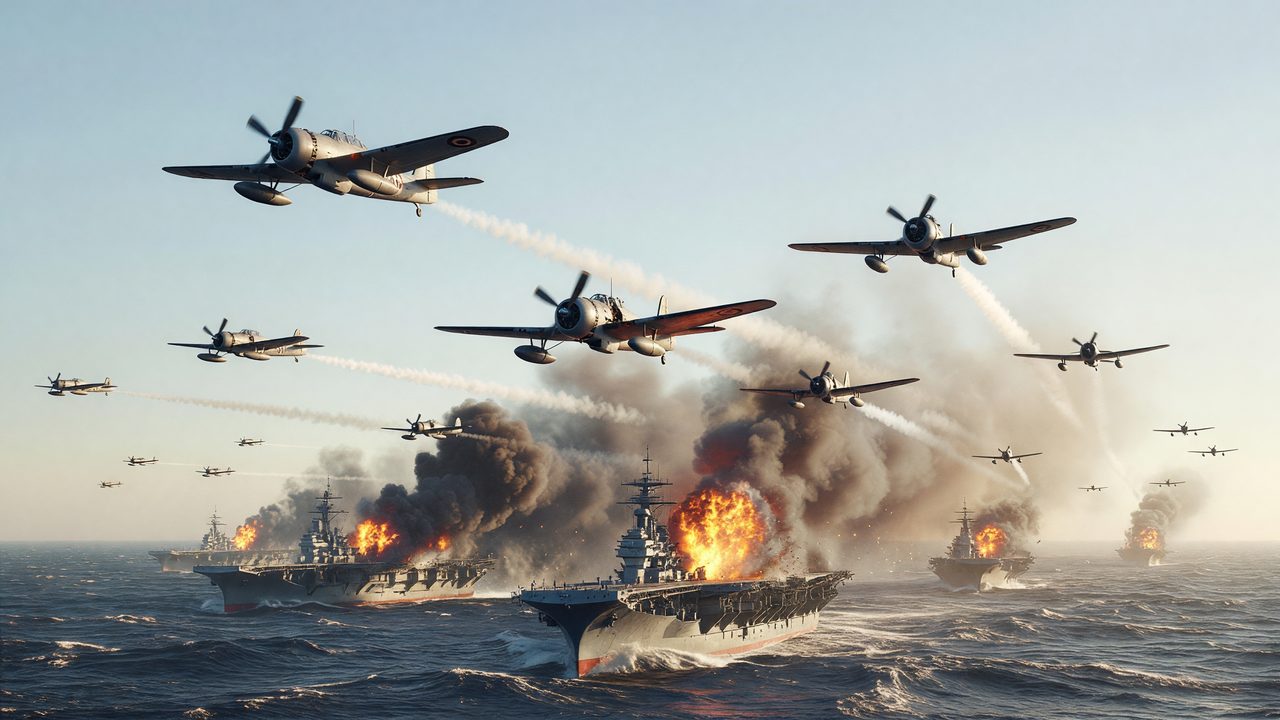
When the Sky Went Empty
On the morning of 4 June 1942, American torpedo crews flew into certain death—and in doing so, handed dive bomber pilots the one thing Japan could not afford to lose: altitude.
Outnumbered, Not Outmatched
The Battle of Midway was never supposed to be winnable on paper. Admiral Chester Nimitz’s CinCPac action report of 28 June 1942 records a Japanese striking force built around four fleet carriers, supported by battleships, cruisers, and a screen of destroyers. The Americans had three carriers—Yorktown patched together in seventy-two hours at Pearl Harbor—and air groups still absorbing replacements after the Coral Sea. Nimitz wrote bluntly that “perhaps only two” carriers would be fit to fight. Events, he added, “proved that every air unit which was employed could have ill been spared.” The victory would not come from numbers. It would come from sequence, exposure, and a price paid in blood.
The Morning Assault
Before the carrier groups arrived, Midway itself had already thrown everything it had at the enemy. Army B-26s, Navy TBF Avengers, and Marine dive bombers attacked the Japanese carrier force in the first hours of 4 June. CinCPac’s report describes “most gallant” attacks against “overwhelming” fighter concentrations. Two of four B-26s did not return. Only one shattered TBF came back. Marine Major Lofton Henderson and seven of his sixteen bombers were shot down. The island’s striking power was largely spent—and four Japanese carriers still operated freely after the island-based attacks.
Then the fleet carriers struck. Task Force 16 launched from Enterprise and Hornet beginning about 0700, completing by roughly 0755; Yorktown’s air group followed later (~0906). The plan called for dive bombers high, torpedo planes low. But coordination broke down. CinCPac noted that fighters “failed to accompany the torpedo planes,” while Hornet’s fighters stayed with her bombers. The lumbering TBD Devastators of Torpedo Squadrons Six, Eight, and Three went in alone.
Gallantry at Sea Level
What followed was slaughter. Enterprise’s captain, George Murray, reported that Torpedo Six faced “enemy Zero fighters in large numbers” and “heavy anti-aircraft fire”—ten of fourteen aircraft failed to return. Torpedo Eight from Hornet was annihilated; a single pilot survived. Yorktown’s Torpedo Three pressed the attack with similar losses. Navy, Marine, and Army torpedo crews had attacked without fighter cover and paid for it at wave-top height.
Yet their sacrifice reshaped the battle. In his action report of 16 June, Task Force 16 commander Raymond Spruance wrote that the torpedo attack, “while not in itself very effective,” had forced radical Japanese maneuvering and prevented a second strike launch against the American carriers. Critically, he observed that Japanese fighters “pulled down” to destroy the torpedo planes, leaving the sky clear above. The Japanese combat air patrol was dragged to sea level just as American SBD Dauntless dive bombers, delayed by search problems and a northward turn by the enemy fleet, finally found their targets.
Five Minutes That Broke the Fleet
Between roughly 1020 and 1025 Midway time, the altitude separation Spruance described turned catastrophic for Japan. Dive bombers from Enterprise and Yorktown arrived over Akagi, Kaga, and Soryu with the enemy’s fighters committed low and many Japanese aircraft still on deck, refueling and rearming from the morning’s Midway strikes. Spruance noted that Akagi was caught with “most, if not all, of his planes on deck.” Within minutes, three carriers were burning. A fourth, Hiryu, would be crippled later that afternoon. Nimitz’s report tallied four Japanese carriers sunk, roughly 275 aircraft and 2,400 men lost. Japan would never again hold the strategic initiative in the Pacific.
Spruance closed his assessment with words that still carry weight: the torpedo squadron attacks “was of an especially gallant nature.” Gallantry, not torpedo hits, had been decisive.
Why it matters to you
Modern strike planning teaches you to coordinate timing, altitude, and escort so every element survives to deliver ordnance. Midway inverts the lesson in the most painful way imaginable: the torpedo squadrons failed precisely because they lacked fighter cover, flew slow at low altitude, and arrived out of sync with the dive bombers. Yet that very vulnerability fixed Japanese fighters at the wrong altitude and the wrong moment. As a pilot, the takeaway is not to fly unescorted into enemy fighters—it is to understand how threat presentation drives adversary behavior. Elevation, timing, and fuel state determine who sees whom first. The torpedo crews did not intend to serve as bait; doctrine and circumstance placed them there. Still, their sacrifice emptied the sky above three Japanese carriers long enough for dive bombers to decide the Pacific War in five minutes. Coordination matters. Altitude matters. And sometimes the course of history turns on who holds the high ground when the clock runs out.