When the Sky Turned Red Over Dresden
"Firestorm in the Elbe valley"
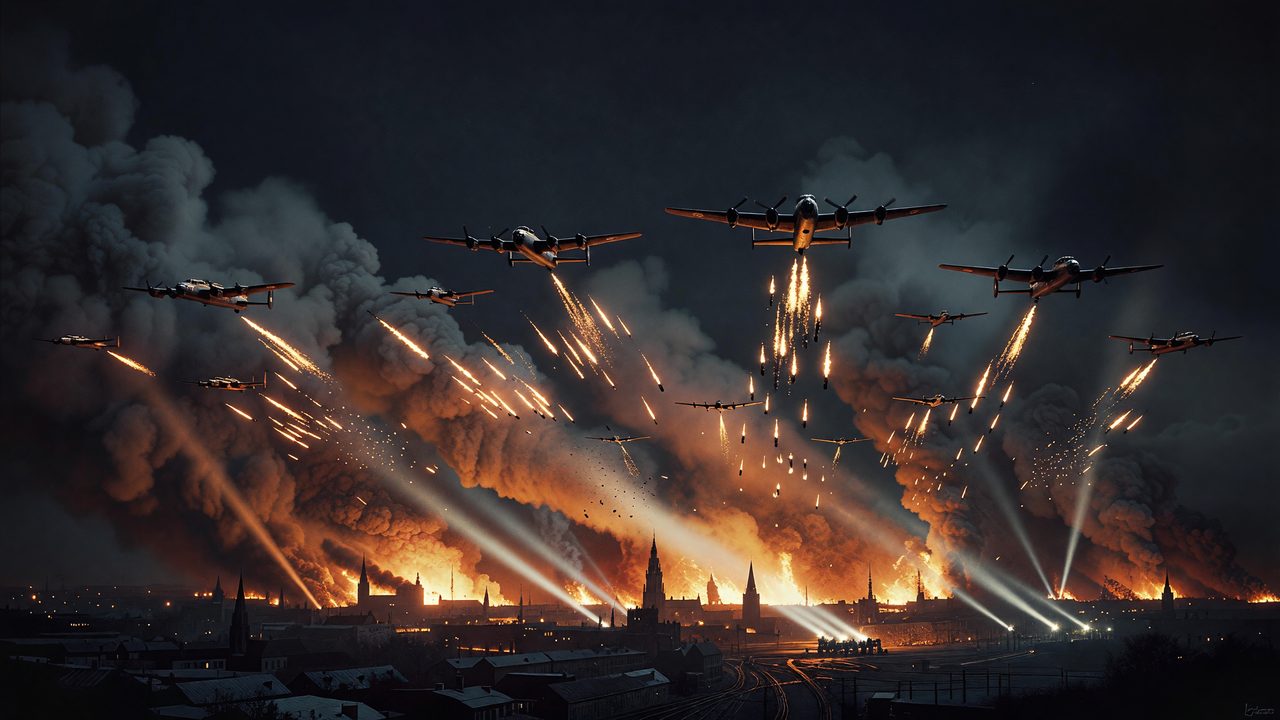
When the Sky Turned Red Over Dresden
In the final winter of the Second World War, Allied bombers turned a Saxon rail hub into a firestorm — and a briefing sheet into one of aviation history's most enduring ethical debates.
The Target on the Map
By February 1945, the war in Europe had entered its closing act. Soviet armies were driving west across Silesia, and German commanders needed every rail line, marshalling yard, and road junction still functioning. Dresden sat at the intersection of those needs: a communications center and industrial city on the Elbe, roughly seventy miles from the advancing Red Army. For Royal Air Force Bomber Command, that geography made it a military problem dressed in baroque architecture.
Air Chief Marshal Arthur Harris received orders to strike Dresden in late January. Contemporary accounts note that Dresden had not ranked among his highest-priority industrial targets, which only sharpened the postwar argument over why the city was chosen when the Reich was already collapsing. Crews who flew the mission were told a plainer story at briefing: disrupt German troop movements and deny the Wehrmacht a staging area as the Eastern Front contracted. A Lancaster pilot with No. 619 Squadron, John Whiteley, recalled being instructed that the raid would impede the German army's effort to slow the Russian advance — a rationale he considered sound, given Dresden's documented wartime industry.
Briefing for Burn
The paperwork survives in the International Bomber Command Centre Digital Archive, and it reads with the clipped precision of a complex instrument approach. A bomb-aimer's briefing from No. 44 (Rhodesia) Squadron, dated 13 February 1945, sets H-Hour at 2215 and spells out loads, heights, wind settings, and camera instructions across two filled forms. On the reverse, the objective appears in capital letters: "TO BURN AN ENEMY INDUSTRIAL AREA." That single line has echoed through military ethics classrooms ever since.
The tactics sheet describes a carefully sequenced attack. Pathfinder Mosquitoes would mark a sports ground near the aiming point with target indicators; flares and colored markers would guide the main force through cloud if necessary. Minimum bombing height stood at 10,000 feet, with timed runs and sector limits that resemble nothing so much as a choreographed arrival procedure — except the "runway" was a city, and the "approach plates" were drawn in incendiary red and green.
Eight Hundred Heavies
Shortly after nightfall on 13 February, the first wave took shape. Contemporary newspaper accounts preserved in aircrew logbooks describe 796 Lancasters dispatched in two RAF waves that night, plus nine Mosquitoes, crossing Germany in a bomber stream that stretched for hundreds of miles — while Halifaxes struck the simultaneous Böhlen diversion. They carried a mixed load of high explosives and incendiaries designed to break roofs and ignite what lay beneath. A second RAF force followed roughly four hours later, striking a city already burning.
Whiteley, approaching from the northwest at 17,000 feet, identified the Elbe threading through Dresden below ten-tenths medium cloud. He listened to the Master Bomber on VHF as Pathfinders marked the target, then received the order to bomb. His crew's debriefing report, filed after a nine-hour-twenty-minute sortie, recorded that marking was very good and that results were considered effective despite the cloud — adding a detail that would define the raid in public memory: the glow from the fires remained visible when the Lancaster was still 150 miles from the target. Other crews reported seeing gun flashes along the Eastern Front as they departed, the war's two great land offensives unfolding beneath the same winter sky.
The concentrated incendiary attack produced a firestorm — a self-sustaining conflagration driven by intense heat and inrushing winds — that consumed the medieval heart of the city. The following day, United States Army Air Forces heavy bombers returned in daylight to strike what remained, completing the two-phase assault that contemporary press accounts called a "2,000-ton double blow."
The Argument That Outlived the Flames
Dresden's destruction became controversial almost as soon as the fires cooled. Winston Churchill, who had championed the strategic bombing campaign, reportedly began questioning the bombing of German cities when the scale of Dresden's devastation became clear — a shift that veterans like Whiteley found bitter, having flown under orders they believed legitimate. Historians and ethicists have debated the raid ever since: Was Dresden still a proportionate military target in February 1945? Did area bombing of a city center qualify as necessary force, or as something darker? Casualty estimates vary widely, which has only widened the dispute.
What is not in dispute is the professional skill demanded of the crews. They navigated to a distant target at night, coordinated on master-bomber radio calls, delivered ordnance on marked aim points through cloud, and returned across a hostile continent — all while the strategic purpose of their work was being reconsidered by the statesmen who had ordered it.
Why it matters to you
Every rated pilot inherits a question Dresden crystallized: who decides what constitutes a legitimate target, and how do you execute that decision with precision while the political ground shifts beneath you? The No. 44 Squadron briefing did not say "destroy a cultural landmark"; it said burn an industrial area and disrupt enemy movement — language that forced crews to trust the intelligence and law-of-war judgments made far above their altitude. Modern rules of engagement, collateral-damage estimation, and mission-planning doctrine grew partly from the reckoning that followed raids like this one. When you brief a flight today — whether a training sortie or an operational mission — you are practicing the same discipline those Lancaster crews embodied: understand the stated objective, verify it against your own judgment, execute with technical excellence, and accept that history, not the cockpit, will ultimately judge whether the objective was right. Dresden does not teach you how to drop bombs. It teaches you to read a target package critically, and to know that the most precise strike in the world cannot outrun the ethics of why you were sent.