When the Sky Stopped Listening to Propellers
"Test running log for Whittle W.1 engine"
When the Sky Stopped Listening to Propellers
On a spring evening in Lincolnshire, a young RAF officer proved that thrust could come from fire and spinning steel alone—and nothing in aviation would ever sound the same.
An Idea Born in the Cadet Mess
The jet age did not begin on a runway. It began in the mind of a Royal Air Force cadet who, in 1928, saw a way past the hard ceiling that piston engines were already brushing. Frank Whittle later recalled that conception in his First James Clayton Lecture, delivered in June 1945 to the Institution of Mechanical Engineers and published in its Proceedings. He was not yet an established engineer; he was a serving officer wrestling with a problem that would define the next century of flight.
Whittle filed his patent in January 1930, years before any government contract, industrial partner, or test cell existed to receive it. The paperwork described a gas turbine driving a compressor, expelling a jet of high-velocity gas—the thermodynamic outline of every jet engine that would follow. In March 1936, Power Jets Ltd. was formed to turn theory into hardware. The GEC/Whittle historical records preserved in British Thomson-Houston files document both milestones: the patent filing and the company that would carry Britain’s jet program through the war.
From Blueprint to Bench
Building a jet engine in the late 1930s meant inventing the tools to build it. Materials that could survive combustion-chamber temperatures, bearings that could endure rotational speeds no propeller hub had ever seen, fuel systems that could meter flow across a power curve nobody had measured—the problems arrived faster than solutions. Whittle’s team worked through failures that would have ended a less stubborn program.
The Science Museum Group Collection holds the test-running log for the Whittle W.1 engine, a document as unglamorous as it is decisive. Entries span 12 April to 30 May 1941, recording hours on the test stand, adjustments, setbacks, and incremental gains. Laboratory notebooks rarely make history books, but this one does: it is the paper trail between a patent filed in a Depression winter and an aircraft about to leave the ground under jet thrust alone.
Fourteen May 1941
British Thomson-Houston archival reports, preserved through the GEC-Whittle paper collection, record W.1 flight-engine clearance and the first flight of the Gloster E.28/39 at RAF Cranwell. Some BTH logs note 15 May 1941; Whittle’s contemporary account in his 1945 lecture—and the W.1 test log’s flight entry—place the event on 14 May. Historians generally accept Whittle’s date, and it is the one that belongs in the pilot’s timeline.
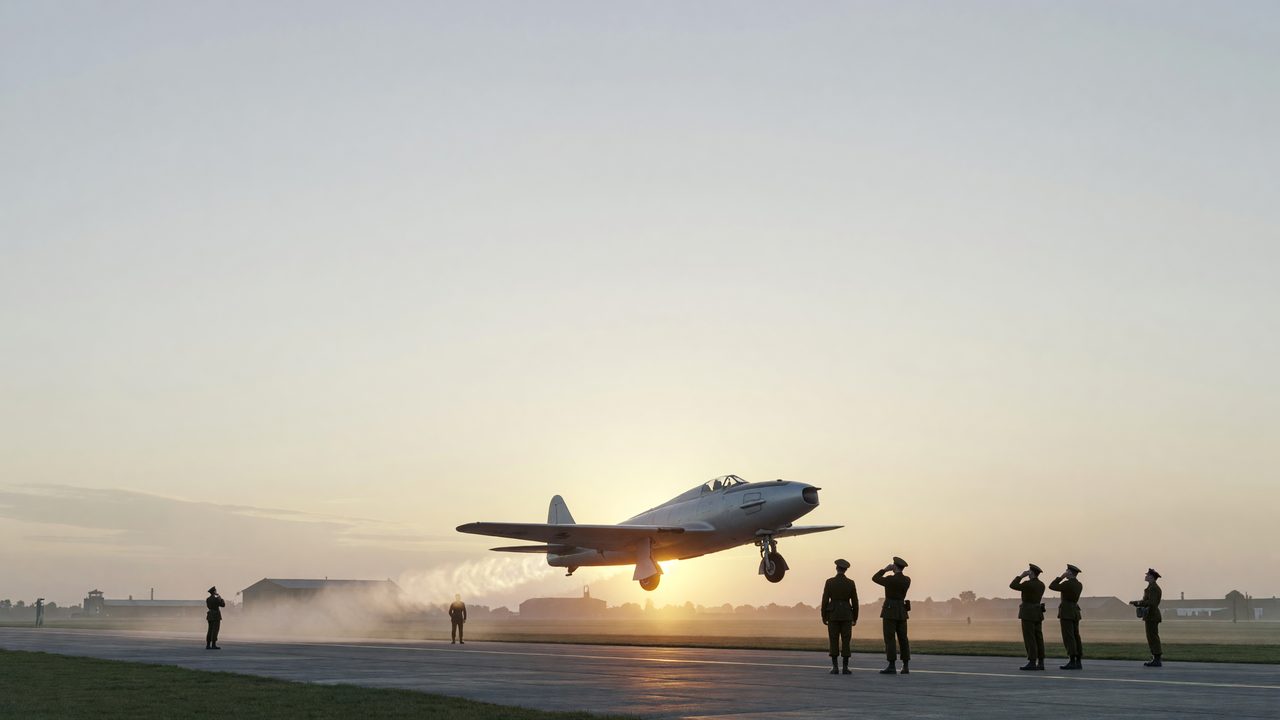
The E.28/39 was not a fighter. It was an experiment wearing wings—compact, cautious, designed to answer one question: can this engine fly an airplane? The answer came on an English spring evening when Gloster chief test pilot Gerry Sayer lifted off under roughly 850 pounds of jet thrust. The duration was short. The altitude was modest. The sound was new—a low, urgent roar unlike any Wright Cyclone or Rolls-Royce Merlin. Observers on the ground heard the future.
A War Already Underway
When Whittle’s jet climbed above Lincolnshire, the Battle of Britain was less than a year in the past and the strategic bombing campaigns were grinding across Europe. Piston-engine aircraft—Spitfires, Lancasters, Mustangs—still owned the sky. Yet the first flight mattered precisely because the war was not waiting.
Germany’s own jet program, centered on Hans von Ohain’s engine and the Me 262, would reach combat in 1944. Britain’s Gloster Meteor entered squadron service before the European war ended. The jet did not decide World War II; propellers and radials did the bulk of that work. But the E.28/39 flight proved that the transition had started—that within a decade, the sound of a flight deck would change forever.
Whittle’s 1945 lecture, delivered as victory was still fresh, reads as both memoir and engineering testimony. He had watched an idea move from cadet-thesis speculation to patent to company to test cell to first flight in thirteen years—a pace that feels glacial until you remember that every step required inventing the step after it.
Why it matters to you
The legacy of that May evening continues in every turbine cockpit you will ever sit in. Modern jet pilots train to manage thrust that arrives without the inertia of a propeller disc—spool times, EPR or N1 targets, stabilized approach thrust settings, and engine-out profiles all descend from the fundamental shift Whittle demonstrated at Cranwell: power is no longer a mechanical handshake between cylinders and air, but a continuous thermodynamic process you command through instruments and procedure. When you brief a rejected takeoff or practice a single-engine go-around, you are applying disciplines born in an era when no manual existed. The E.28/39 flew for minutes; your training inherits decades of lessons learned since—but the first lesson was that the engine and the airplane had become a single, unforgiving system. Whittle’s 1945 account of that journey is not ancient history. It is the origin story of the powerplant you trust at rotation.