When the Sky Grew Wide: Boeing’s 747 and the Birth of Mass Air Travel
"If you build it, I'll buy it."
When the Sky Grew Wide: Boeing’s 747 and the Birth of Mass Air Travel
On a grey February morning in 1969, a prototype wider than imagination itself left the ground—and rewrote what “flying” could mean for the world.
The Boeing 747 did not begin on a drawing board. According to aviation historians and industry accounts preserved in public records, it began with a wager. Juan Trippe, the visionary founder of Pan American World Airways, had spent decades pushing air travel toward larger aircraft and lower fares. On a fishing trip, the story goes, he turned to Boeing president William Allen and said, “If you build it, I’ll buy it.” Allen answered, “If you buy it, I’ll build it.” That handshake—more promise than contract—committed two titans of aviation to a machine larger than anything the commercial world had ever attempted.
What followed was one of the great industrial gambles of the twentieth century. Boeing assembled a workforce of roughly 50,000 people—dubbed “the Incredibles”—and erected a new factory at Everett, Washington, sized for an airplane whose fuselage stretched half a football field and whose tail rose as high as a six-story building. Lead engineer Joe Sutter and his team wrestled with millions of parts, miles of wiring, and schedules that slipped as the global economy faltered. The company’s finances grew so strained that Sutter once expected to be fired for refusing to cut his engineering staff. Boeing stayed the course.
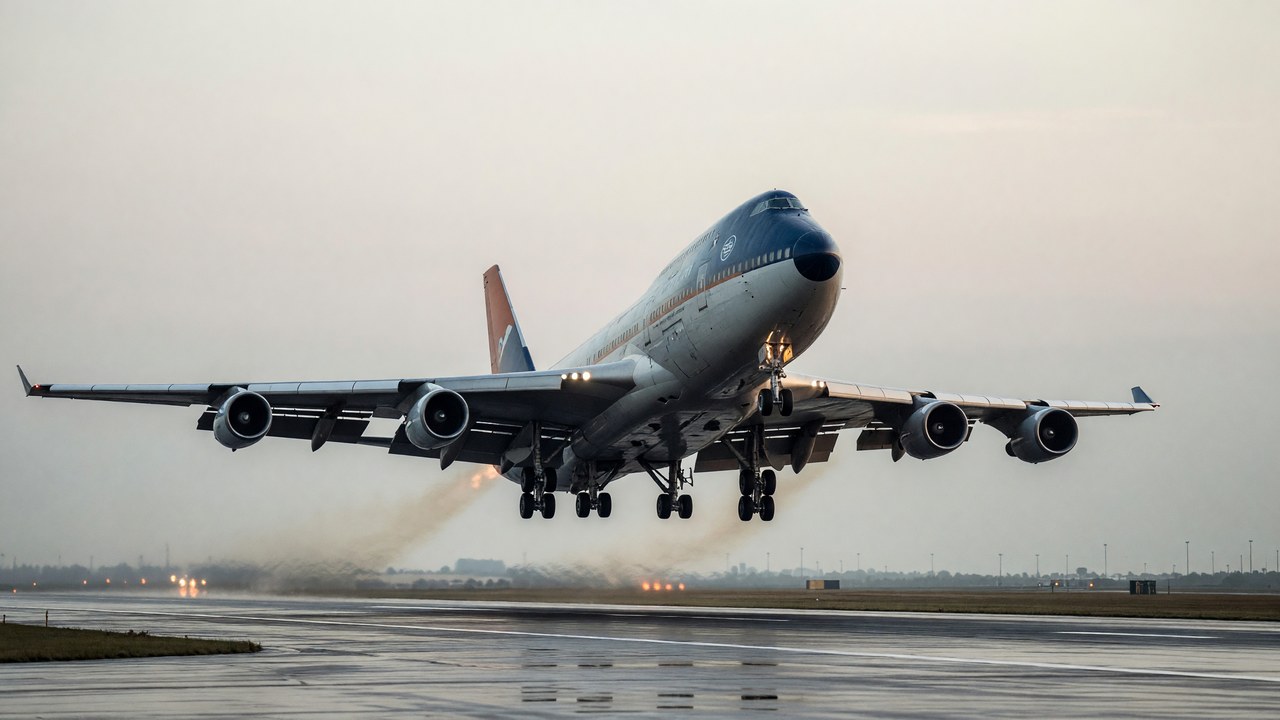
On February 9, 1969, beneath a grey Everett sky, chief test pilot Jack Waddell released the brakes of RA001—the prototype 747-121 registered N7470 and christened City of Everett. Four Pratt & Whitney JT9D turbofans spooled to power. After only 4,500 feet of runway, the nose wheel lifted; a heartbeat later, the first wide-body airliner was climbing away from Paine Field. Brien Wygle occupied the right seat, Jesse Wallick monitored systems from the flight engineer’s station, and a few hundred Boeing employees watched from the ramp. Contemporary accounts in The Seattle Times and retrospective coverage in FlightGlobal describe a deliberate, unhurried flight—capped well below the jet’s eventual cruise speed and altitude—meant to prove that the enormous machine could be flown with grace rather than drama. Waddell’s assessment after touchdown, quoted in the press the next morning, was simply that the airplane was “beautiful.”
The 747’s silhouette made the engineering legible. The fuselage told a story of two levels: a main deck wide enough for twin aisles and hundreds of seats, and a forward “hump” that housed a upper-deck lounge in early passenger configurations. That crown would become the most recognizable profile in aviation—a swan-like head atop a vast body and sweeping wings. Pan American Airways accepted the first delivery and inaugurated scheduled 747 service on January 22, 1970, advertising an aircraft that was part ship, part plane, with economy cabins the size of living rooms and an upstairs lounge for those who climbed the spiral staircase into the hump.
Over more than five decades of production, Boeing would build 1,574 747s. They served as passenger queens on the world’s longest routes, as tireless cargo workhorses lifting outsized freight through hinged noses and vast bellies, and as flying command posts for heads of state. The type carried billions of travelers—by Boeing’s own accounting, a figure approaching the majority of humanity—shrinking oceans into overnight crossings and, through Trippe’s logic of scale, helping make intercontinental flight something ordinary families could contemplate.
The jumbo jet did not merely carry more people. It carried a conviction that the whole world could afford to fly.
Why it matters to you
The 747’s legacy lives in the cockpit skills you train today, even if you will never hand-fly a three-story-high approach in a -400. The program pioneered the integrated systems thinking behind modern transport-category aircraft: multiple hydraulic channels, complex electrical architectures, and flight decks where a captain, first officer, and systems expert must share workload deliberately—the same crew coordination principles now drilled in CRM. Its wide-body aerodynamics demanded refined energy management, stabilized approach discipline, and respect for inertia that every heavy-jet syllabus still teaches. When you brief a long final, monitor automation, and call airspeed trends on a swept-wing airplane, you are practicing refinements born in the gamble Allen and Trippe made on the water. Mass transit took wing that February morning; the habits that keep it safe followed it into every flight deck you will ever occupy.