When the Sky Brought War Home
"When the war came home at eighty-five miles per hour, filled with hydrogen"
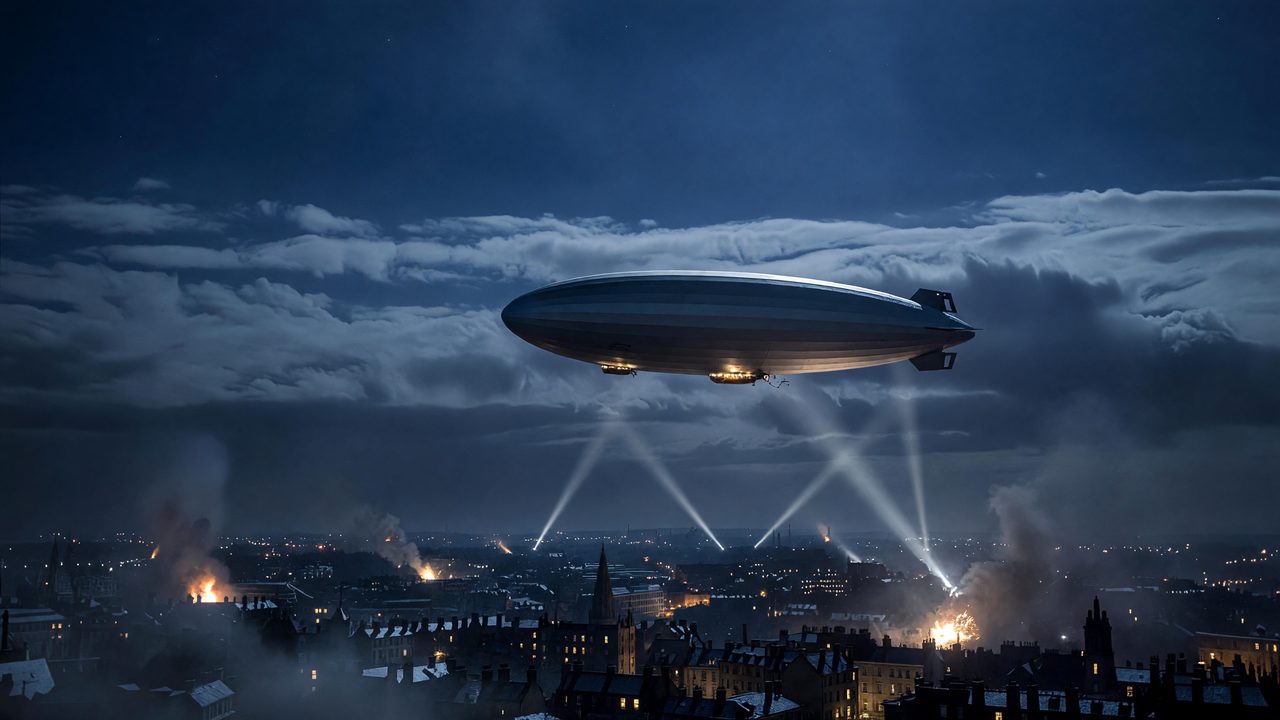
When the Sky Brought War Home
Before 1915, no British civilian had ever been killed by an aircraft. German Zeppelins changed that in a single winter night—and in doing so, invented a form of warfare that would reshape aviation for a century.
The First Fatal Hours
On the night of 19 January 1915, residents of Great Yarmouth and King’s Lynn on England’s east coast heard an unfamiliar sound overhead: the low, rhythmic thrum of propellers driving enormous rigid airships through the dark. German Navy Zeppelins had crossed the North Sea not to scout troop movements or strike military targets, but to drop bombs on sleeping towns.
The results were modest by later standards—roughly two dozen bombs fell across Norfolk—but the human cost was historic. Seventy-two-year-old Martha Taylor and shoemaker Samuel Smith became the first British civilians to die in an aerial attack. Until that January night, the war in the air had remained a distant abstraction for most Britons. After it, the home front was no longer safe.
Imperial German planners had wagered that Count Ferdinand von Zeppelin’s rigid airships could shatter civilian morale and compel the government to divert men, guns, and attention from the trenches of France and Belgium. Each vessel could cruise at roughly 55–60 mph and deliver about two tons of bombs. They were slow, vulnerable, and imprecise—but they could reach places no artillery could touch.
London Under the Searchlights
The campaign’s psychological target was unmistakable. The first raid on London came on 31 May 1915, when Kapitänleutnant Erich Linnarz led LZ 38 across the capital. Linnarz later recalled the experience in a memoir published in the 1930s, describing how his crew navigated by landmarks glimpsed through breaks in the cloud, then released their payload into streets that had never before heard the whistle of falling bombs.
Over the next three years, Zeppelins returned again and again—to Hull, Southend, Liverpool, Edinburgh, and London itself. British official records preserved at The National Archives document the chaos on the ground. Major General Ferrier’s 1915 report on the Humber defences tallies bomb drops and casualties with bureaucratic precision; Major Robert Hall’s 1916 operational diary records the frantic scramble of fire crews, searchlight crews, and anti-aircraft batteries trying to answer an enemy they could see but rarely reach.
The single most destructive raid struck London on 8 September 1916, when Kapitänleutnant Heinrich Mathy’s Zeppelin set fires across the city. Twenty-two people were killed and eighty-seven wounded. Contemporary accounts describe entire blocks glowing orange against the night sky—a spectacle of terror that German commanders hoped would force surrender.
The Bullet That Changed Everything
The raids did not break British resolve. They did, however, force a reckoning with the limits of existing defences. Anti-aircraft guns fired blindly into the dark. Fighter pilots climbed through cloud without knowing whether they pursued friend or foe. The system was fragmented and improvised.
The turning point arrived on the night of 2–3 September 1916, when Second Lieutenant William Leefe Robinson of the Royal Flying Corps intercepted a Zeppelin over Cuffley, Hertfordshire. Flying a BE2c, Robinson closed to point-blank range and fired a new mixture of explosive and incendiary ammunition into the airship’s gas cells. The hydrogen-filled hull ignited and fell in a spectacular fireball. Robinson received the Victoria Cross—the first awarded for air-to-air combat over Britain.
German designers responded with “Super Zeppelins,” larger and tougher machines built to fly higher and carry more bombs. It was too late. The new bullets had exposed the rigid airship’s fatal weakness: a single lucky burst could turn roughly 1.1 million cubic feet of hydrogen into an inferno. By August 1918, when the last raid was attempted along the Norfolk coast, the Zeppelin as a strategic weapon was effectively obsolete.
The Toll and the Legacy
When the campaign ended, the arithmetic was grim. More than five hundred British civilians had been killed and over a thousand injured—figures corroborated by official casualty records cited in subsequent historical analysis, including BBC reporting that drew on the work of aviation historian Ian Castle. Property damage ran into millions of pounds. Yet morale held. Factory shifts continued. Recruitment lines did not vanish.
What the Zeppelins did achieve was institutional. The raids convinced British leaders that defending the homeland required a unified aerial command—not separate army and navy air arms answering to different masters with incompatible procedures. That conviction culminated in the formation of the Royal Air Force on 1 April 1918: the world’s first independent air force, created in direct response to the threat that had arrived, silently, from above.
Why it matters to you
Every time you study airspace structure, NOTAMs, or the layered responsibilities of modern air traffic control, you are touching a legacy that began with Martha Taylor and Samuel Smith. The Zeppelin raids killed more than five hundred British civilians and led directly to the creation of the Royal Air Force in 1918. Historians still debate whether this was the first true strategic bombing campaign or merely a failed experiment in terror—but for pilots, the lesson is practical either way. Warfare from the air does not require precision navigation or fighter escort to alter national policy; it requires only the ability to reach the civilian population and the political will to accept the consequences. Understanding that history sharpens your judgment about why nations invest so heavily in integrated air defence, why rules of engagement distinguish military from civilian targets, and why the question of what constitutes legitimate aerial warfare remains as urgent now as it was on that January night over Norfolk.