When the Scout Grew Teeth: The MQ-9 Reaper
"If the Predator was the scout, the MQ-9 Reaper was the ex..."
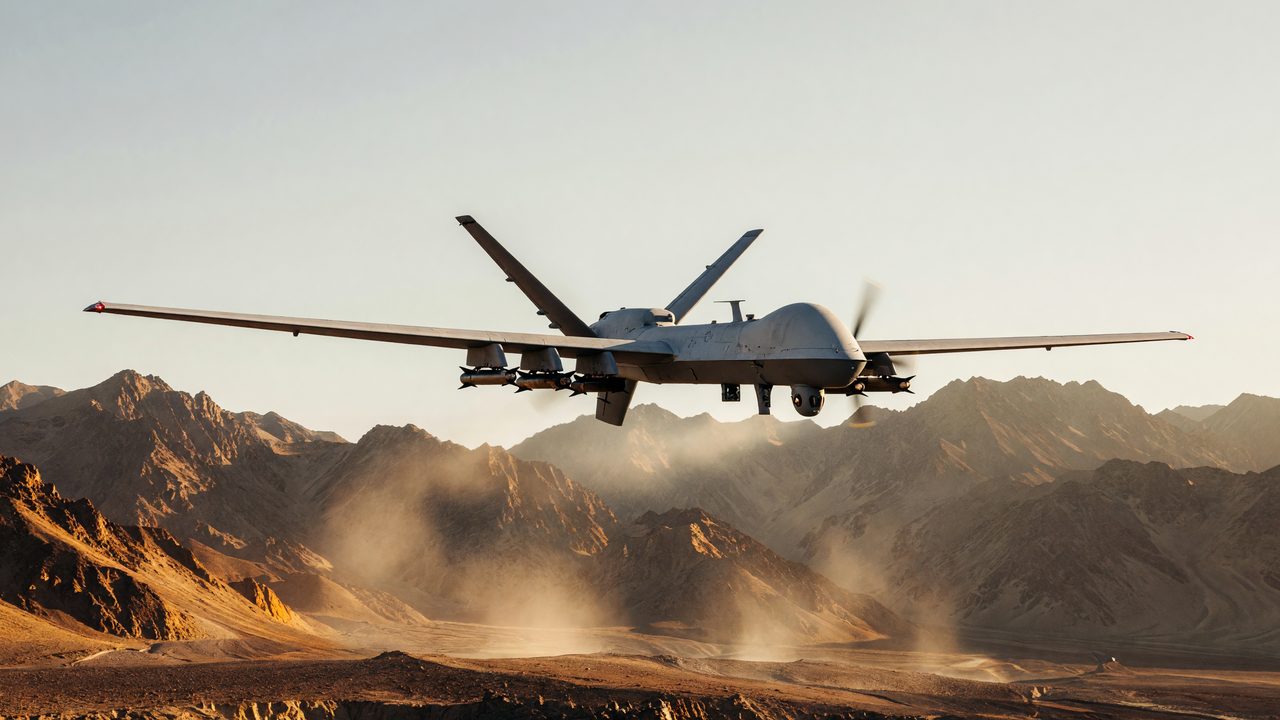
When the Scout Grew Teeth: The MQ-9 Reaper
If the Predator proved that an unmanned aircraft could watch a battlefield from above, the MQ-9 Reaper proved it could hunt—and kill—with the authority of a manned strike platform.
From Predator B to Hunter-Killer
In the late 1990s, General Atomics Aeronautical Systems began work on what it called Predator B—a privately funded venture launched in 1998, without waiting for a government contract to justify the engineering. The prototype climbed away from the runway for the first time in February 2001, a turboprop airframe that looked like a scaled-up cousin of the MQ-1 Predator already earning its keep over the Balkans and the Middle East.
The timing could hardly have been more consequential. When hijacked airliners struck the Pentagon and the World Trade Center on 11 September 2001, the Air Force had already seen enough of the Predator’s reconnaissance value to want something larger, faster, and far more lethal. Service leaders directed Congress to fund two pre-production YMQ-9 aircraft, accelerating a program that had been moving on private capital and engineering conviction. What emerged was not an incremental upgrade. It was a different category of machine.
Power, Span, and Payload
The numbers tell the story in the language pilots understand. The Reaper stretches 66 feet from wingtip to wingtip—roughly the span of a light twin—and draws its thrust from a 900-horsepower Honeywell TPE331-10GD turboprop, a engine class more at home on a commuter airliner than on a reconnaissance drone. The Air Force fact sheet credits the aircraft with a payload capacity of 3,750 pounds distributed across seven hardpoints. On those stations, crews have hung AGM-114 Hellfire missiles, GBU-12 Paveway II laser-guided bombs, and Joint Direct Attack Munitions.
General Atomics advertises endurance beyond 27 hours at altitude—a figure that redefines what “loiter” means in operational planning. Where the Predator had been a sensor platform that could sting if pressed, the Reaper was purpose-built as a hunter-killer: roughly three times faster and nine times more powerful than its predecessor, designed to find time-sensitive targets and destroy them with precision across continents, not merely report their coordinates to someone else.
The lineage also reaches back to earlier unmanned combat experimentation. Designation records tie the Predator B program to engineering heritage flowing from the MQ-1 Predator and General Atomics’ privately funded Predator B work, part of the broader push toward unmanned strike that the Air Force had been exploring long before the Reaper entered squadron service.
Naming the Weapon
Until 2006, the aircraft was known in development circles as Predator B—a designation that described genealogy more than mission. That year the Air Force chose a name with sharper intent: Reaper. The word fit. This was not a platform built to loiter politely above the weather and feed video to a ground station. It was built to close kill chains.
Initial operational capability followed in 2007. On 25 September of that year, a production-model Reaper flew its first combat sortie in support of Operation Enduring Freedom, the campaign that had already reshaped American air power after 9/11. The National Museum of the U.S. Air Force preserves the story of that flight as a milestone: the moment a remotely piloted aircraft moved from proving it could serve in theater to proving it could carry the fight as a primary strike asset.
Two Million Hours and Counting
The enterprise grew fast. By 2014, the combined MQ-1 Predator and MQ-9 Reaper fleet had logged more than two million flight hours—a statistic that captures both the scale of America’s remotely piloted air force and the operational appetite that drove it. Crews in ground control stations, linked to aircraft halfway around the world by satellite, were no longer experimenting with a novelty. They were running a permanent, distributed combat air patrol.
The Reaper remains the backbone of the U.S. Air Force’s remotely piloted aircraft fleet. Museum curators at Wright-Patterson display a YMQ-9 as a representative airframe, a physical reminder that the aircraft now woven into daily operations began as a prototype that first flew in the winter of 2001. The scout had grown into the executioner.
Why it matters to you
The engineering principles pioneered in the Reaper’s design—high-aspect-ratio wings for endurance, turboprop efficiency at medium altitude, redundant systems managed across datalink latency, and payload flexibility across multiple stores stations—echo in the manned aircraft you train in today. Every hour you spend managing power, weight, and fuel is the same arithmetic that let a 66-foot unmanned airframe stay aloft for more than a day while carrying precision weapons. The Reaper demonstrated that the decisive variable in modern air power is not always who sits in the cockpit, but how well the platform balances endurance, sensor reach, and strike capacity. Whether you fly a Cessna or a King Air, you are practicing the same foundational discipline: matching aircraft capability to mission demand, one careful decision at a time.