When the Ramp Drops, the World Moves
"A Cold War giant that learned to kneel."
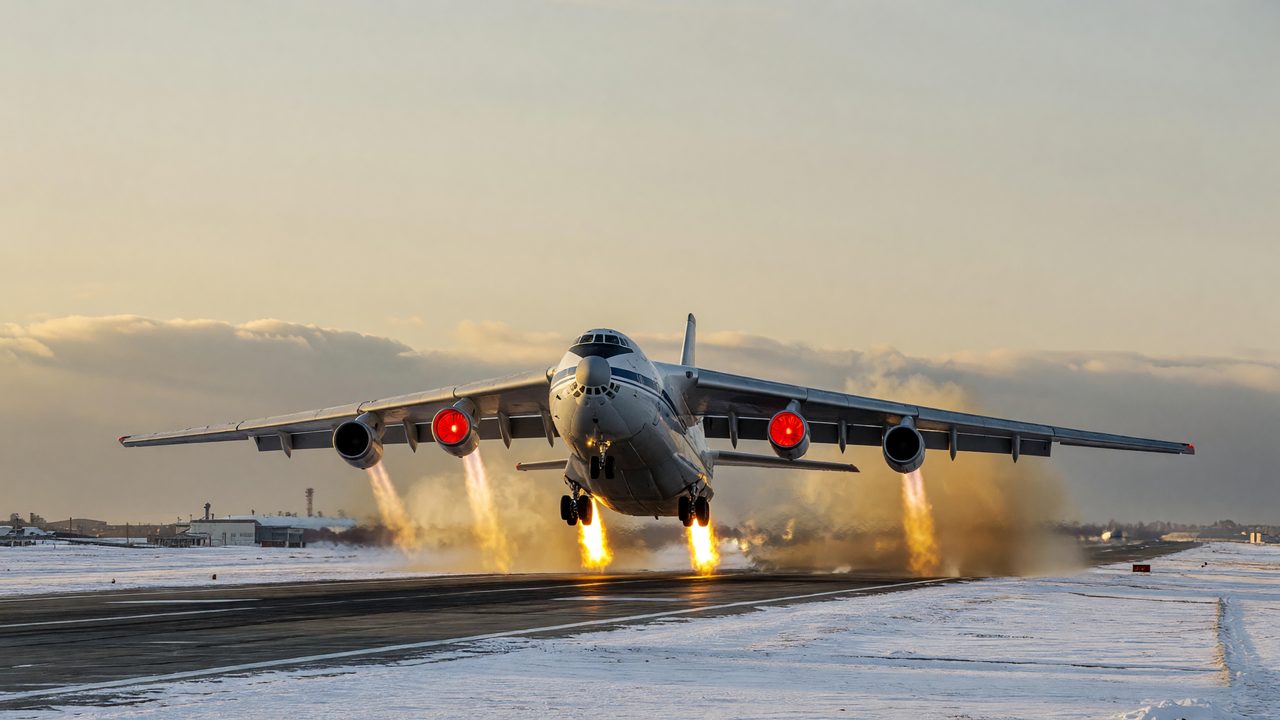
When the Ramp Drops, the World Moves
On a December morning in Kyiv, a four-engine giant proved that brute tonnage and refined aerodynamics could share the same airframe—and changed what “possible” meant for outsized cargo.
Birth of a Production Colossus
When the An-124 Ruslan lifted from the factory aerodrome in Kyiv’s Sviatoshyn district on 24 December 1982, it entered history as the heaviest production transport ever to fly. The airplane was the final major design guided by General Designer Oleg K. Antonov, and it answered a Soviet military requirement to push airlift capacity well beyond the 100-ton class. What emerged was not merely a bigger freighter, but a deliberately engineered system for moving objects that had no other path through the sky.
Antonov Company documents describe a development program that examined 540 configuration variants and tested 185 wind-tunnel models before settling on a thick, supercritical wing—structurally deep yet aerodynamically efficient. Extruded panels up to 28 meters long, polymer composites, and a double-deck fuselage with separate pressurization reduced weight while protecting crew and cargo attendants. Four Lotarev D-18T turbofans, each rated at 24 tonnes of thrust, gave the Ruslan the power to haul strategic loads across continents.
The Kneeling Door That Swallowed Cities
The An-124’s signature is its nose. A massive upward-hinged ramp and aft cargo door create a through-loading tunnel: vehicles can drive in one end and out the other, slashing turnaround time on remote strips. Beneath that opening sits the airplane’s other revolution—multi-strut landing gear with a kneeling function. Hydraulically, the fuselage lowers toward the ramp, shrinking the step height between ground and cargo floor. Forklifts roll aboard. Winches track in generators. Internal cranes lift single pieces weighing up to 20 tonnes.
Volga-Dnepr’s technical data for the An-124-100 quantify the envelope: maximum payload of 120 tonnes, a cargo hold measuring 6.4 by 4.4 by 36.5 meters, and a maximum takeoff weight of 392 tonnes. Range with full payload reaches 4,500 kilometers at cruise speeds near 750 km/h. Those numbers read like industrial specifications, but in practice they mean power transformers for earthquake recovery, Siemens generators crossing continents, and satellite hardware that cannot be disassembled without destroying its purpose.
Records That Redefined “Heavy”
The Ruslan did not just carry weight—it carried weight high. Antonov Company records thirty world records set on the type. The most striking remains the absolute payload-to-altitude mark: on 26 July 1985, an An-124 lifted 171.219 tonnes to 10,750 meters. That figure sits far above routine operating weights, yet it demonstrates surplus structural and aerodynamic margin built into the airframe. Other flights pushed distance without refueling—more than 20,000 kilometers on a closed circuit in 1987—and commercial sorties moved 129 tonnes of transformers from Spain to New Caledonia, entries that reached the Guinness Book of Records.
Production spanned factories in Kyiv and Ulyanovsk from the mid-1980s into the 2000s, with the civil An-124-100 entering service as the Cold War ended. Military regiments flew round-the-world routes over the poles; Antonov Airlines, established in 1989, turned the type toward charter markets from its Hostomel base. Today, the surviving fleet—operated chiefly by Antonov Airlines and Volga-Dnepr—remains the practical answer when no road, rail link, or smaller aircraft can absorb the cargo. If it must arrive in one piece, the Ruslan is often the only call.
Still Flying the Impossible Job
Decades after its maiden flight, the An-124 remains a niche, not a novelty. Each mission blends aeronautical discipline with logistics choreography: loadmasters calculating centre of gravity along a hold longer than many runways are wide, flight engineers monitoring four engines feeding a mass that dwarfs entire commuter fleets, and crews landing on prepared strips where ground support may be little more than a marshaller and a prayer. The airplane’s size draws crowds at airports from Minneapolis to Auckland, but its economics depend on cargo that cannot be bargained into smaller boxes.
Why it matters to you
The Ruslan’s kneeling gear and nose ramp solve a ground problem—bridging the gap between pavement and payload—but its flight records expose a performance lesson every pilot trains for: weight and altitude are adversaries. Lifting 171 tonnes to 10,750 meters required not raw power alone, but careful management of density altitude, engine limits, and structural margins—the same variables that govern whether your Cessna clears the pine line on a humid summer afternoon or a jet transport meets obstacle clearance at max gross. The kneeling system, meanwhile, is a reminder that landing gear is not passive structure. It is an active interface between aircraft and earth, shaping how safely and quickly cargo transitions from static to airborne. Study the Ruslan and you see weight-and-balance, systems knowledge, and performance planning pushed to their industrial limit—then brought back to the cockpit skills that keep every flight, large or small, inside the envelope.