When the Propeller Outruns the Jet
"Single-engine, 1,200 shp, and a cockpit that belongs in a Gulfstream."
When the Propeller Outruns the Jet
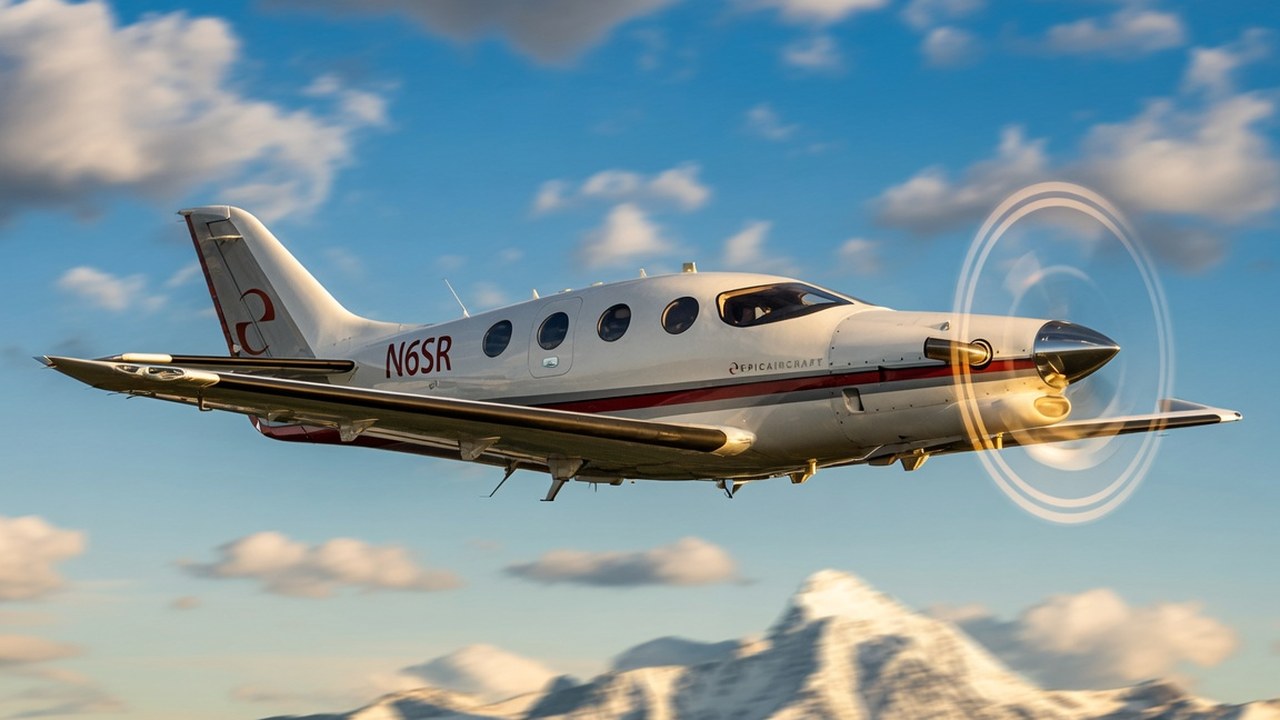
The Epic E1000GX turns a homebuilder’s composite dream into an FAA-certified turbine that cruises at jet speeds on a single pilot’s certificate—and teaches a generation of instrument pilots what modern turboprop engineering really means.
Somewhere above the mid-teens, the cabin settles into a quiet, pressurized calm and the numbers on the Garmin G1000 NXi begin to read like a light jet’s flight plan. That sensation is deliberate. Epic Aircraft set out to build a single-engine turboprop that would not apologize for its propeller, and the E1000GX delivers on the promise with a maximum cruise near 374 mph at 34,000 feet—an altitude and airspeed pairing that leaves many entry-level jets looking at their fuel gauges.
The story begins in Bend, Oregon, where composite speed has long been a local dialect. The E1000’s lineage runs through the kit-built Epic LT, itself rooted in the Lancair Legacy tradition of homebuilt performance. For years, pilots who wanted that kind of speed accepted experimental-category limitations. In November 2019, after more than 1,000 hours of flight testing on two prototypes, the FAA awarded type certificate E00015AT, and the E1000 became a fully factory-built aircraft—no builder’s logbook required. Aviation International News captured the industry’s relief in early 2019 reporting as certification finally crossed the finish line of a seven-year effort. Deliveries followed in 2020, and the GX variant has since added certified flight into known icing and further avionics refinement.
What makes the performance credible is not horsepower alone but what the airframe does with it. The E1000GX is built almost entirely of carbon-fiber composite—epoxy and carbon cloth over a foam core—yielding a strength-to-weight ratio that aluminum construction struggles to match at this scale. A Pratt & Whitney Canada PT6A-67A flat-rated to 1,200 shaft horsepower turns a Hartzell five-blade composite propeller. The wing spans 43 feet with winglets; the cabin holds six seats in a pressurized shell tested well beyond its 6.6-psi differential. Epic Aircraft’s published specifications cite a best rate of climb of 4,000 feet per minute and takeoff distances that belie the aircraft’s capability. Flying magazine’s 2019 flight test treated the E1000 as a genuine paradigm shift: a turbine single that handled with the crispness of a high-performance piston yet carried turbine range and cabin comfort.
The cockpit philosophy borrows from fighters and business jets. The G1000 NXi integrated flight deck—with synthetic vision, FMS-driven navigation, and a Garmin GFC 700 autopilot—consolidates the instrument-rated pilot’s scan. A side-stick controller replaces a traditional yoke, freeing panel space and reinforcing the aircraft’s sportscar ethos. For the pilot stepping up from a Bonanza or Cirrus, the transition is less about learning new avionics than about respecting turbine systems, pressurization schedules, and the discipline of high-altitude flight in a single-pilot environment.
Payload and range complete the case. With 1,100 pounds available at full fuel, the E1000GX can carry four adults and baggage on a 1,900-nautical-mile leg without trading seats for tanks—a combination that redefines what owners expect from a single-engine turboprop. At eco-cruise speeds, range stretches even further; at max cruise, the airplane closes distance at rates that embarrass turbine twins of a prior generation. The FAA type certificate data sheet E00015AT anchors these claims in regulatory fact, not marketing copy.
For the instrument-rated pilot, the E1000GX is a flying classroom in modern general aviation: bleed-air pressurization, turbine power management, RNAV procedures in the flight levels, and the subtle aerodynamics of a clean composite wing near MMO. It is an aircraft that thinks like a jet while billing like a turboprop.
Why it matters to you
The PT6A-67A’s free-turbine architecture is the engine lesson hiding inside every E1000GX checkout. In this design, the gas generator—compressor, combustor, and compressor turbine—spins largely independently of the power turbine that drives the propeller through a reduction gearbox. They are not mechanically locked together. Practically, that means power response is not instantaneous: advance the condition lever and fuel flow must spool the gas generator before the power turbine delivers torque to the prop. In the terminal area, a single pilot who treats the power lever like a throttle on a piston engine will lag behind the airplane. Anticipation becomes a core skill.
Reverse thrust capability flows from the same separation. The propeller can be driven into beta and reverse pitch while the gas generator maintains its operating regime, giving the E1000GX strong ground handling without the complex reverser hardware of a jet. That is a workload gift on short runways—if you understand it. Mismanage the levers and you can idle the prop while the core keeps producing energy, or chase airspeed with power changes that arrive a beat late.
For your training, the takeaway is workload management: plan power changes early on approach, know which lever does what, and respect spool time the way you respect density altitude. The E1000GX is fast because its engine and airframe are sophisticated. Fly it with the same sophistication, and the turboprop that thinks it is a jet becomes one of the finest teachers in the fleet.