When the Mission Became the Emergency
"Houston, we’ve had a problem here."
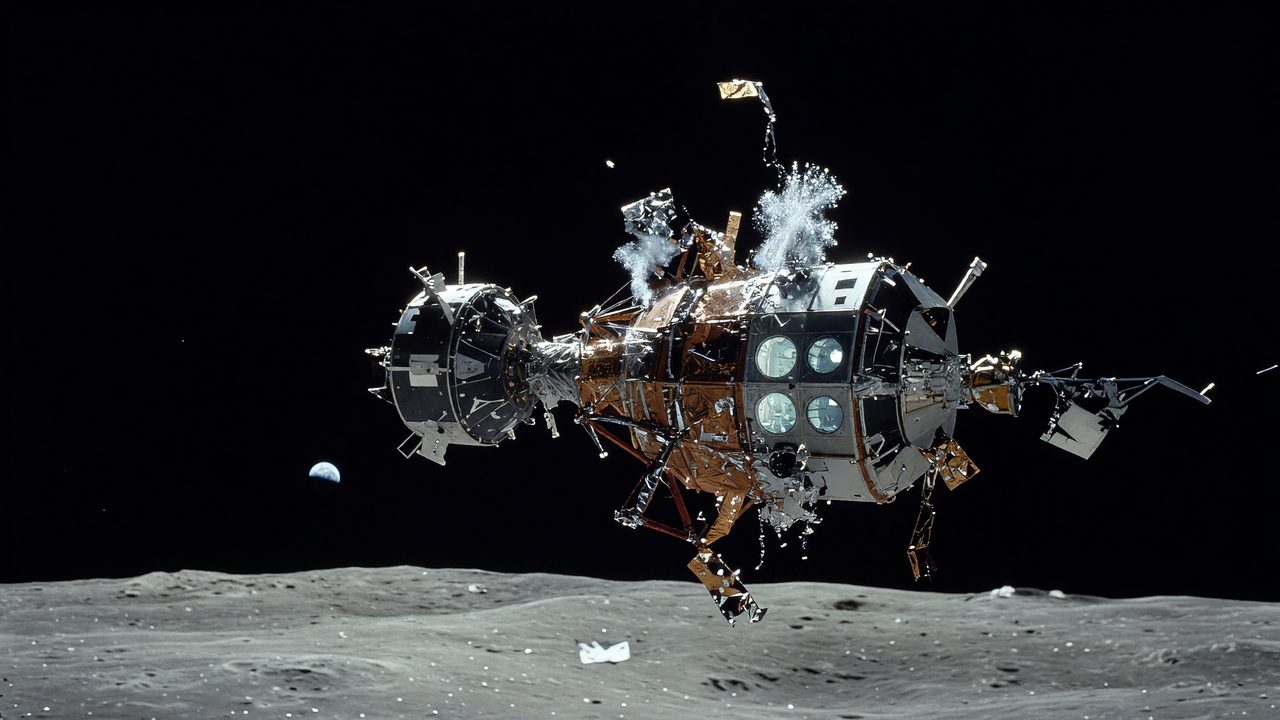
When the Mission Became the Emergency
Apollo 13 was built to land on the Moon. Instead, it became the greatest survival story in spaceflight—and a master class in crew coordination, systems thinking, and calm under impossible constraints.
On April 11, 1970, a Saturn V rocket lifted off from Kennedy Space Center carrying the third planned lunar landing of the Apollo program. Commander James A. Lovell Jr., Lunar Module Pilot Fred W. Haise Jr., and Command Module Pilot John L. “Jack” Swigert were bound for Fra Mauro, a rugged highland region on the Moon’s near side. Lovell had already flown twice in space; Haise was making his first flight; Swigert had joined the prime crew only days earlier when the original command module pilot was exposed to measles. By the standards of Apollo, the early outbound journey was unremarkable—checklists, burns, and the steady arithmetic of translunar injection.
That routine ended at 9:08 p.m. Central Standard Time on April 13, when the spacecraft was roughly 205,000 miles from Earth. The crew heard a sharp bang. Instruments showed the electrical system degrading. Swigert radioed Mission Control: “Houston, we’ve had a problem here.” Ground CapCom Jack Lousma asked for clarification; Lovell’s voice followed: “Houston, we’ve had a problem.” An oxygen tank in the Service Module had exploded, crippling the command module Odyssey. Oxygen and electrical power vented into space. The lunar landing was immediately abandoned. The question was no longer geology—it was whether three men could get home.
NASA’s official mission history and the National Air and Space Museum both describe what followed as improvisation at the edge of the possible. With Odyssey shut down to preserve what little remained, the lunar module Aquarius—designed for two astronauts to spend roughly two days on the lunar surface—became a lifeboat for three men on a four-day return. Flight controllers in Houston rewrote procedures in real time. The crew executed a free-return trajectory around the Moon, then used Aquarius’s descent engine for critical course corrections. Inside the cramped lunar module, power budgets were measured in watts, water was rationed, and the cabin grew bitterly cold as life-support systems labored far beyond their design limits.
Carbon dioxide became the next enemy. The command module’s lithium hydroxide canisters could scrub CO₂ from the air, but they were square—and the lunar module’s openings were round. Engineers on the ground devised a workaround using plastic bags, cardboard, and tape: a literal square peg in a round hole, built on the floor of Mission Control and radioed step by step to the crew. Lovell, Haise, and Swigert assembled the adapter in flight. It worked. NASA’s history office treats that episode as emblematic of the mission: not a single heroic gesture, but thousands of small, verified solutions under relentless time pressure.
Re-entry demanded one last gamble. The service module was jettisoned so the crew could photograph the damage—confirming the scale of the explosion—and then Aquarius was released. In the final hours, Odyssey was powered up cold, its guidance and entry systems awakened after days in hibernation. On April 17, six days after launch, the command module splashed down safely in the South Pacific. The Fra Mauro landing never happened. Yet the flight is remembered as a “successful failure”: a mission that missed its objective but proved that trained people, clear communication, and disciplined procedure could recover from catastrophe. Apollo 14 would reach Fra Mauro the following year, benefiting from hard-won lessons in tank design, electrical safeguards, and abort planning.
Why it matters to you
Apollo 13 endures in pilot training for the same reason it endures in history: it is a case study in resource management long before that phrase appeared in every flight manual. Lovell, Haise, and Swigert did not improvise wildly—they followed procedures where they existed, invented carefully where they did not, and stayed in constant coordination with experts on the ground. They prioritized life over mission, power over comfort, and verified each workaround before trusting it. Modern crew resource management, emergency checklist discipline, and “aviate, navigate, communicate” all echo that night 205,000 miles from Earth. You may never face a venting oxygen tank, but you will face partial failures, shifting priorities, and the need to fly the aircraft you have, not the one you planned for. Apollo 13’s legacy is proof that preparation and calm execution can turn a successful failure into a survivable one.