When the Jet Decided for Itself
"500 feet"
When the Jet Decided for Itself
On a May morning over Edwards, a machine took off with no cockpit—and a mission to fight.
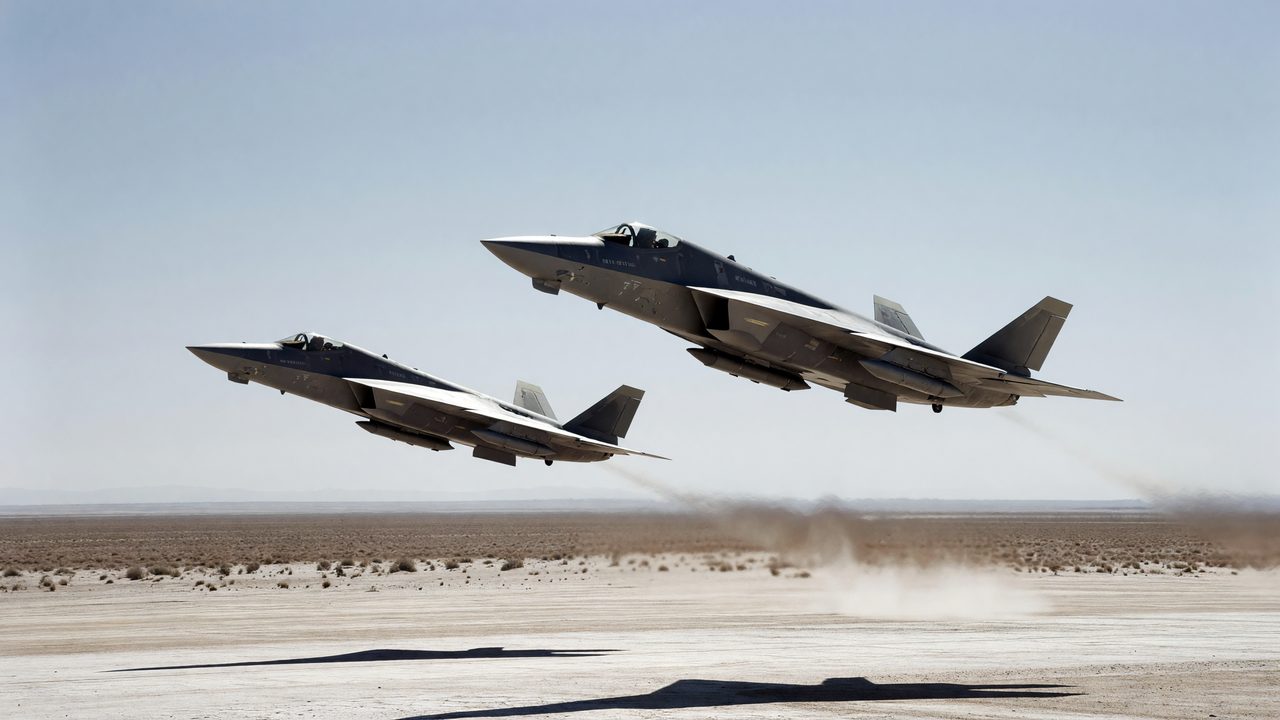
The California desert has witnessed countless first flights, but the one that lifted off Edwards Air Force Base on 22 May 2002 carried a different kind of promise. The Boeing X-45A Unmanned Combat Air Vehicle rose to 7,500 feet and flew for fourteen minutes at roughly 195 knots—not a record for altitude or duration, but a threshold crossing. According to Boeing’s contemporaneous news release, this was not another reconnaissance drone pressed into service. From its first line on the drawing board, the X-45 was conceived as a combat aircraft, built to suppress enemy air defenses in hostile airspace where manned fighters would pay a steep price.
Phantom Works, Boeing’s advanced development arm, built the jet for the Defense Advanced Research Projects Agency and the U.S. Air Force. The airframe announced its intentions in its silhouette: swept wings, internal weapons bays, and a composite skin shaped for reduced radar signature. It looked less like the camera-carrying remotely piloted vehicles pilots had grown accustomed to seeing on training-range briefings, and more like a fighter that had simply been built without a place for a human being. NASA’s program summary on the X-45 placed it within the broader Joint Unmanned Combat Air System effort—a tri-service initiative pairing DARPA, the Air Force, and the Navy in the search for an autonomous strike platform capable of taxi, takeoff, and landing without a stick and throttle in the loop.
For nearly two years after that maiden hop, engineers and test pilots at Edwards refined the vehicle’s flight envelope and its relationship to the ground. The breakthrough that changed the conversation arrived on 18 April 2004. The Air Force Test Center’s historical record notes that the X-45A became the first autonomous unmanned aircraft to release a precision-guided weapon, dropping a 250-pound inert bomb onto a ground target. A human still supervised the mission from the ground, but the mechanical act of arming, aiming, and releasing belonged to the machine’s own logic. The National Air and Space Museum, which preserves an X-45A in its collection, identifies that moment as the first weapons release from a fully autonomous unmanned combat air vehicle—a distinction that separates the X-45 from earlier drones that merely carried sensors or required constant human input for every maneuver.
The program’s most striking demonstration came less than a year later. On 4 February 2005, two X-45As launched together into the test range. Without a pilot in either airframe, the pair evaluated the tactical geometry of a simulated threat, determined which aircraft held the superior attack position, and executed a coordinated strike. A single operator on the ground watched and authorized, but the allocation of roles—the decision of who would shoot and when—unfolded in the air, negotiated between two autonomous agents. In an era when datalink latency and lost-link procedures already dominated unmanned-aircraft doctrine, the X-45 proved something more ambitious: that tactical judgment could be encoded, tested, and trusted at the speed of combat.
The broader J-UCAS program did not survive budget politics and diverging service requirements. The Navy eventually advanced Northrop Grumman’s X-47B toward carrier-based unmanned operations, and the Air Force’s unmanned strike ambitions evolved along separate paths. Yet the X-45’s legacy outlived its production line. It established that an unmanned jet could not only fly a sortie but also prosecute a target, cooperate with a wingman, and adapt its plan when the battlespace shifted—capabilities that once belonged exclusively to crews in flight suits.
Why it matters to you
The engineering principles pioneered on that May morning in 2002—autonomous navigation, sensor fusion, internal weapons carriage, and reduced observability—did not vanish when J-UCAS was dissolved. They migrated into the manned aircraft you train in and the avionics suites you brief before every sortie: flight-control laws that fly through turbulence while you manage the mission, mission computers that prioritize threats faster than hand-eye coordination alone, and composite structures that save weight without sacrificing strength. The X-45 never asked you to surrender airmanship; it asked a harder question of the profession—where human judgment ends and machine execution begins. Every time you hand a well-briefed autopilot a climb clearance, trust a traffic advisory on a glass display, or study how another aircraft shares airspace with you through automation, you are touching the same boundary the X-45 crossed over Edwards. Understanding that history does not make you a drone operator. It makes you a better pilot in an age where the cockpit and the algorithm increasingly share the same sky.