When the Instruments Lied: Air France 447 and the Stall Nobody Named
"June 1, 2009"
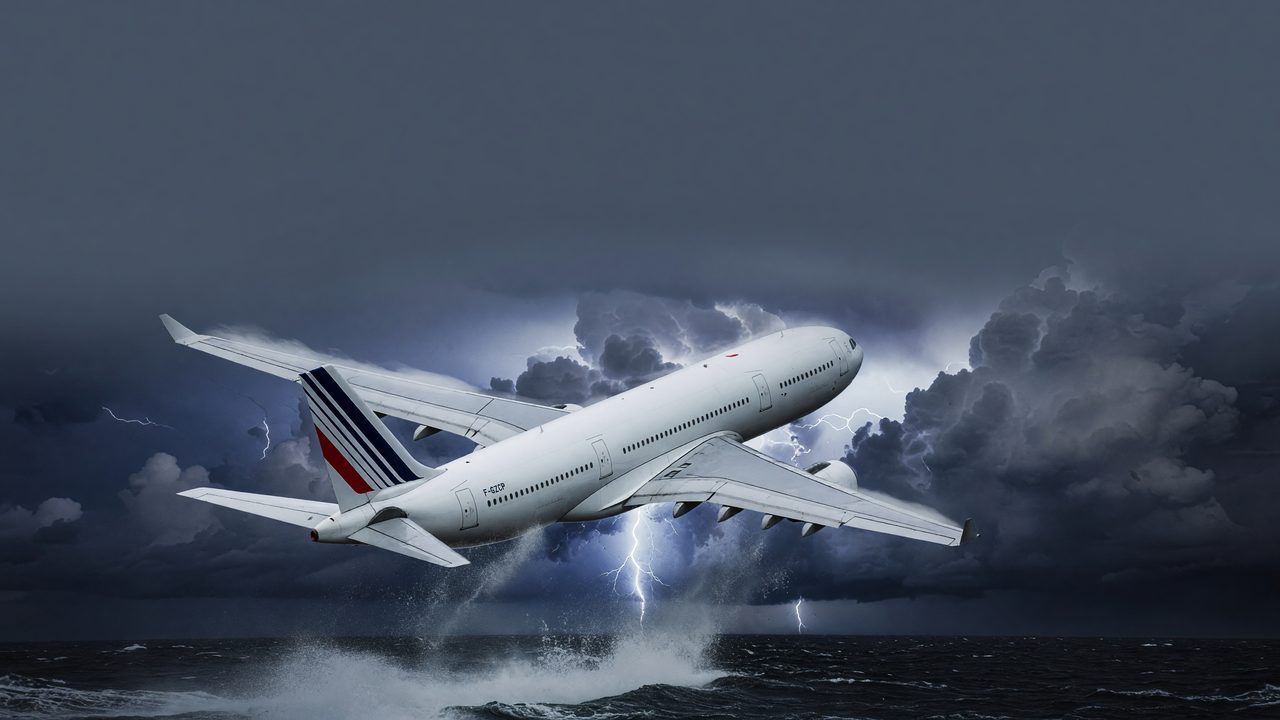
When the Instruments Lied: Air France 447 and the Stall Nobody Named
On a moonless night above the equatorial Atlantic, a modern fly-by-wire airliner fell from cruise altitude because two pilots, overwhelmed by warnings and contradictory data, held the nose up until the ocean ended the flight.
In the last minutes of May 31, 2009, local time, Air France Flight 447 lifted away from Rio de Janeiro–Galeão International Airport bound for Paris Charles de Gaulle. The aircraft was an Airbus A330-203, registration F-GZCP, crewed by three flight-deck officers and carrying 216 passengers. For the first several hours the leg was unremarkable—a long oceanic crossing in the small hours, autopilot engaged, autothrust managing power, the crew monitoring systems that had made the A330 one of the world’s most widely flown widebodies.
Somewhere near the intertropical convergence zone, the environment changed. Meteorological analysis later placed the airplane in a region of convective activity with ice crystals at altitudes where liquid water is scarce but supercooled particles remain a hazard to external sensors. The A330 was equipped with Thales pitot probes, and the probes began to accumulate ice sufficient to disrupt reliable airspeed measurement. When measured speeds became inconsistent, the flight control computers did what they were designed to do: they dropped out of normal law, disconnected the autopilot and autothrust, and presented the crew with alternate law—still fly-by-wire, but with altered envelope protections and a cockpit suddenly alive with cautions.
The captain, Marc Dubois, had left the flight deck for a scheduled rest period. At the controls were two copilots: David Robert, the relief first officer, in the left seat as pilot flying, and Pierre-Cédric Bonin, a less experienced first officer, in the right seat. The transition from automated cruise to hand-flown aircraft in turbulence, at Flight Level 350, was abrupt. The startle effect documented in the Bureau d’Enquêtes et d’Analyses (BEA) investigation is not an abstraction; it is visible in the flight data. Bonin made a pronounced nose-up input on the sidestick. The airplane began to climb, bleed speed, and move toward an angle of attack that would eventually exceed forty degrees.
What followed was not a single failure but a cascade. Stall warnings sounded, yet they were intermittent—sometimes silenced by logic tied to invalid airspeed—so the very alert meant to define the emergency became unreliable. The trimmable horizontal stabilizer migrated to a nose-up position and remained there as the crew held back pressure. Robert, recognizing that altitude was being lost, called for descent, but the airplane was no longer in a controllable climb; it was descending in a deep aerodynamic stall, nose high, engines at high power, vertical speed increasing toward the sea. Dubois returned to the cockpit within minutes. By then the situation had passed the point where altitude and skill could recover it. At 02:14 UTC on June 1, after a fall lasting roughly three and a half minutes from cruise, AF 447 struck the Atlantic. There were no survivors among the 228 people on board.
Search efforts stretched across years before the wreckage was located on the ocean floor in 2011 and the flight recorders were recovered. The BEA’s final report, published in July 2012, did not reduce the accident to frozen pitot tubes. It examined organizational factors—delayed replacement of probe models known to be vulnerable, training that emphasized high-altitude stall avoidance through power and pitch attitudes without reinforcing recognition at the edges of the envelope, and cockpit resource management that never coalesced around one clear diagnosis. The crew, the report made plain, never verbalized the word stall.
For pilots trained in the twenty-first century, AF 447 is often taught as a pitot-static lesson. That is incomplete. The probes initiated the chain; human performance and system logic completed it. A technologically advanced aircraft can still be lost in manual flight if angle of attack is ignored in favor of instinctive pull. The BEA’s recommendations helped drive regulatory attention to high-altitude upset training, startle recovery, and clearer crew communication under partial information—themes that appear again in later loss-of-control accidents where automation hands the airplane back without handing the crew a tidy narrative.
Why it matters to you
The chain of events that brought AF 447 down from FL350 is studied in classrooms and simulators precisely because the pattern persists: automation disconnects, warnings stack, airspeed becomes doubtful, and a pilot—startled, task-saturated, convinced that up must equal safety—flies a perfectly serviceable airplane into an unrecoverable stall. Your job in recurrent training is not to memorize a French airline tragedy but to rehearse the opposite reflex: when cues conflict, trust angle of attack and energy state over assumption, announce the aerodynamic condition plainly to the other pilot, and resist the pull that feels protective but is not. AF 447 is modern history with an antique aerodynamic ending. The skills that would have changed its last three minutes are the same skills examiners still probe today—identify the stall, unload the wing, and fly the airplane you have, not the one you wish the instruments described.