When the Instructor Lets Go
"The first solo flight is an event "which forever remains ..."
When the Instructor Lets Go
From open-cockpit tandem trainers to hangar walls across America, the shirttail solo endures as aviation’s humblest diploma — and its most honest measure of a pilot’s first step into self-reliance.
Charles A. Lindbergh understood that some moments in a flying life refuse to fade. In We, his 1927 account of the journey that would soon carry him alone across the Atlantic, he paused in Chapter II, “My First Plane,” to describe the first solo as “one of the events in a pilot’s life which forever remains impressed on his memory.” He was not indulging nostalgia. He was naming a threshold. Before that flight, the student is carried along by another person’s judgment, another person’s hands on the controls when the wind misbehaves. After it, the airplane returns with only one soul aboard, and the earth receives a pilot who has crossed an invisible line.
The shirttail ritual grew out of the machinery of that instruction. In the 1920s, the standard path into the sky ran through open-cockpit tandem trainers — the student forward, the instructor aft, the engine drowning out conversation. There was no radio link, no intercom, no discreet tap on the shoulder. When the instructor needed to correct a climb, arrest a turn, or demand attention before the horizon tilted wrong, he reached forward and tugged the fabric at the student’s back. The shirttail was not decoration. It was the only tactile channel between teacher and pupil, a crude but effective language written in cotton.
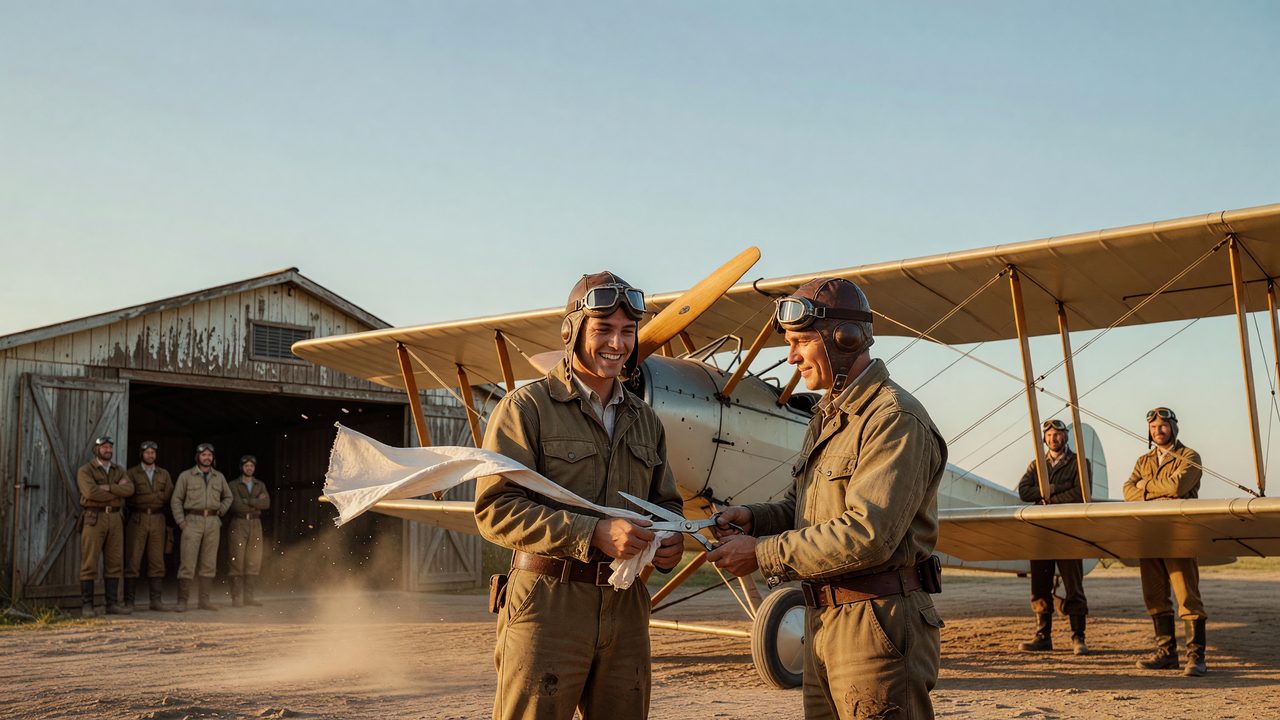
Cutting that tail became the punctuation mark on the first solo. The event itself was spare and exacting: three takeoffs, three landings, and a heart that would not settle. When the student rolled clear of the runway and shut down, the instructor appeared with scissors. The severed cloth declared what words could only approximate — you no longer need to be pulled. Contemporary accounts from flight training centers describe the symbolism plainly: the student has graduated from needing the instructor’s hands-on assistance. The scrap, signed and dated, joined others pinned to hangar walls, a textile record of passages that no logbook entry quite captures.
The tradition did not expire with closed cockpits and headsets. Documented practice in U.S. flight schools from Florida to Alaska shows instructors still honoring the cut, sometimes drenching the new soloist with water in the spirit of older rites, sometimes decorating the tail with drawings of the airplane flown and the weather endured that day. Flight-training publications have traced the custom’s roots to those radio-less tandem cockpits while noting its persistence into the twenty-first century — framed tails hung in schools and homes as trophies of the day someone else’s grip on the fabric finally released.
What survives in the ritual is not sentiment alone. It is pedagogy made visible. Every master of the sky was once a student who had to let go while someone who knew more stood close enough to grab cloth if judgment failed. The shirttail solo compresses that arc into a single gesture: instruction ends where self-reliance begins, and the wall of tails proves that the passage is communal even when the flying is solitary.
Why it matters to you
Lindbergh’s insistence that the first solo remains “impressed on his memory” is not antique poetry; it is a reminder that primary training still hinges on a discrete psychological shift. Modern syllabi, glass cockpits, and datalinked briefings do not replace the moment you must execute a pattern alone, manage energy and alignment without a voice in your ear, and accept that the airplane’s safety is now yours alone. The shirttail ceremony encodes what every rated pilot once learned in muscle and nerve: competence is demonstrated not when someone can correct you, but when correction is no longer required. Whether your school cuts fabric or simply shakes your hand, the lesson is identical. The first solo remains a cornerstone of aviation culture because it is the day the training wheels come off — and the day you discover you can fly without them.