When the Future Took Off Quietly
"July 27, 1949"
When the Future Took Off Quietly
On May 2, 1952, a British jet airliner carried paying passengers for the first time — and the propeller age began its long retreat.
The Prototype That Whispered
The jet age did not announce itself with a roar. On July 27, 1949, the de Havilland Comet rose from Hatfield, Hertfordshire, on its maiden flight, and Britain laid claim to the world's first jet airliner. The RAF Museum's archives on the type record a machine that seemed to belong to tomorrow: swept elegance, four Ghost turbojets buried in the wing roots, a pressurized cabin designed for altitudes where the air thins and the ride smooths. For nearly three years the Comet underwent testing and refinement while airlines and governments watched. The engineering was audacious. The question was whether passengers would board.
May 2, 1952
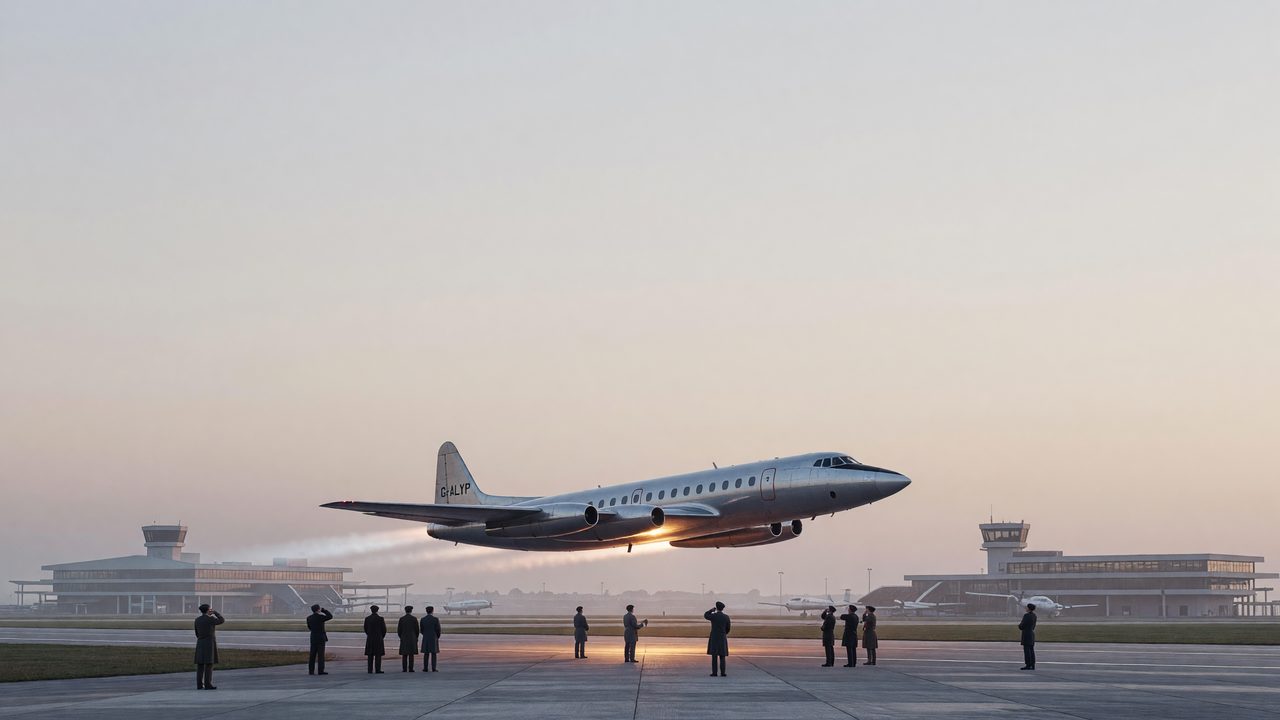
That question was answered on a Friday afternoon at London Airport. BOAC Comet G-ALYP, a Comet 1, rolled down Runway 5 at 1512 local time with thirty-six passengers and a crew of seven aboard. Contemporary accounts noted something propeller crews had never experienced: near the terminal buildings, the jet's departure was nearly inaudible — a ghost of thrust where piston airliners had announced themselves with a rhythmic thunder. BBC's On This Day archive describes crowds cheering as the aircraft climbed away on a route of nearly seven thousand miles to Johannesburg.
Captain A.M. Majendie commanded the first sector. The itinerary called for halts at Rome, Beirut, Khartoum, Entebbe, and Livingstone, with crew changes at Beirut and Khartoum on a journey expected to last twenty-three hours and forty minutes. BOAC chairman Sir Miles Thomas planned to join the flight at Livingstone in Northern Rhodesia. The fare matched piston equipment — £175 one way, £315 return — yet the Comet promised something no Constellation or Hermes could deliver: speed. On the same airline's piston-engine Hermes, the Johannesburg run required twenty-seven hours and fifty-five minutes over a route roughly one thousand miles shorter.
Fourteen Minutes Early
G-ALYP touched down at Palmietfontein after twenty-three hours and thirty-eight minutes aloft, about two minutes ahead of the scheduled twenty-three hours and forty minutes. An estimated twenty thousand people gathered to welcome her. Sir Miles Thomas declared the flight had "put British civil aviation—jet-propelled—on the map of the world." Each passenger received a certificate signed by Captain Majendie. The event was more than a publicity triumph. As FlightGlobal noted in its 2022 retrospective on the debut service, this was the first revenue passenger flight of a jet airliner — the moment scheduled jet travel ceased to be an experiment and became commerce.
The Cruel Mathematics
The Comet's triumph was brief. Within a year, catastrophic losses exposed a design the industry did not yet understand. Investigations traced failures to metal fatigue concentrated around the Comet's square-cut window apertures and its relatively thin fuselage skin. The cycle of pressurization at altitude — climb, cruise, descent, repeat — imposed stresses that accumulated invisibly until fuselage panels could fail catastrophically. The fleet was grounded. Redesign followed, but confidence never fully returned; American rivals Boeing and Douglas captured the jet market the Comet had opened.
The Comet's legacy is therefore twinned: herald of a new era, and cautionary lesson written in sorrow. Round windows, rigorous fatigue testing, conservative margins on pressurization cycles — these became standard because the Comet proved what happened when they were not.
Why it matters to you
Every time you brief a pressurized flight, you inherit engineering decisions forged in the Comet's wake. Your aircraft's oval windows, its damage-tolerance inspections, its maintenance intervals tied to cycle counts — these are not abstract regulations but responses to a failure mode that killed passengers and grounded a fleet. The future arrived quietly, then thunderously, on a May afternoon in 1952; the principles pioneered that day — respect for cyclic stress, skepticism toward untested assumptions, the understanding that a smooth ride at altitude exacts a price from the structure — remain embedded in the aircraft you fly today. Knowing that history does not make you a historian. It makes you a safer pilot.