When the Fuel Gauge Hit Empty, Airmanship Became the Weapon
"Oxcart Story"
When the Fuel Gauge Hit Empty, Airmanship Became the Weapon
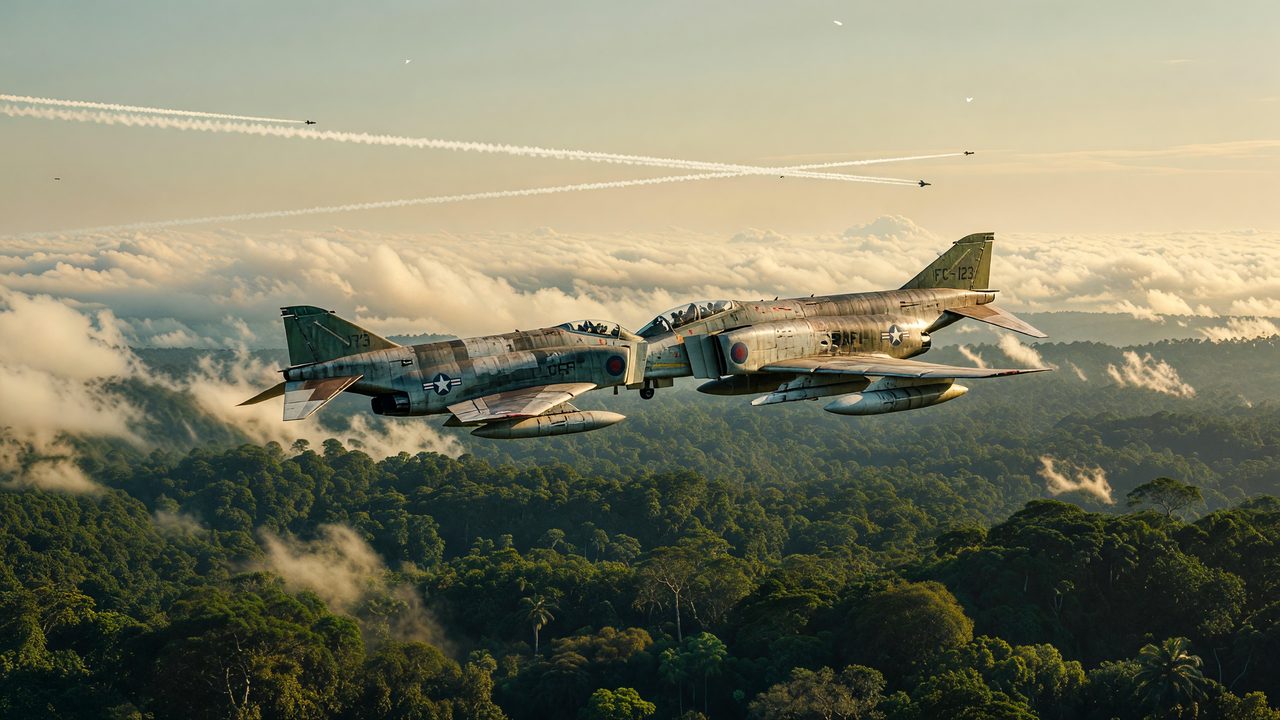
On March 10, 1967, over the most heavily defended airspace on Earth, two crippled F-4 Phantoms had nothing left but skill, judgment, and the willingness to invent a maneuver no manual described.
The steel mills at Thai Nguyen, north of Hanoi, sat behind a curtain of anti-aircraft fire that U.S. Air Force crews called the hardest environment they had ever attacked. That morning, four men from the 8th Tactical Fighter Wing climbed out of Ubon Royal Thai Air Force Base into McDonnell F-4C Phantoms and headed for a target that had already drawn blood from the wing more than once. Captain Earl Aman and his weapons systems officer, Lieutenant Bob Houghton, took hits before they even rolled in. Captain Bob Pardo and Lieutenant Steve Wayne absorbed damage during the strike itself. By the time the formation climbed above 20,000 feet and turned for Thailand, both jets were venting fuel. The arithmetic was brutal: Aman’s Phantom would not carry him to Laos, where a bailout might meet a rescue helicopter instead of a rifle squad.
Pardo faced the cold ledger every combat pilot understands. With careful throttling he might nurse his own leaking jet to a tanker and home. Aman and Houghton, punching out over North Vietnam, would almost certainly join the prisoners at Hoa Lo — the prison Americans called the Hanoi Hilton. Pardo never treated that as a real option. As he later told historians and Air Force biographers, the idea of abandoning a crew you had just fought beside did not enter his mind. He would stay until the fuel was gone, and then he would think of something else.
Something else arrived sooner than anyone wanted. Still above hostile territory, Aman’s engines flamed out. His Phantom began a powered glide toward the Laotian jungle at roughly 250 knots and three thousand feet per minute. Pardo had heard old stories — in 1952 over Korea, fighter ace Robbie Risner had nudged a stricken F-86 with his own aircraft — but the Air Force had since discouraged the practice as too dangerous to repeat. Desperation rewrote the rulebook. Pardo eased forward and tried to press his radome against Aman’s tail. Turbulence threw him off. He slid underneath and tried to lift the other jet on his fuselage, but the nose of his F-4 pitched up toward Aman’s canopy — a collision that would have destroyed both cockpits and any chance of survival.
Then Wayne spotted the tailhook. Aman lowered it. Pardo set the steel probe against his windscreen and pushed. The crippled Phantom’s sink rate fell by half, to about fifteen hundred feet per minute. Contact broke every thirty seconds as the hook swiveled in the slipstream; Pardo backed away, lined up again, and held position with rudder and throttle in a dance that demanded fighter-pilot touch in airplanes already wounded. Cracks spiderwebbed across the glass under the hook’s pressure, so Pardo shifted the contact point to the metal frame at the base of the windscreen. When his left engine caught fire he shut it down; when sink rate worsened he restarted it and ran it hot, against procedure, because procedure assumed you would still have fuel tomorrow.
For roughly twenty minutes Pardo pushed Aman’s jet across eighty miles of sky. North Vietnam dropped behind them. At six thousand feet Aman and Houghton ejected into Laos. Minutes later Pardo’s remaining engine starved and he and Wayne went out as well. Rescue helicopters pulled all four from the jungle; Pardo, the last man down, reached friendly hands roughly forty-five minutes after his wingmen. Back at Ubon the bar tabs disappeared. The next day Pardo and Wayne returned to the same steel mill.
The episode entered squadron lore as Pardo’s Push. Headquarters accountants briefly threatened charges for the lost airframe before wiser heads prevailed. Twenty-two years later, Pardo and Wayne received Silver Stars at Shaw Air Force Base. The maneuver never became standard doctrine — it could not, not in a twin-engine jet with a pointed nose and a tailhook never meant for in-flight contact. What endured was the standard beneath it.
Why it matters to you
You will never push another airplane home with a tailhook against your windscreen, and your training manual will not ask you to. But the disciplines Pardo relied on are the same ones embedded in every modern cockpit: know your aircraft’s structure and limits well enough to improvise inside them; manage energy and fuel as finite resources with human lives attached; fly formation with precision when inches matter; communicate a plan clearly to another crew; and make the decision that keeps a teammate alive before you optimize for your own recovery. CRM, unusual-attitude control, systems knowledge, and the wingman ethos are not Vietnam relics. They are the engineering of airmanship — the layer of human judgment that no autopilot, no checklist, and no glass cockpit replaces. When the gauges say you are out of conventional options, that layer is still the weapon you train to keep sharp.