When the Crowd Holds Its Breath
"Farnborough, by contrast, was a postwar child"
When the Crowd Holds Its Breath
From a muddy field south of Paris to a Hampshire research aerodrome, the world's great airshows carry forward a single promise: aviation shown, explained, and felt in the open air.
Long before Le Bourget became synonymous with jet noise and billion-dollar order books, the airshow was already a public ritual. In October 1909, the Grande Quinzaine de Paris unfolded at Port-Aviation near Juvisy, on what contemporary meeting records describe as the world's first purpose-built airfield. Hangars, grandstands, and marked courses had risen from parkland south of the capital, and Parisians came by train to watch fragile biplanes contest speed and endurance over two weeks. The Archbishop of Paris even blessed the machines before the official tribune — a detail that captures how strange and sacred powered flight still seemed. That autumn meeting at Port-Aviation was not merely sport. It was aviation stepping before a paying public and asking to be believed.
Paris had already announced its commercial ambitions. Earlier that same year, the first Salon de la locomotion aérienne opened inside the Grand Palais, drawing enormous crowds to inspect exhibits rather than races. Flight Global's archival survey of a century of shows traces this exhibition lineage from 1908, when aircraft first shared space at the Paris Motor Show, through the dedicated salon of 1909 and on to the postwar cycles that made the event a fixture of odd-numbered years. For decades the salon remained an indoor affair; flying demonstrations later shifted to Orly. Then, in 1953, the show found its permanent home at Le Bourget — an airport already steeped in record-setting lore. The move, documented in Flight Global's centenary reporting, gave Paris room to grow into the largest aerospace trade fair on earth while preserving the essential bargain struck in 1909: manufacturers display, governments negotiate, and the public eventually walks the flight line.
Farnborough, by contrast, was a postwar child. Britain's Society of British Aircraft Constructors had staged irregular exhibitions at Hendon Aerodrome beginning in 1932, gathering constructors and their latest metal on the very ground where Royal Air Force pageantry had trained a generation to look skyward. Hendon served through the 1930s until the 1938 display moved from Hendon to Hatfield and took place before wartime suspension; nine years passed before the industry gathered again. Even the 1946 revival at Radlett proved that the old formula needed a new stage — somewhere with space, road and rail access, and freedom from civilian traffic patterns. In September 1948 the show alighted at the Royal Aircraft Establishment airfield in Hampshire. Simple Flying's historical account of the inaugural Farnborough event records the milestones plainly: the first week-long show, the first open to the public, 187 exhibiting companies and seventy aircraft on the field. What had been a national industry day-out was becoming a spectacle with international reach.
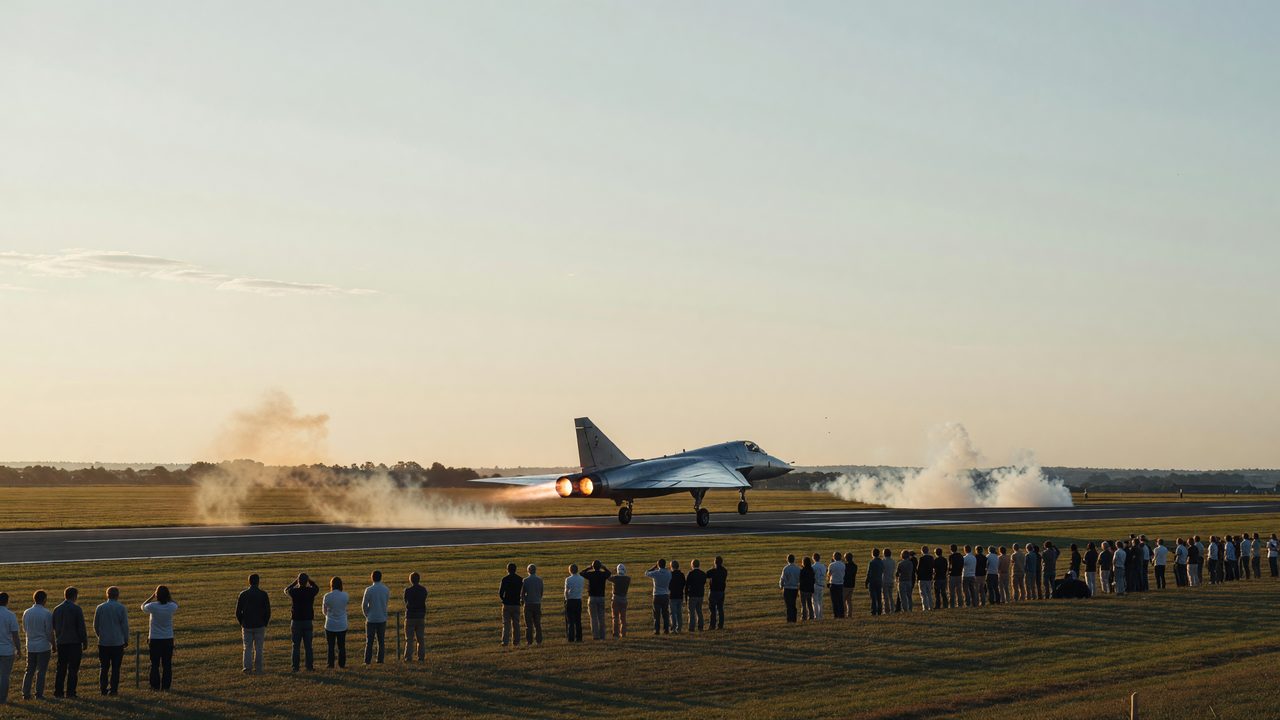
The two shows matured on complementary calendars — Paris in odd years, Farnborough biennial from 1962 onward — and each evolved from national showcase into global marketplace. Farnborough International's own heritage timeline marks 1974 as the year the event formally embraced its international identity, complete with foreign aircraft on the line and the Blackbird's thunderous arrival. Yet walk either ramp today and the sensory vocabulary remains recognizably 1909: the sharp scent of kerosene on hot pavement, the chest-thump of afterburners, and that peculiar hush when a prototype rotates for a first public flight. Commerce dominates the briefing rooms, but the flight line still performs the older duty. An airshow is where engineers, sales directors, and test pilots remember that aircraft exist to be seen and heard, not only contracted.
Why it matters to you
You may never fly a Parisian display sequence or brief a customer beside a static fighter, but you inherit the airshow's discipline every time you brief a passenger, conduct a fly-by, or explain your aircraft to someone who has only seen aviation on a screen. The heritage from Port-Aviation to Farnborough is not nostalgia; it is the practice of making flight legible to people who do not live in the cockpit. Professional pilots train for precision and procedure, yet public confidence still rests on clarity, calm, and the ability to translate technical reality into human terms — the same skills that held a crowd at Juvisy in 1909 and still hush the chalets when a new wing takes shape against a Hampshire sky. Farnborough may be the postwar child, but the family resemblance is unmistakable. The best pilots carry that tradition whether they are closing a sale or simply answering the question every airshow visitor still asks: what is it like up there?