When the Cowl Became the Weapon: Southwest 1380 and the Hidden Crack
"April 17, 2018"
When the Cowl Became the Weapon: Southwest 1380 and the Hidden Crack
A single undetected fatigue fracture in a CFM56 fan blade turned a routine climb into a textbook case of how engine failures propagate beyond the nacelle—and why the cockpit response still defines the outcome.
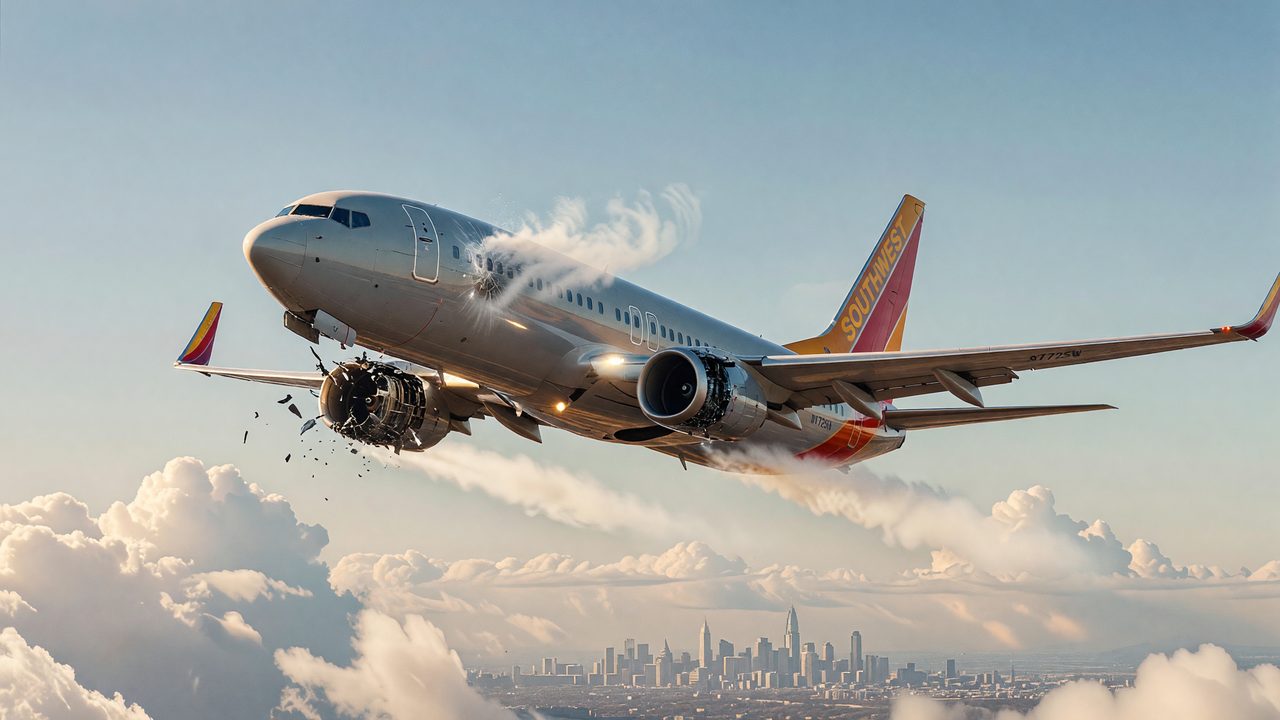
On the morning of April 17, 2018, Southwest Airlines Flight 1380 had been airborne for roughly half an hour. The Boeing 737-700, registered N772SW, was climbing through flight level 320 out of New York–LaGuardia, bound for Dallas Love Field with 144 passengers and five crewmembers aboard. At about 11:03 a.m. Eastern Daylight Time, the left CFM56-7B engine suffered a catastrophic fan-blade-out event. What followed was not a contained engine failure in the narrow sense pilots are taught to expect, but a cascade that breached the cabin.
Fan blade No. 13 fractured at its root where the blade seats in the disk dovetail. Metallurgical work by the National Transportation Safety Board traced the break to a low-cycle fatigue crack that had grown in the dovetail slot—precisely the kind of hidden defect fluorescent penetrant inspection is meant to catch. On this blade, it had not been found. The separated blade struck the fan case, shattered, and sent fragments forward into the inlet while a deformation wave rippled around and along the case. The inlet compromised; sections of inlet and fan cowl departed the aircraft. Loads transmitted through the inboard fan cowl’s radial restraint fitting cracked the cowl structure and severed all three latch assemblies joining the cowl halves. A recovered piece—the inboard fan cowl aft latch keeper—matched impact marks on the fuselage beside row 14. The cabin window there departed the airplane. Rapid depressurization followed.
In the cabin, the pressure differential did what physics demands: passenger Jennifer Riordan was partially pulled through the failed opening. Fellow travelers and cabin crew fought to restrain and retrieve her. Despite their efforts, she died—the flight’s sole fatality. Eight others suffered minor injuries. In the cockpit, Captain Tammie Jo Shults and First Officer Darren Ellisor donned oxygen, declared an emergency, and executed a controlled descent. Seventeen minutes after the engine failure, they landed safely at Philadelphia International Airport. The 737 was substantially damaged; everyone else aboard survived.
The NTSB’s 2019 aircraft accident report, Left Engine Failure and Subsequent Depressurization, Southwest Airlines Flight 1380, framed the probable cause as that fatigue crack in blade No. 13. But the board’s narrative went further. Certification testing and Boeing’s 737-700 analyses had not fully anticipated how forward-traveling blade fragments and cowl loads would interact with the airframe in this event. The trajectory of debris exceeded what CFM56-7B containment certification had demonstrated; stresses on the fan cowl exceeded design assumptions. A hidden crack initiated the sequence, yet the path from engine to hull breach exposed gaps between how powerplants are tested on the ground and how they fail on a jet climbing at altitude.
The inspection history matters for maintenance-minded pilots. The crack likely predated the blade set’s October 2012 overhaul, when fluorescent penetrant inspection failed to reveal it. After a similar Southwest fan-blade-out in August 2016 at Pensacola—an event that ended without hull penetration—CFM International added eddy-current inspection at overhaul and, later, on-wing ultrasonic checks tied to fan-blade relubrication. Neither had caught blade No. 13 before April 2018. Three days after the Philadelphia accident, the FAA issued Emergency Airworthiness Directive 2018-09-51, mandating enhanced CFM56-7B fan-blade dovetail inspections; CFM’s Service Bulletin 72-1033, issued the same day and revised through 2018, prescribed repetitive ultrasonic examination. By August 2019, those programs had turned up cracks on fifteen other blades across separate engines—evidence that the failure mode was not unique to N772SW.
Why it matters to you
Southwest 1380 is studied in training rooms because its lessons stack: an engine failure is not always “land at the nearest suitable airport” in isolation—it may arrive paired with pressurization loss, structural damage, and cabin chaos you cannot see from the left seat. Shults and Ellisor modeled the priorities—fly the aircraft, communicate, descend to a breathable altitude, divert—while passengers and cabin crew handled the human crisis aft. That division of labor is CRM under maximum stress. The accident also reminds rated pilots that airworthiness is a chain of inspections as much as a chain of command; the FAA’s emergency AD and CFM’s service bulletin exist because a crack in a dovetail slot, invisible to routine visual checks, can still write the accident report. Similar patterns—initial mechanical failure, secondary airframe damage, time-critical descent—appear in modern NTSB investigations. Recognizing the full arc early, not just the first master warning, is a skill worth rehearsing before the cowl, not the blade, becomes the threat.