When the Collection Had No Roof: How America Built Its Shrine to Flight
"For decades, the collection had no home worthy of its con..."
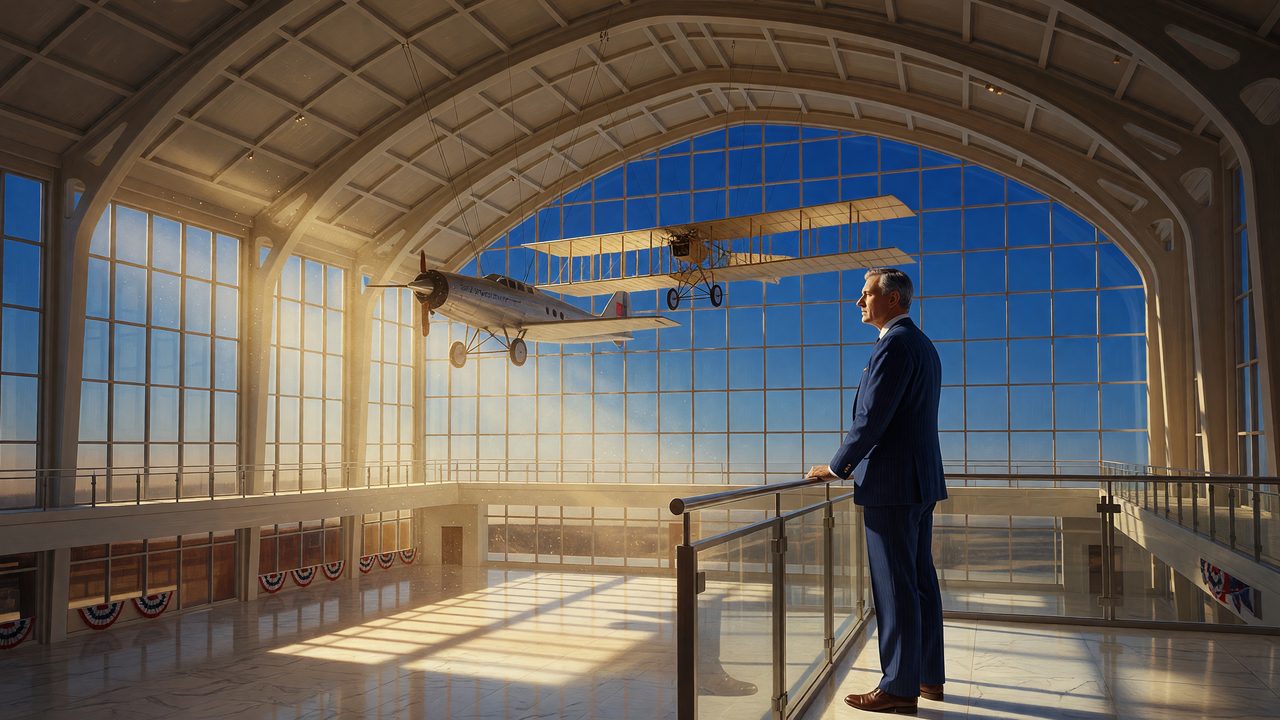
When the Collection Had No Roof: How America Built Its Shrine to Flight
For thirty years, the nation’s greatest aviation treasures waited in borrowed warehouses while Congress, curators, and astronauts argued over what a museum of the sky ought to be.
Walk into the National Air and Space Museum on the National Mall today and you meet machines that rewrote human possibility: the Wright Flyer, Charles Lindbergh’s Spirit of St. Louis, spacecraft that carried Americans to the Moon. The galleries feel inevitable, as though these icons have always stood within sight of the Washington Monument. They have not. The story of how flight’s memory found a permanent home is itself a chapter of aviation history—one shaped by wartime urgency, legislative patience, and the conviction that preserving hardware also preserves human courage.
Congress planted the seed on August 12, 1946, when President Harry S. Truman signed Public Law 722, the 79th Congress’s H.R. 5144—An Act to establish a national air museum, and for other purposes. The statute gave the Smithsonian Institution formal authority to collect and exhibit the artifacts of aeronautics at a moment when piston engines still ruled the sky and jet age promises were only beginning to arrive. Paul E. Garber, curator of the Division of Aeronautics, documented the legislative hearings and signing in the Smithsonian’s 1946–1947 annual report. His files, preserved in the Institution’s National Air and Space Museum records spanning 1912 to 1971, show that establishing a museum on paper was far easier than housing one in brick.
For decades afterward, the collection had no home worthy of its contents. World War II aircraft—fighters, bombers, trainers that had crossed oceans and defined an era—languished in an abandoned factory in Park Ridge, Illinois, and in a Navy facility at Norfolk, Virginia. Out of public view, they weathered and waited. Curators cataloged, restored what they could, and dreamed of galleries where a student could stand nose-to-nose with a Mustang or a Flying Fortress and understand what sustained flight under fire actually demanded. The gap between legal mandate and physical shelter measured a generation.
The name evolved as the mission did. In 1966, President Lyndon B. Johnson signed legislation renaming the institution the National Air and Space Museum, anticipating the space age that Apollo would soon make vivid for every American household. The rebranding was more than semantics. It acknowledged that the story of flight now ran from Kitty Hawk through lunar orbit—that propellers and rocket nozzles belonged under one institutional roof. Smithsonian histories on airandspace.si.edu trace that 1966 congressional action as the bridge between the 1946 founding act and the museum the public knows today.
It was not until 1976, during America’s bicentennial celebration, that the museum’s present building opened on the National Mall. Former Apollo 11 astronaut Michael Collins, who had guided the command module while Neil Armstrong and Buzz Aldrin walked the Moon, served as director—a signal that the institution would treat spaceflight not as an appendix to aviation but as its natural extension. Opening day answered a question Garber’s generation had carried for thirty years: whether a republic that had mastered the atmosphere and reached another world would invest in making that achievement visible. The crowds said yes. Today the museum is among the most visited U.S. museums, with roughly 3.1 million visitors in 2023 and a top-five ranking rather than the top spot, drawing millions who may never otherwise stand beside a fabric-covered pioneer biplane or a capsule that survived reentry.
What visitors encounter is not merely metal and wood. The Wright Flyer embodies the first controlled, powered, heavier-than-air flight. The Spirit of St. Louis carries the solitude of a mail pilot who bet his life on fuel, weather, and dead reckoning across the Atlantic. Between them and the space gallery lies the intangible heritage of the men and women who believed the sky was not a limit but a beginning—engineers who corrected a stall in a wind tunnel, mechanics who turned wrenches by floodlight, pilots who accepted that proficiency and judgment were perishable skills. Museums keep the machines so the lessons stay legible.
Why it matters to you
Every time you brief a cross-country, practice a soft-field landing, or study how a predecessor solved a problem you have not yet faced, you inherit a culture that was once stored in Illinois warehouses because nobody had built it a door. That long wait is why aviation museums remain a cornerstone of pilot training culture: they turn abstract syllabus items into evidence you can walk around. Standing before a historic airframe teaches scale, compromise, and consequence—the same habits of mind you need when you evaluate your own aircraft’s limits or explain your decision-making to a examiner. The National Air and Space Museum exists because a nation decided that memory required architecture. Your job as a pilot is to carry that memory into the cockpit, where the sky is still not a limit but a beginning.