When Textbooks Said No: The HondaJet’s Over-the-Wing Bet
"The wing-mount engine that defied every textbook."
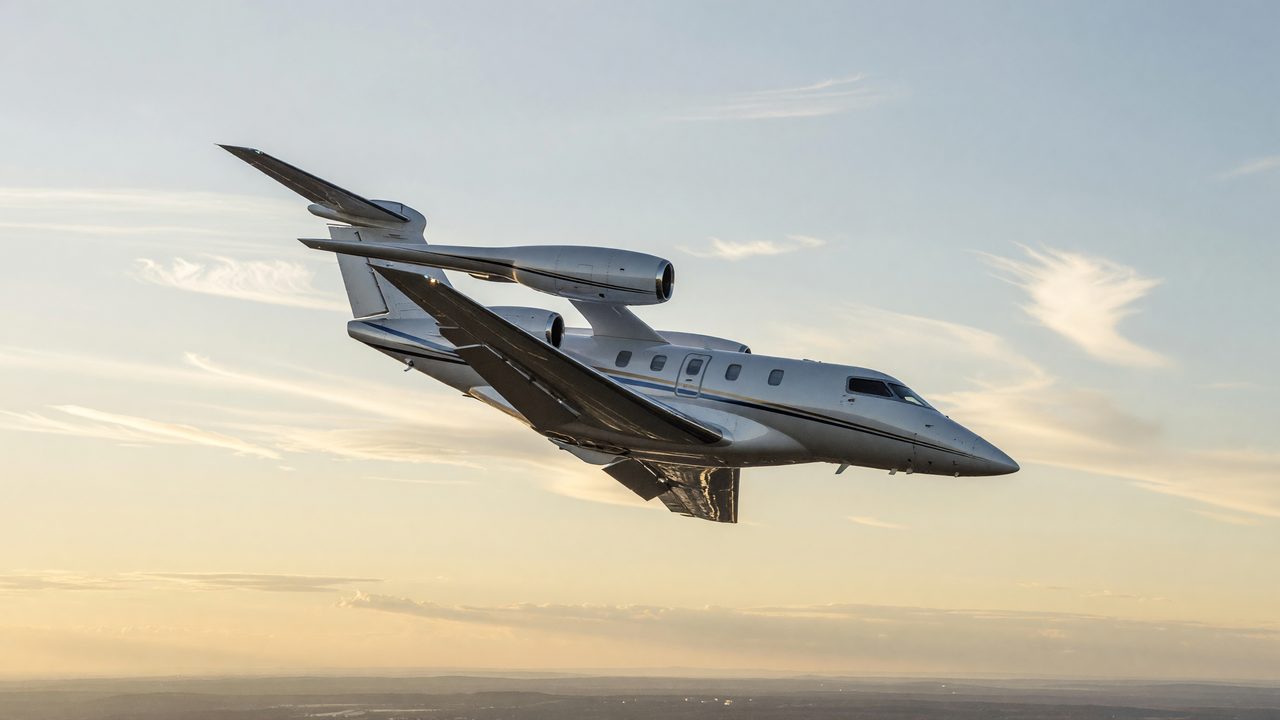
When Textbooks Said No: The HondaJet’s Over-the-Wing Bet
A car company’s very light jet turned a century of engine-placement dogma upside down—and gave pilots a 420-knot classroom in how data beats doctrine.
Soichiro Honda was ten years old when he pedaled miles to a military airfield near Hamamatsucho, climbed a tree because he could not afford admission, and watched American barnstormer Art Smith throw an airplane through the Japanese sky. The smell of hot oil, the roar of pistons, the impossible fact of flight—Honda would later say the moment never left him. Decades passed. Motorcycles, automobiles, a global mobility empire. Yet the boy in the tree had planted a seed that would outlive him. When Honda finally built its own airplane, it would not look like anything on the ramp.
The man who gave that seed its aerodynamic shape was Michimasa Fujino. Honda assigned him in 1986 to fill the last blank square on the company’s mobility map: the sky. Fujino’s path ran through composite experimentals and wind-tunnel nights, including early work tied to Mississippi State University’s Raspet Flight Research Laboratory, where Honda’s MH02 prototype proved that a Japanese industrial giant could fabricate and fly an all-composite business aircraft. By 1997 he was sketching what would become the HA-420 HondaJet. The configuration that survived every review was, by conventional wisdom, absurd: twin turbofans mounted on pylons above the wing, not tucked on the aft fuselage where every textbook said they belonged.
Orthodoxy had reasons. Nacelles over a wing were thought to interfere with airflow, strengthen shock waves, and choke drag divergence at transonic speeds—the same problems that had limited the 1970s VFW-Fokker 614. Fujino’s bosses were not gentle. In one meeting, he recalled being told he had never seen such a stupid engineer—and that he was fired. He walked Tokyo for days, then returned to the drafting table with a smaller band of believers. Quietly, they ran computational fluid dynamics and booked time in the Boeing Transonic Wind Tunnel. The results contradicted the syllabus. At the right spanwise station, the over-the-wing engine mount—OTWEM, in Honda’s lexicon—did not simply tolerate high Mach numbers; measured pressure fields showed the nacelle wake could interact with the wing in a way that reduced wave drag relative to a conventional tail-mounted installation, while eliminating the heavy carry-through structure that steals cabin volume from passengers in the rear-engine layout. Fujino published the findings in the AIAA Journal of Aircraft; peer review called the work relevant. Empirical evidence, not opinion, slowly turned the corporate tide.
The proof-of-concept HondaJet that rolled out of a hangar at Greensboro’s Piedmont Triad International Airport embodied the full stack of that research: a co-cured composite fuselage, a machined aluminum wing shaped for natural laminar flow, and Honda’s own FADEC-controlled HF118 turbofans. Engineers had worked sixteen-hour days for months, loading software past midnight on the eve of the event. On 3 December 2003—deliberately two weeks ahead of the Wright brothers’ centennial, preserving margin for last-minute gremlins—test pilots Richard Gritter and David Paul West lifted the aircraft from Runway 5. Fujino watched telemetry from a windowless control room, hearing takeoff on the radio but not seeing it; when the crew reported handling matched simulation, he took it as the highest compliment his team could receive. The flight was clean. The project’s commercial future was not; management had privately told Fujino the program would end after demonstration. Relief and dread arrived together.
Salvation came from pilots, not boardrooms. A chance meeting in the Bahamas with a Citation owner who wanted to buy a HondaJet he could not yet order gave Fujino the customer voice he needed. Fifteen months of negotiation put the prototype on the Oshkosh flight line in July 2005, where enthusiasts overwhelmed the static display—and some mailed checks to Tokyo for airplanes that did not officially exist. CEO Takeo Fukui’s whispered assent in 2006—“Honda is a personal mobility company”—opened the order book for the HA-420. Seven years of conforming-aircraft flight test followed: four test ships, icing hunts from the Great Lakes to Winnipeg, Garmin G3000 avionics matured from the POC’s pioneering G1000 installation. FAA type certification landed in December 2015; the first customer delivery came days before Christmas. The production GE Honda HF120-powered jet cruises at 422 knots, carries an 8,000-foot cabin altitude at FL430, and still swallows the practical payload owners actually bring—golf bags for four among them—in a fuselage volume OTWEM made possible.
Why it matters to you
Every checkride and every type-rating oral exam trains you to treat “known” aerodynamic truths as guardrails. The HondaJet story is a disciplined reminder of what overturns them: repeatable measurements. Fujino did not win the OTWEM argument by charisma or by citing a car company’s brand; he won by mapping off-body pressure contours in a transonic tunnel, comparing drag divergence Mach numbers against a clean wing, and documenting stall patterns on a scale model until the data showed the shock wave could be minimized—not merely endured—when the nacelle sat at the optimized chordwise position. That is the same epistemology you use when a POH stall speed does not match what your airplane actually does at a new CG, or when a simulator’s engine-out profile feels wrong in the real aircraft: form a testable hypothesis, instrument the result, let the evidence revise the model. Honda’s heresy became a certified very light jet because wind-tunnel orifices and CFD grids spoke louder than tradition. In an industry that still teaches engine placement from 1960s textbooks, the HA-420 is proof that the most useful skill a modern pilot carries is not memorizing where things have always gone—it is knowing when to trust the tape.