When Swept Wings Met Over the Yalu
"500 feet"
When Swept Wings Met Over the Yalu
In a narrow slice of North Korean sky, the jet age learned how to fight — and what still separates a trained pilot from a faster airplane.
The Arrival
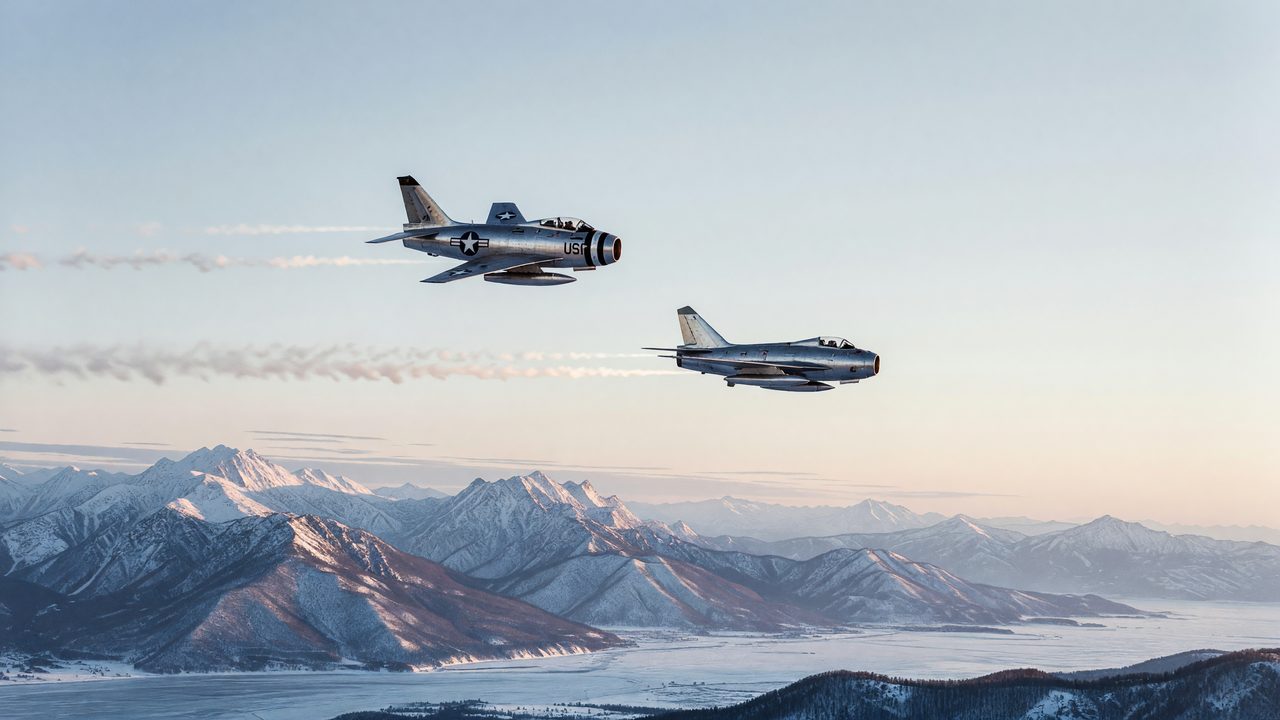
When the 4th Fighter-Interceptor Wing reached the theater in mid-December 1950 — its Sabres forward-deploying to Kimpo within days — the Korean War had already rewritten air combat once. Propeller fighters had given way to jets, but nothing yet had matched swept-wing against swept-wing in earnest battle. The wing brought dozens of F-86A-5 Sabres (about 49), still wearing invasion stripes from the recent UN offensive, and a blunt assignment: break the MiG-15’s grip on the skies above North Korea before UN bombers and reconnaissance aircraft became untenable.
The MiG-15 was not a theoretical threat. Soviet-designed and fielded in numbers, it climbed hard, turned tight at altitude, and carried heavy cannon armament that could shred a Sabre in a brief burst. American intelligence would later confirm, through captured components analyzed in the Far East Air Force Weekly Intelligence Roundup of June 24, 1951, how thoroughly Soviet engineering underpinned the type Americans faced daily. What the roundup could not fully capture was who sat in the cockpits. Many “Chinese” and “North Korean” MiGs were flown by experienced Soviet aviators — “Honchos,” in the slang of the 4th — whose skill surprised squadrons accustomed to measuring enemy quality by markings alone.
First Blood
Four days after Kimpo, the theoretical became historical fact. On December 17, 1950, Lieutenant Colonel Bruce Hinton of the 336th Fighter Squadron closed to roughly 600–800 feet of a MiG-15 south of the Yalu River and scored the first Sabre kill of the war. Hinton’s own combat narrative, documented in the record of a December 17, 1950 engagement, reflects the compressed geometry of early jet dogfighting: high closure rates, brief firing windows, and the pilot’s burden to solve a three-dimensional problem faster than radar or guns could forgive error.
That engagement opened a chapter the National Museum of the United States Air Force would later frame in its “MiG Alley: Sabre vs. MiG” analysis — not as a duel of equals on paper, but as a contest of systems and habit. American radar-ranging gunsights extended effective gun range when pilots trusted the symbology. Soviet cannon demanded respect at every merge. Training met numbers along a corridor bounded by the Chongchon River and the Yalu, a band of sky pilots simply called MiG Alley.
The Grind
By June 1951, the fight had become industrial. The 4th Fighter Wing flew 427 MiG sweeps in just two weeks — a tempo Robert F. Futrell’s official USAF history, The United States Air Force in Korea, 1950–1953, places within the wider FEAF campaign to maintain air superiority over the battlefield while diplomacy stalled on the ground. Sweeps were not glamorous duels; they were standing patrols, vectoring, fuel discipline, and the constant arithmetic of altitude advantage.
The published kill ratio — roughly eight Sabre victories for every loss — became the war’s headline statistic. It also concealed harder truths. The MiG-15 could out-climb and out-turn the early F-86 at many altitudes. What the Sabre offered instead was flyability under stress: hydraulically boosted controls that let WWII veterans translate muscle memory into jet-speed maneuvering, and a gunnery culture sharpened by years of combat. The machine did not win every parameter; the man often decided which parameters mattered in the last thousand feet.
The Proving Ground
MiG Alley became more than a nickname. It was the first sustained laboratory for jet-versus-jet combat — the place where assumptions about speed, climb, and turn radius collided with radios, G-limits, and fuel burns that no piston-era syllabus had fully anticipated. The lessons did not end in 1953. They echoed through the missile experiments of the late 1950s, through the gun-and-missile arguments over Vietnam, and through every modern briefing that asks whether technology or training owns the outcome when two fighters meet in contested airspace.
Why it matters to you
The engineering choices pioneered in MiG Alley still ride in the aircraft you fly. Hydraulically assisted control systems, ranging solutions that translate closure into usable gun or sensor cues, and the discipline of energy management under G — these were forged when swept wings first learned to fight each other over cold Korean valleys. Your training inherits that argument: the airplane sets the envelope, but you decide how much of it survives contact with a determined opponent. Whether you are a student mastering sight picture and power management or a rated pilot refreshing intercept geometry, you are practicing the same question Hinton answered at 1,500 feet in December 1950 — not whether the jet is superior on a chart, but whether you can make it superior in the last decisive moment.