When Sidesticks Replaced the Spiderweb
"delightfully responsive and reassuringly stable."
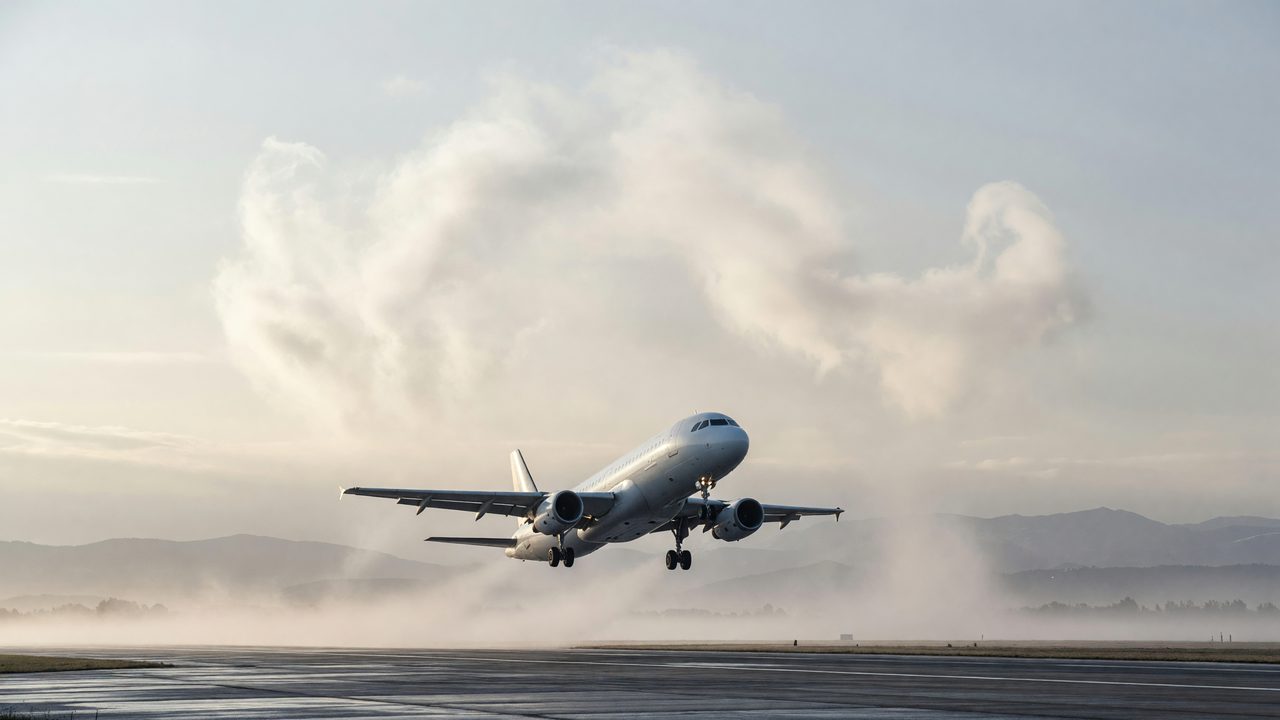
When Sidesticks Replaced the Spiderweb
On a misty February morning in 1987, a narrowbody jetliner took off from Toulouse and carried into the sky the first fully digital fly-by-wire control system ever entrusted to civil airline service — changing how pilots fly, how manufacturers design, and how millions of passengers move across the globe.
A New Kind of Maiden Flight
Fog hung low over Toulouse-Blagnac Airport on 22 February 1987 when prototype A320 F-WWAI, wearing the manufacturer’s house colors and a stripe of launch-customer logos, rolled toward the runway. At the controls sat Pierre Baud, Airbus vice president of the Flight Division and chief test pilot. Beside him were Bernard Ziegler, senior vice president of engineering, and Gérard Guyot, director of test and development — three men who had spent years betting that a commercial airliner could be flown through software as reliably as through steel cable.
For three hours and twenty-three minutes, the sidesticks spoke to computers, and the computers spoke to the control surfaces. Baud later reported that the maiden flight encountered no problems in the control system’s seven computers. The mechanical spiderweb of cables and pulleys that had governed aviation since its birth remained on the ground, irrelevant. When Baud stepped from the cockpit, he offered a verdict that would echo through training departments for decades: the jet was “delightfully responsive and reassuringly stable to fly,” with handling qualities that fly-by-wire brought together for the first time in a transport aircraft.
Philosophy Before Aluminum
The A320 was never intended as a conventional competitor. Launched in March 1984 with ninety-six firm orders — Air France leading the list — it represented Airbus Industrie’s bid to escape the twin-aisle niche defined by the A300 and A310 and contest the heart of the single-aisle market. Engineers refined the airframe for cruise efficiency, but the deeper gamble was philosophical: digital flight controls with envelope protection that would prevent a pilot from commanding the aircraft beyond its structural and aerodynamic limits.
Eight days before the first flight, on Valentine’s Day 1987, the Prince and Princess of Wales had witnessed the aircraft’s public rollout in Toulouse. The ceremony drew royalty and skepticism in equal measure. European industry needed the A320 to succeed; critics wondered whether passengers would trust an airplane whose pilots no longer pulled directly on the elevators and ailerons. The romance, as it turned out, was between Europe and a new idea of flight — one that married human judgment to electronic vigilance rather than replacing the one with the other.
From Certification to the World’s Busiest Skies
A 1,200-hour flight-test program followed the maiden sortie, aimed at certification of the 150-to-180-seat fly-by-wire transport in early 1988. Air France accepted the first delivery on 28 March 1988 and placed the type into revenue service on 18 April, initially on European routes. British Airways followed close behind. Orders accumulated at a pace that would eventually make the A320 family the world’s best-selling single-aisle line — surpassed in total sales only by the Boeing 737, and in innovation arguably by nothing else in its class.
Prototype F-WWAI logged an extraordinary second career as a testbed, flown by 110 different Airbus test pilots and used to evaluate twenty-nine engine variants before its retirement in 2016. The airframe now rests at the Aeroscopia Museum in Toulouse, registration restored, winglets removed, paint returned to its 1987 livery — a preserved artifact of a revolution still in motion.
Every Two Seconds
Airbus marked thirty years of A320 operations in 2017 with numbers that read like aviation poetry: more than 13,000 orders, a production rhythm that delivers one jetliner from a final assembly line roughly every seven hours, and a global cadence of one A320-family takeoff or landing every two seconds. More than 11.5 billion passengers have ridden the family’s wider fuselage and quieter, more efficient wing. The neo re-engining program, whose first flight came in September 2014, extended the architecture rather than replacing it — proof that the digital foundation laid in 1987 still carries the weight of the industry.
Why it matters to you
The engineering principles pioneered on that misty Toulouse morning are embedded in the aircraft you train on today, whether you touch a sidestick in an A320 simulator or study envelope protection in a ground school briefing. Fly-by-wire does not fly the airplane for you; it shapes your inputs, guards the margins, and returns consistent handling across weights and configurations that would have demanded constant trimming in a cable-driven jet. Understanding that partnership — when to trust the protections, when to work within them, and how normal-law logic differs from alternate or direct law after a failure — is not historical curiosity. It is core stick-and-rudder skill reframed for the digital age Baud proved was ready for the line. The spiderweb is gone. The judgment is still yours.