When Scale Met the Sky
"240 feet"
When Scale Met the Sky
On a spring morning over Toulouse, European engineers proved that bigger could fly — and then discovered what “bigger” could not buy.
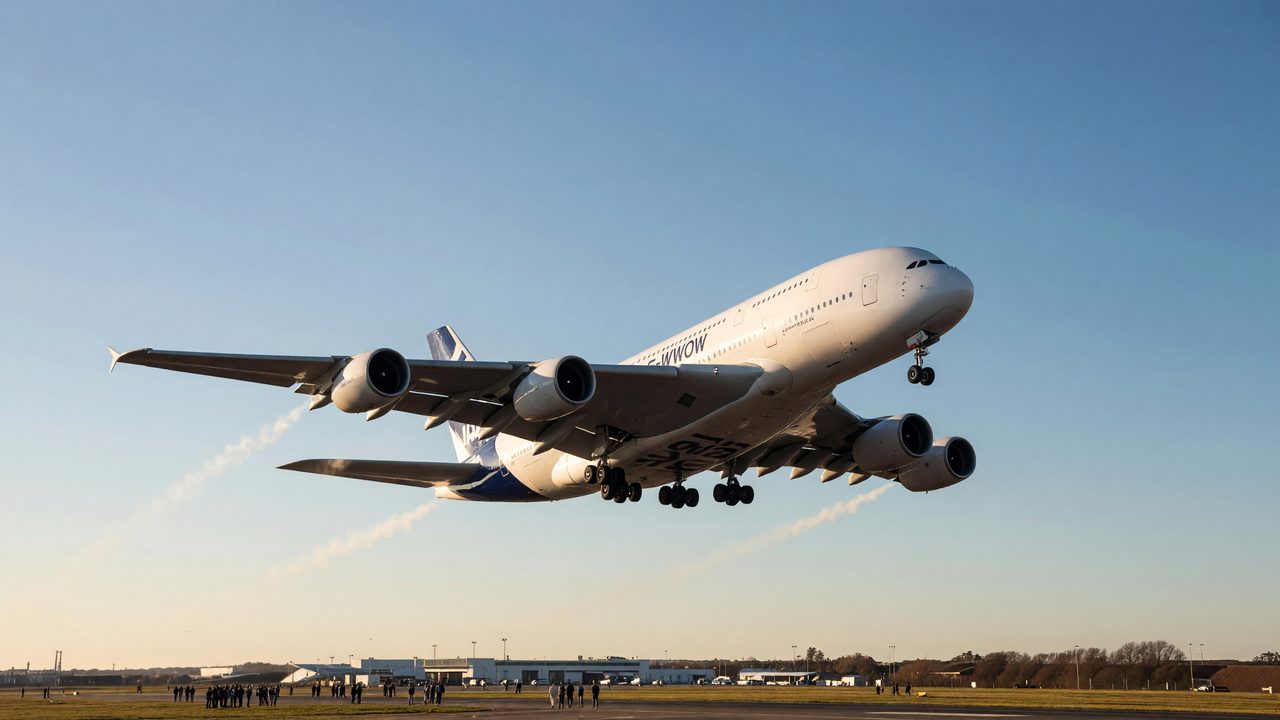
At 10:29 on the morning of April 27, 2005, four Rolls-Royce Trent 900 engines spooled to life beneath the wings of F-WWOW, and 421 tonnes of aluminum, composites, and European ambition rolled down runway 32L at Toulouse-Blagnac. Test pilots Claude Lelaie and Jacques Rosay shared command of the maiden sortie as the Airbus A380 — a full-length double-decker with twin aisles from nose to tail — lifted into clear sky above southwestern France. For nearly four hours the aircraft worked the airspace west of Toulouse, circling over the Pyrenees and the Bay of Biscay while flight-test engineers on two decks fed a live stream of performance data to teams on the ground. When the superjumbo returned, tens of thousands of spectators lining the grass banks erupted in applause. Aviation history, Airbus declared in its press release that day, had been made.
The numbers alone justified the fanfare. Stretching roughly 240 feet in length and standing 80 feet tall, with a wingspan near 260 feet, the A380 surpassed every passenger jet that had flown before it. Each wing, broad enough to park dozens of automobiles side by side, had already survived exhaustive static and load testing across facilities in France, Germany, and the United Kingdom. Composites and advanced materials such as GLARE accounted for a quarter of the structure, trimming weight while a 5,000-psi hydraulic system and fly-by-wire cockpit carried the handling logic forward from earlier Airbus widebodies. The program had been sold as the natural successor to the Boeing 747 after that aircraft’s thirty-seven-year reign as the queen of the skies — a hub-and-spoke answer to swelling traffic between the world’s largest airports.
Reality arrived in instalments. Wiring delays, weight growth, and mounting development costs pushed delivery timelines and budgets deep into the red; by the time Singapore Airlines accepted its first aircraft on October 15, 2007, the entry-into-service date had slipped by nearly two years. Ten days later, on October 25, Flight SQ380 departed Changi with 455 passengers bound for Sydney, ending the 747’s long tenure as the world’s most spacious airliner in revenue service. Seats aboard that inaugural flight had been auctioned for charity, with one bidder paying $100,380 for the privilege of boarding first. Passengers praised the cabin’s quiet and space; analysts, and Boeing itself, noted a more awkward arithmetic. The market was tilting toward smaller, long-range twin-engine jets that could link cities point to point without filling 500 seats.
For all its engineering triumphs — Airbus claimed it was the quietest, most fuel-efficient jetliner of its generation — the A380 remained an aircraft built for a network model that airlines were quietly revising. Orders never approached early forecasts. Production wound down with 251 aircraft delivered, the final airframe leaving the line in 2021. The superjumbo had not failed to fly; it had flown superbly. It had simply brushed against the practical ceiling of scale — airport gates, training footprints, route economics, and the relentless preference for flexibility over sheer capacity.
Why it matters to you
The Trent 900s that lifted F-WWOW on that April morning embodied more than raw thrust. They sat at the center of a fly-by-wire ecosystem — integrated avionics, high-pressure hydraulics, composite structural trade-offs, and cockpit commonality — that Airbus refined across the A320, A330, and A350 families. When you transition between Airbus types today, or study how modern transport categories manage energy, noise, and automation, you are working inside design choices first hardened on the largest airliner ever certified. The A380 tested the outer edge of the envelope so the aircraft you train in could inherit the lessons without carrying the weight.