When Propellers Fell Silent: The 707 and the Atlantic
"December 20, 1957"
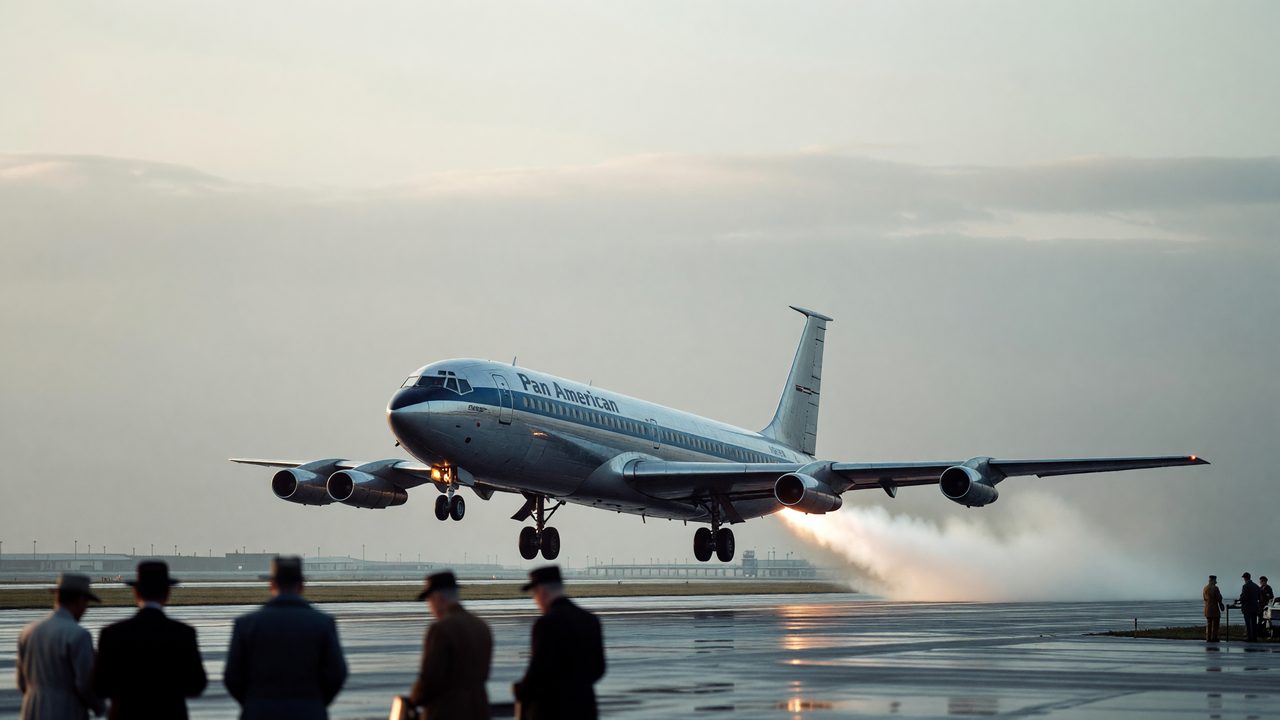
When Propellers Fell Silent: The 707 and the Atlantic
On a rainy December afternoon in 1957, Boeing proved that jets belonged in airline timetables—and less than a year later, Pan Am proved they belonged across an ocean.
William Allen did not hedge. As president of Boeing in the mid-1950s, he committed the company’s resources to a single conviction: passengers would trade the familiar drone of piston engines for the sharp urgency of the jet. Competitors were building jets too—the British Comet had already flown, Soviet Tupolev designs were entering service—but Allen’s wager was specifically American and specifically commercial. Boeing would not merely demonstrate jet technology; it would mass-produce it for paying travelers. The company’s own historical record describes the decision as having “bet the company” on a vision that commercial aviation’s future lay in turbine power.
The path to that bet began with a prototype that never carried a fare-paying passenger. The Model 367-80, known as the Dash 80, was a swept-wing testbed that first flew in 1954 and showed Boeing engineers what a jet transport could become. From that airframe grew the 707 family—wider cabin, production tooling, and the economics of the airline balance sheet. Pan American World Airways president Juan Trippe, who had reshaped international route structures for decades, signed for twenty Boeing 707-120s in October 1955. The order gave Boeing something no laboratory flight could: a customer waiting at the gate.
Renton, December 20, 1957
Chief of flight test Alvin “Tex” Johnston sat on a drenched runway at Renton Municipal Airport with copilot Jim Gannet and flight engineer Tom Layne aboard the first production 707-120. It was a cold, rainy Northwest Friday—the sort of afternoon that tests a test pilot’s patience more than his skill. At 12:30 p.m., the crew committed. The 707 lifted off, climbed over Renton, and almost immediately found weather closing in. Johnston brought the airplane down at nearby Boeing Field after just seven minutes. When the sky cleared later that day, the crew flew again, logging seventy-one minutes that Boeing still marks as the type’s maiden voyage. The shrill song of Pratt & Whitney turbojets had replaced propeller thrum on an American production line.
Idlewild to Le Bourget, October 26, 1958
Less than eleven months later, scheduled service began. Pan Am’s Clipper America, registered N711PA, departed Idlewild Airport in New York—today’s John F. Kennedy International—with 111 passengers and 11 crewmembers bound for Paris-Le Bourget. Contemporary accounts describe a send-off ceremony, remarks from Trippe, and a U.S. Army band on the ramp. The airplane’s early-model range could not quite stretch the North Atlantic in one hop; a fuel stop at Gander, Newfoundland, was part of the operational reality, not a failure of the mission. Even with that pause, the crossing took eight hours and forty-one minutes—roughly half the elapsed time of a piston-liner schedule. For the first time, a generation of travelers could leave New York on the evening of 26 October and arrive in Paris the following morning after roughly eight hours and forty-one minutes' elapsed time, including the Gander fuel stop.
Pan Am had opened the door; other routes followed quickly. By January 1959, 707s were linking New York and Los Angeles, compressing a continent into a morning’s work. Boeing soon introduced the longer-legged 707-320 Intercontinental, which in May 1959 flew nonstop from Seattle to Rome—a distance of 5,382 miles in eleven hours and six minutes, demonstrating how quickly the design matured beyond its earliest Atlantic limitations.
An Icon Takes Shape
Eight hundred and sixty-five Boeing 707s were produced and delivered—not including 154 Boeing 720s—with the wider 707-family civilian total usually cited as 1,010; airline production ran into 1978–1979, and military derivatives were built later. The silhouette—swept wings, four underslung engines, a fuselage that looked fast even at the gate—became the visual shorthand for the Jet Age. Military derivatives and corporate transports extended the type’s service life; many airframes eventually found second careers as freighters. The 707 was not the first jet to fly, nor even the first to cross the Atlantic commercially. But as engineering historians have noted, it inaugurated the most successful jetliner dynasty in civil aviation, a design lineage that would grow through the 727, 747, and beyond.
Why it matters to you
The 707’s legacy is not nostalgia—it is engineering culture embedded in every turbine airplane you step into today. Allen’s company-wide bet established a pattern modern aviation still follows: prototype boldly, then iterate for range, payload, and runway performance as operational data arrives. The early 707-120’s Atlantic fuel stop at Gander is a lesson in planning margins and fuel management that every cross-country student pilot recognizes in miniature. Swept-wing aerodynamics, high-altitude cruise, pressurized cabins scaled for hundreds of souls—these were not abstract breakthroughs; they became the baseline assumptions behind type certification, crew training, and the performance charts in your POH. When you brief a long cross-country, calculate fuel reserves, or study how a manufacturer stretched a design from regional hop to intercontinental stage length, you are working in a discipline the 707 made ordinary. William Allen bet the company on the jet. The principles behind that wager—systems integration, iterative improvement, and designing for the mission the market will actually fly—remain the foundation of the aircraft you train in now.