When Machines Negotiate: TCAS and the Guardian in the Cockpit
"TCAS II, the fully capable version, issues two kinds of a..."
When Machines Negotiate: TCAS and the Guardian in the Cockpit
Long before two pilots can see each other through the haze, a network of airborne computers may already have agreed on who climbs and who descends.
On a clear Sunday morning in August 1986, a Piper Archer wandered into the arrival path above Cerritos, California, and collided with Aeroméxico Flight 498, a DC-9 descending toward Los Angeles International Airport. Eighty-two people died in the wreckage and on the ground. The National Transportation Safety Board traced a chain of familiar failures: an IFR jet on a published arrival, a VFR pilot who never heard the traffic call, and a controller juggling multiple aircraft on a busy frequency. The accident did not invent the idea of airborne collision avoidance, but it gave Congress a reason to act. Public Law 100-223, passed in the wake of Cerritos, required Traffic Alert and Collision Avoidance System II—the fully capable version—on all U.S. passenger aircraft carrying more than thirty seats. What had been an engineering experiment became a legal obligation.
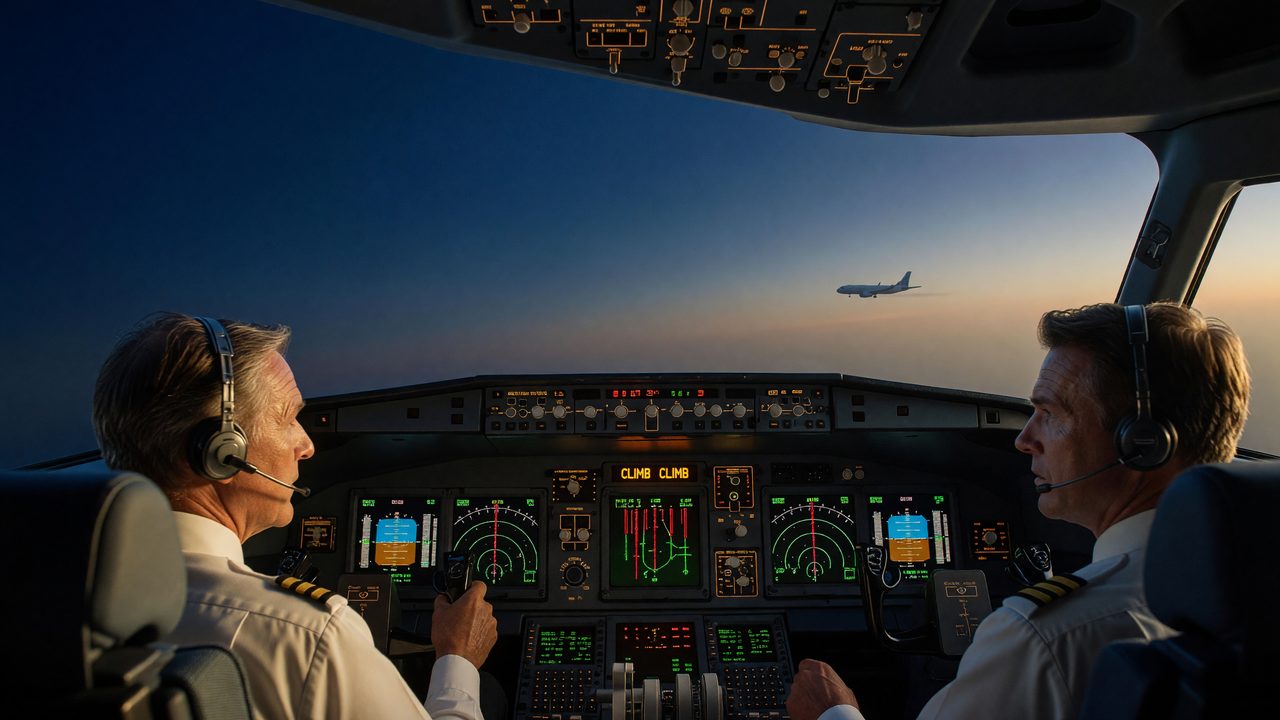
The Federal Aviation Administration had been studying the concept for years. At a 1981 FAA decision point on the Traffic Alert and Collision Avoidance System (TCAS), agency researchers laid out a vision in which radar transponders would do more than report position: they would compute threats, warn crews, and, when necessary, command escape maneuvers. That vision matured into TCAS II, which issues two distinct kinds of alerts. A Traffic Advisory, or TA, tells the crew that another aircraft is a potential conflict and urges visual acquisition. It is information, not instruction. A Resolution Advisory, or RA, is different. It is a command—a calculated vertical maneuver designed to increase separation when closure rates and geometry indicate a genuine risk of collision. Pilots train to treat an RA as immediate and mandatory, overriding routine altitude assignments until the alert clears.
The elegance of TCAS II lies in what happens when two equipped aircraft meet. Each system interrogates the other through the Mode S data link, exchanging range, bearing, and altitude. When both computers agree that an RA is warranted, they coordinate so their commands are complementary, not contradictory. One aircraft is told to climb; the other is told to descend. The negotiation happens in seconds, without human intervention, because human reaction time is the variable the system was built to overcome. Researchers James Kuchar and Lydia Yang, writing in the Lincoln Laboratory Journal, described TCAS as a distributed decision architecture: no single ground radar owns the solution; each aircraft carries its own threat model and shares just enough data to keep paired maneuvers from making a bad situation worse.
Commercial TCAS II entered service around 1990, and the cockpit changed quietly. The box did not replace see-and-avoid doctrine or air traffic control separation standards; it added a last line of defense when those layers thinned. Internationally, ICAO adopted ACAS—the global name for the same family of capability—and by 2003 required it worldwide for applicable aircraft. Today more than twenty-five thousand aircraft carry this silent sentinel, a machine that negotiates with other machines so humans have time to fly.
The FAA’s TCAS II v7.1 introduction booklet, published as an advisory circular, reflects decades of refinement. Software versions adjusted climb and descent rates, reduced nuisance alerts, and sharpened the logic that distinguishes a genuine threat from a passing airplane that will miss by miles. Vertical guidance remains the core strategy because horizontal maneuvering at jet speeds demands information TCAS was never designed to provide. The system does not know your clearance, your STAR, or the mountain on your chart. It knows geometry, closure, and altitude—and it acts when those numbers say you are on a collision course.
Why it matters to you
Whether you fly a regional jet or train in a simulator wired to a glass cockpit, the engineering principles pioneered in TCAS II are embedded in the aircraft you touch today. You will hear a TA as a cue to look outside and locate traffic; you will hear an RA as a command to pitch toward the commanded vertical sense and hold until “Clear of Conflict.” Training emphasizes that you do not second-guess the box in the heat of an RA, and you do not chase altitude with aggressive control inputs that could stall the airplane or amplify the encounter. You report RAs to controllers because the system’s logic and ATC’s picture are related but not identical. Understanding that distinction—advisory versus mandatory, coordinated versus improvised—is not academic history. It is the skill modern pilots drill because, somewhere above the clouds, two computers may already be negotiating on your behalf, and your job is to execute their agreement with disciplined, predictable flying.