When Dreams Outweigh Gravity: The Antonov An-225 Mriya
"Built originally to carry the Buran space shuttle orbiter..."
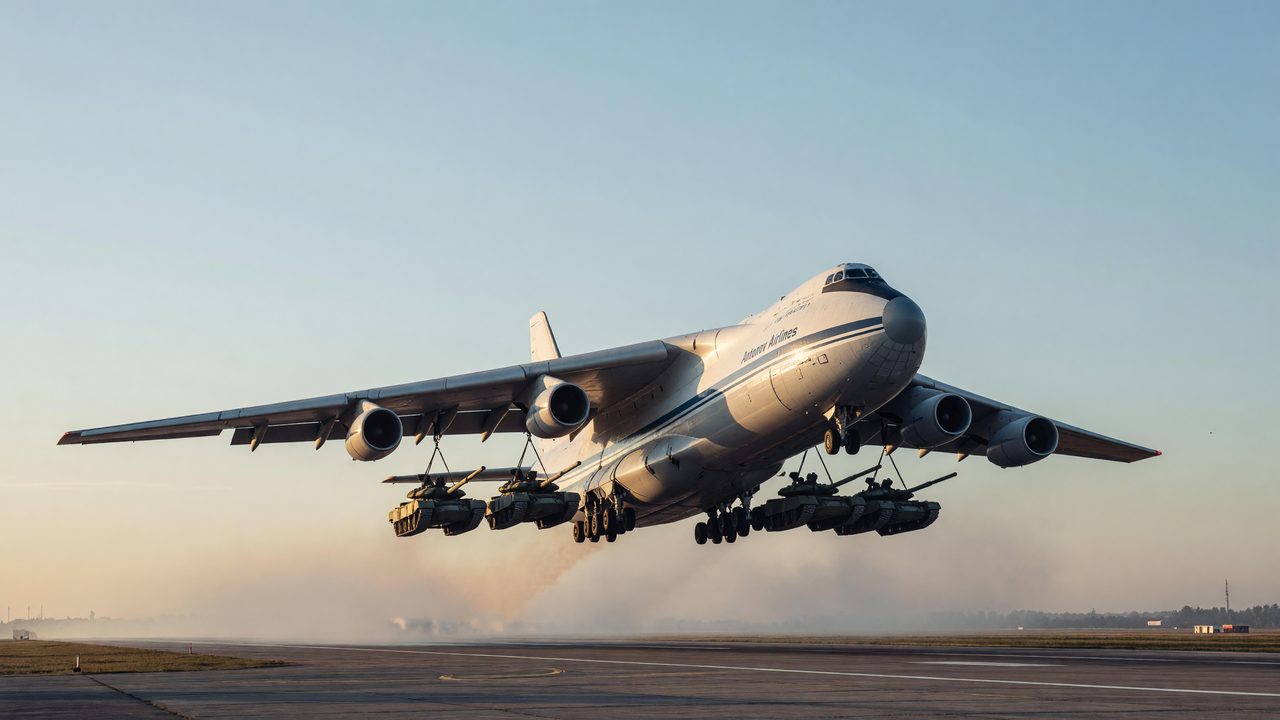
When Dreams Outweigh Gravity: The Antonov An-225 Mriya
Built to ferry a Soviet space shuttle on its back, the lone completed Mriya became the heaviest thing ever to leave the runway—and a masterclass in what happens when aerodynamic limits are pushed to their absolute edge.
Born for Buran
In the late 1980s, Soviet planners faced a logistical puzzle: how to move the Buran orbiter and Energiya rocket stages from factories near Moscow to the Baikonur Cosmodrome, 2,400 kilometres away across terrain that made a dedicated highway impractical. Antonov Design Bureau’s answer was not a bigger truck but a bigger airplane—one evolved from the already enormous An-124 Ruslan.
The result, designated An-225 and christened Mriya—Ukrainian for “dream”—rolled out in Kyiv on 30 November 1988. Chief designer Petr Balabuev chose a Ukrainian name for what had been a Soviet programme, a quiet assertion of identity at a moment when the union itself was fracturing. On 21 December 1988, veteran test pilot Oleksandr Galunenko lifted the six-engine leviathan from Svyatoshyn airfield on its maiden flight. Two airframes were started; only one was finished. The second hull remained in a Gostomel hangar for decades, a steel skeleton that never learned to fly.
Antonov’s official chronology records the aircraft’s dimensions in numbers that read like typos until you measure them against a hangar door: 84 metres long, 88.4 metres of wingspan, 18.2 metres tall. Six Progress D-18T turbofans, each producing more than 50,000 pounds of thrust, pushed a maximum takeoff weight of 640 tonnes into the sky. The pressurized cargo bay stretched 43 metres—longer than the Wright brothers’ first flight—and could swallow payloads internally or carry them on the dorsal mount originally intended for Buran.
Records Written in Tonnes
The An-225 did not merely fly heavy; it documented every excess. On 22 March 1989, Galunenko’s crew departed with 156.3 tonnes aboard and, within three hours and forty-five minutes, notched 110 world speed, altitude, and weight-to-altitude records verified by international commissioners. That appetite for the record book never faded.
After the Soviet collapse left the type without a mission, the lone Mriya spent seven years in storage. Antonov returned it to commercial service on 7 May 2001, reinforced floors and modern avionics transforming a military shuttle carrier into a global heavy-lift contractor. Four months later, on 11 September 2001—a date whose meaning would shift violently hours after the wheels left the ground—Galunenko commanded a demonstration flight loaded with five Ukrainian T-80 tanks totalling 253 tonnes. International observers aboard certified 124 world records in a single sortie. Antonov’s own history page notes 214 national records on that same flight. Over its career the type accumulated 240 world records in all, a tally Antonov describes as unique in aviation.
Commercial work followed the spectacle. In 2009 the Mriya moved a single generator piece weighing 186.7 tonnes from Germany to Armenia—a load so concentrated that engineers spent months designing a distribution frame to protect the aluminium cargo floor, rated for only ten tonnes per running metre. The following year it carried wind-turbine blades 42.1 metres long, the longest cargo item ever flown. When Siemens needed twelve 160-tonne generators delivered across the Andes, chartering the Mriya shaved months off a brutal overland route. Pandemic relief flights in 2020–2021 proved the cavernous hold could move volume as readily as mass.
The Elephant Kneel and the Ground Beneath
Operating the Mriya demanded choreography foreign to most flight decks. With 32 landing-gear tires spreading weight across the ramp, the aircraft still could not sit fully loaded on its gear during cargo operations—hydraulic jacks bore the strain while the nose gear retracted in the “elephant kneel,” lowering the forward fuselage to the pavement so oversize freight could winch up custom-built tracks. Loading a single heavy piece could consume an entire day. A flight crew of six—two pilots, two flight engineers, a navigator, and a radio operator—was backed on commercial missions by technical staff numbering more than twenty. Only a handful of pilots held type ratings on an aircraft that visited perhaps a dozen airports a year, each arrival drawing planespotters by the thousands.
Smithsonian Air & Space Magazine, profiling the type in 2015, captured both the engineering and the theatre: an airplane so wide that at RAF Brize Norton it looped on the runway because taxiways could not accommodate its wingspan; an airplane whose cargo hold had no windows, leaving passengers to discover jungle humidity only when the ramp dropped in Bolivia.
Silence at Hostomel
The Mriya’s base was Antonov’s Gostomel airfield northwest of Kyiv—the same airport where the unfinished second fuselage waited. In the opening hours of Russia’s February 2022 invasion of Ukraine, fighting engulfed Hostomel. Satellite imagery and subsequent footage confirmed what Antonov initially could not: the sole airworthy An-225, parked inside its hangar, had suffered catastrophic damage. The forward fuselage and cockpit were destroyed beyond repair. A machine that had moved the immovable was itself reduced to wreckage on the ground where it was born.
Antonov has discussed rebuilding from the second airframe, but the original Mriya—the one that set the records, carried the tanks, ferried generators to tsunami-stricken Samoa—is gone.
Why it matters to you
You will never kneel an elephant on a Cessna 172 ramp, but the Mriya’s operating logic is the same logic your instructor drills into every weight-and-balance worksheet. Center of gravity is not a suggestion; it is the difference between controlled flight and a departure you cannot recover. The Mriya’s loadmasters calculated cargo position to the centimetre because a quarter-million kilograms does not forgive approximation—and neither does a four-seat trainer loaded aft of limits. Structural floors have rated limits per unit length, just as your POH specifies maximum baggage weight and arm. Heavy aircraft need more runway, more fuel, more planning; your cross-country performance charts encode the identical physics at a smaller scale. The An-225 proved that brute force, applied with disciplined engineering, can extend what airplanes carry. The lesson for every pilot rating is quieter but no less binding: know your weight, know your balance, know your limits—and treat all three as seriously as if 253 tonnes depended on it.