When Doctrine Failed, LeMay Rewrote the Brief
"The night Tokyo burned"
When Doctrine Failed, LeMay Rewrote the Brief
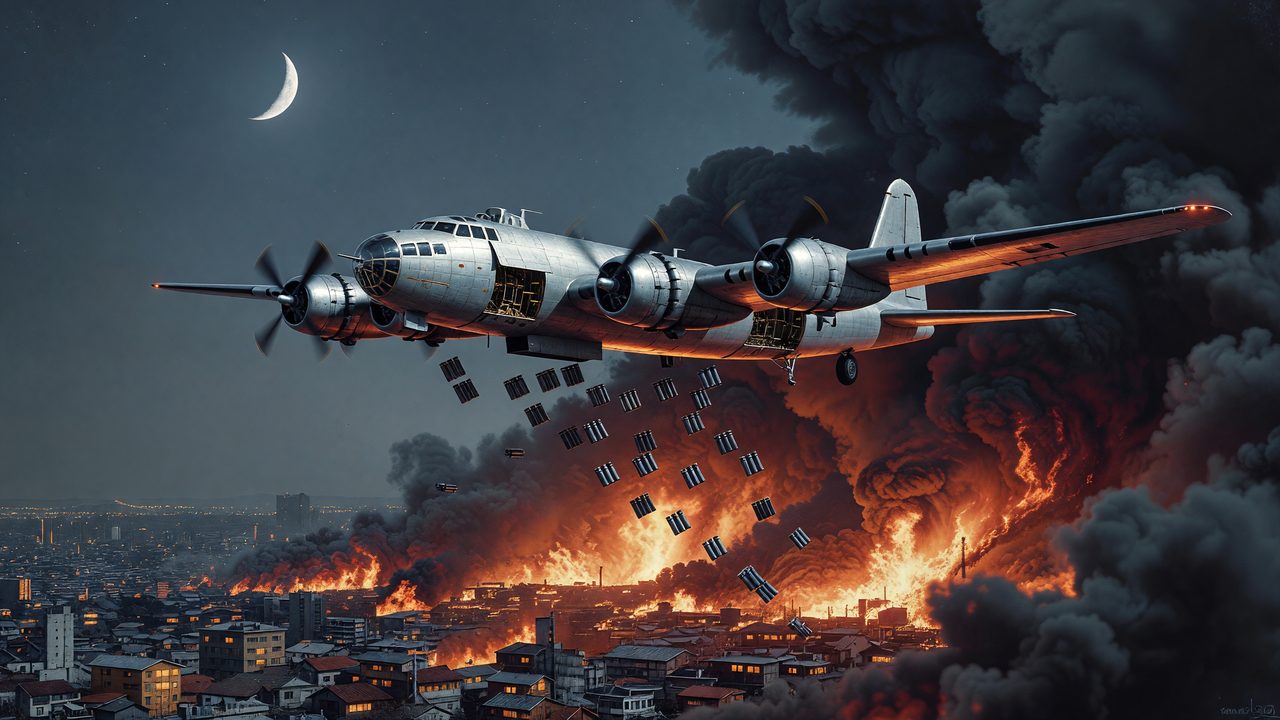
On the night of 9–10 March 1945, XXI Bomber Command abandoned the gospel of daylight precision bombing—and proved that a single raid could reshape a war.
The Problem Precision Could Not Solve
For months, B-29 Superfortresses operating from Guam, Tinian, and Saipan had hammered Japanese industry according to the Army Air Forces’ cherished doctrine: high-altitude, daylight, precision attacks on factory targets. The results, by LeMay’s own blunt assessment in early March, had not matched the publicity. Missions against priority plants repeatedly missed in weather that refused to cooperate. As the official history of the Army Air Forces in the Pacific notes, visual conditions over Japan had proved unreliable; radar bombing at altitude meant area attacks, not the pinpoint strikes the B-29 had been built to deliver.
LeMay and his staff studied alternatives with the Okinawa invasion looming. Incendiary tests against Tokyo in late February had shown promise, but high-altitude delivery scattered the M-69 clusters. Lower altitudes promised accuracy, heavier bomb loads, and easier navigation—at the cost of exposing unarmored bombers to flak over the most heavily defended cities in Japan.
A Calculated Gamble
The field orders for Mission No. 40, flown on the night of 9–10 March 1945, broke nearly every rule in the strategic bombing manual. Three hundred thirty-four B-29s would attack individually, not in tight daylight formations. They would come in between roughly 5,000 and 9,000 feet—altitudes flak experts had called suicidal. Many aircraft stripped their defensive guns entirely, trading eight thousand rounds of ammunition for roughly 3,200 pounds of additional incendiaries. Pathfinder aircraft marked aiming points with M-47 napalm bombs; following crews saturated blocks with 500-pound clusters of M-69 incendiaries, intervalometers set to lay a carpet of fire.
LeMay did not wait for Washington’s approval. Arnold learned of the plan only the day before launch. It was, as the tactical mission report would later document, a commander’s wager on surprise, payload, and the vulnerability of Japan’s wooden urban fabric.
A Sea of Flame
The first pathfinders marked Tokyo shortly after midnight on 10 March. Weather over the target was unusually clear. Within minutes, individual fires merged into conflagrations that fed on wind and closely packed homes serving as feeder plants for larger factories. Brigadier General Thomas Power, commander of the Guam-based wing, spent two hours circling the capital to chart the spread. Contemporary wire reports quoted him calling the burning districts below “a sea of flame,” areas so fully involved he doubted fire equipment could reach them.
The raid’s original target box covered roughly ten square miles of war industry and worker housing. Before the last bombers turned for the Marianas, flames had overrun another five—fifteen square miles in all, an area UPI correspondents compared to southern Manhattan and Brooklyn combined. Nearly two thousand tons of incendiaries had fallen in roughly three hours. Fires were visible two hundred miles away; crewmen described smoke columns rising thousands of feet and heat turbulence that made late bomb runs treacherous. Japanese defenses, unprepared for low-altitude night attack, were scattered and ineffective; fighter opposition was light.
What Changed After Meetinghouse
LeMay called the operation “very much the most successful to date.” Photographs taken on 10 and 11 March confirmed what returning crews already knew: a swath of Tokyo’s industrial, commercial, and residential core erased in a single night. The March fire blitz that followed Meetinghouse demonstrated that sustained incendiary attack could dismantle an urban-industrial economy faster than months of high-altitude precision effort. Five months later, when atomic bombs fell on Hiroshima and Nagasaki, they struck a nation whose largest cities had already learned what massed air attack could do.
Operation Meetinghouse did not invent area bombing. It did something more consequential for aviators: it proved that when aircraft, enemy defenses, and weather refuse to cooperate with theory, the mission commander must rewrite the tactics—not cling to the manual.
Why it matters to you
LeMay’s decision is a case study in mission analysis every pilot trains for, whether in a simulator or a briefing room. Doctrine said the B-29 should fight its way to altitude, stay in formation, and hit point targets in daylight. Reconnaissance and combat data said Japanese weather, radar bombing limitations, and the physics of incendiary delivery made that doctrine ineffective. LeMay weighed risk against outcome: reduced defensive armament increased vulnerability but materially increased payload; low altitude increased flak exposure but improved accuracy and reliability. He chose the profile that accomplished the objective, then accepted responsibility for the consequences. That is not recklessness—it is the disciplined break from standard procedure that occurs when evidence overturns assumption. When your POH, SOP, or training doctrine meets conditions it was not written for, Meetinghouse is the reminder: fly the mission the situation demands, not the one the textbook imagined.