When Discovery Opened the Sky
"5 feet"
When Discovery Opened the Sky
On a spring morning in 1990, five astronauts and a 12-ton telescope climbed above the atmosphere that had blurred humanity’s view of the universe for millennia.
Liftoff from the Cape
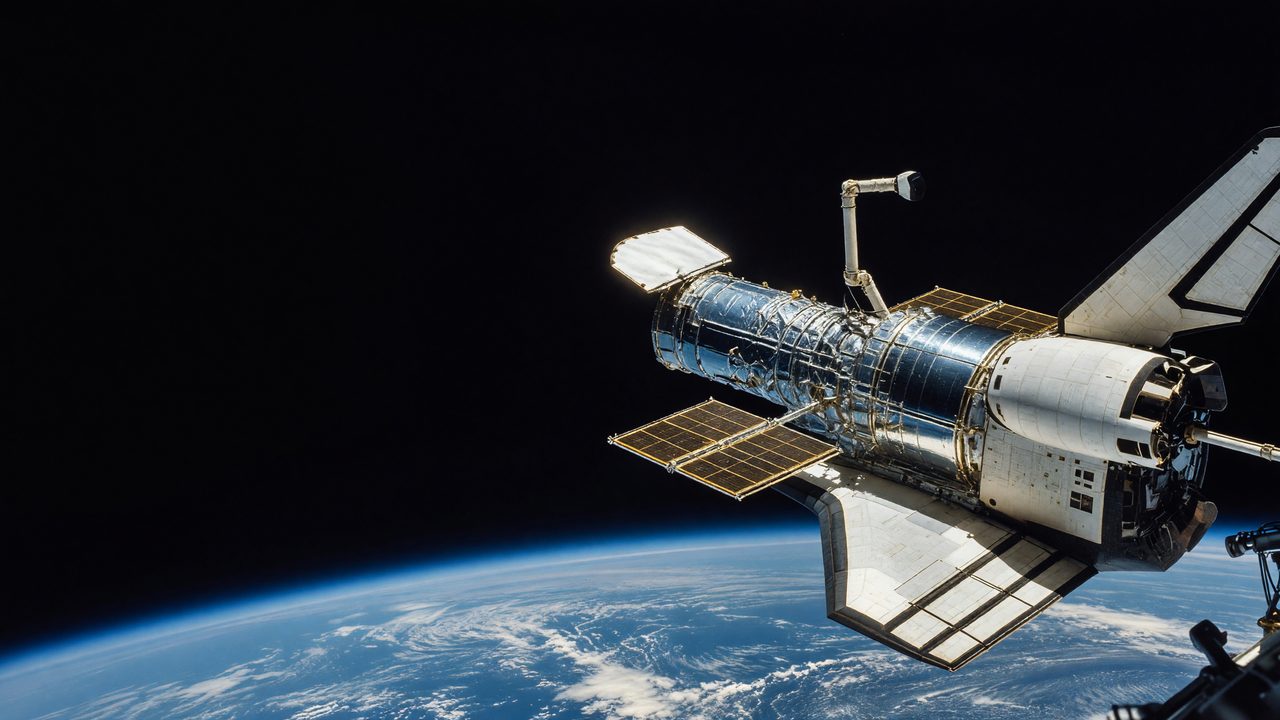
At 8:33:51 a.m. Eastern Daylight Time on 24 April 1990, Space Shuttle Discovery rose from Kennedy Space Center into a Florida sky already bright with anticipation. Mission STS-31 was the thirty-fifth flight of the Space Transportation System, and its sole payload justified the attention: the Hubble Space Telescope, the largest and most complex optical instrument ever built for space. Commander Loren J. Shriver and pilot Charles F. Bolden Jr. sat forward in the cockpit. Behind them, mission specialists Steven A. Hawley, Bruce McCandless II, and Kathryn D. Sullivan carried responsibility for the delicate work ahead. NASA’s mission planning placed Hubble in a circular orbit roughly 330 nautical miles above Earth—high enough to escape most of the atmospheric turbulence that limits ground-based astronomy, yet still within reach of the shuttle for future servicing.
A Machine Built to See
Hubble measured 43.5 feet in length and 14 feet in diameter, a cylinder of polished optics and precision mechanisms sealed against the vacuum. Conceived as a long-duration observatory, it was designed from the outset for on-orbit maintenance: astronauts could return, open its bays, and swap instruments or correct faults. That architectural choice would matter far more than anyone aboard Discovery could know on launch day. For now, the telescope rode in the payload bay like a jewel in a velvet-lined case, its aperture waiting for darkness beyond the blue.
The Release
On the mission’s second day, 25 April, the crew turned to deployment. Hawley, who had trained extensively with the Remote Manipulator System—the Canadian-built robotic arm—grappled Hubble and lifted it clear of the bay. Cameras aboard the shuttle recorded the telescope suspended above Earth, solar panels and antennas still folded. Extension of those arrays was the next critical step; without power, Hubble would be blind within weeks. One solar array initially balked, refusing to unfurl on command. Controllers and crew worked the problem methodically, and the panel eventually deployed. With power flowing and the telescope’s systems alive, Discovery backed away. Hubble was free.
The deployment sequence itself, as documented in NASA’s STS-31 mission report, proceeded without structural damage to the observatory. From the flight deck, the moment looked like triumph.
Five Days and a Flaw No One Saw
STS-31 lasted five days, one hour, and sixteen minutes, concluding with a landing at Edwards Air Force Base in California on 29 April. Public celebration was immediate. Yet within weeks, Hubble’s first images revealed a spherical aberration in the primary mirror—a manufacturing error measured in fractions of a wavelength of light, invisible during pre-launch testing but devastating to optical performance. The deployment had been flawless; the mirror was not. Because Hubble had been built to be serviced in space, engineers and astronauts could address the flaw. Servicing Mission 1 in 1993 installed corrective optics, and subsequent shuttle visits upgraded instruments across three decades. Hubble would go on to observe galaxies more than 13 billion light-years distant, refining estimates of the universe’s age and expansion, and producing imagery that reshaped astrophysics.
Why it matters to you
The legacy of that April morning continues to influence how pilots train today. STS-31 was not merely a launch and a release; it was a chain of discrete, time-critical procedures—grapple, orient, deploy, verify—executed by a crew coordinating with ground controllers under hard constraints. When the solar array stalled, the response was not improvisation for its own sake but disciplined troubleshooting against known contingencies, the same mindset a pilot applies when an annunciator flashes at altitude. More broadly, Hubble’s story teaches that a successful flight does not guarantee a successful outcome: verification must continue after the apparent victory, just as a clean takeoff does not excuse skipping the cruise checklist or cross-checking instruments. Crew resource management, contingency planning, and the humility to assume that hidden defects may still exist—these disciplines, forged in part by missions like STS-31, are now standard in flight training from the private pilot syllabus through airline recurrent programs. Opening the eye on the cosmos required more than reaching altitude. It required a crew trained to execute precisely, adapt calmly, and leave room for what they could not yet see.