When Aluminum Gave Way to Carbon
"December 15, 2009"
When Aluminum Gave Way to Carbon
On a rainy December morning at Paine Field, Boeing staked its future on a material the Jet Age had never fully trusted—and twelve thousand witnesses watched wings bend in ways no metal airliner ever had.
Through the Cloud Break
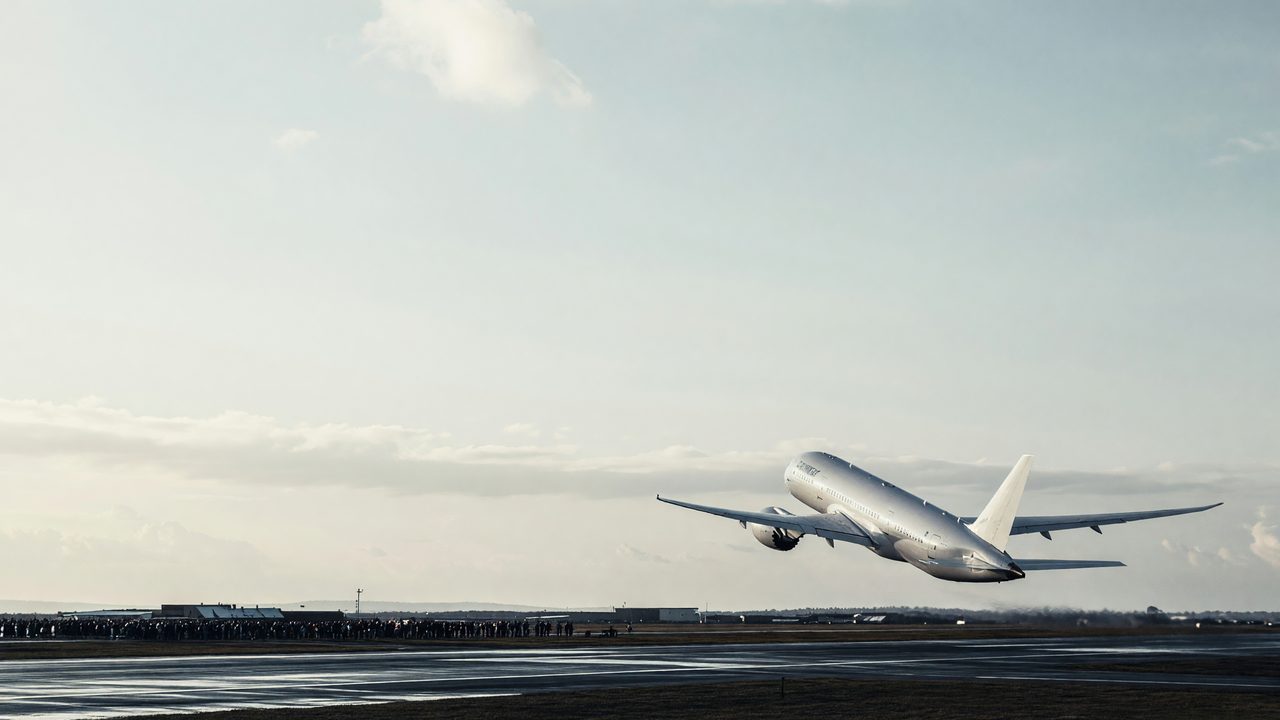
Rain fell on Paine Field on December 15, 2009, but the spectators did not leave. Boeing later estimated that more than twelve thousand employees and guests had gathered at Everett to see the 787 Dreamliner attempt a first flight that two years of delays had turned into something close to folklore. Chief pilot Mike Carriker and Captain Randy Neville needed a brief brightening in the Pacific Northwest overcast; they found it at 10:27 a.m. and rolled.
What followed, documented in Boeing’s own account of the day, was a cautious three-hour mission: climb to 13,200 feet, hold roughly 180 knots, exercise systems while telemetry streamed to engineers at Boeing Field. From the ramp, the view was anything but cautious. The Seattle Times described the upward sweep of the composite wings in flight—a slender curve that made even seasoned Boeing executives remark that carbon-fiber structures simply look different aloft. Lighter and more flexible than conventional metal wings, they flexed visibly on takeoff, trading the rigid reputation of “plastic airplanes” for something more elastic and, in the eyes of many onlookers, more elegant.
Weather shortened the celebration. Carriker told reporters that heavy rain and a lowering ceiling over the Strait of Juan de Fuca had curtailed a flight originally planned for five and a half hours. The crew turned south instead, completing the sortie under visual conditions and landing at Boeing Field a little after 1:30 p.m. For a program that had absorbed billions in overruns, the flight itself was blessedly unremarkable.
A Global Bet on Composites
The Dreamliner was never merely a new model number. Boeing distributed design and manufacturing across a worldwide supplier network and committed to advanced composites at a scale passenger aviation had not seen—roughly half the airframe by weight, a threshold that made the airplane as much materials experiment as transport category product. The promised payoff was efficiency: Boeing publicly targeted about twenty percent lower fuel burn than comparable jets, along with passenger comforts—higher cabin pressure, higher humidity, larger windows—that a composite fuselage and modern systems architecture could support more readily than traditional aluminum barrels.
The same ambition produced factory-floor turbulence. First flight arrived years behind the company’s earliest schedules, and costs climbed into the billions. Program leaders, speaking after the December flight, framed the delay as tuition paid for a workforce now versed in composite assembly and integration. Six flight-test aircraft would eventually join the first ship, flying around the clock and around the globe before certification.
Into Scheduled Service
Delivery turned engineering promise into airline reality. On September 26, 2011, Boeing handed the first production 787 to All Nippon Airways—its launch customer—in a ceremony beside the Everett factory, an event the company’s media office described as a milestone in commercial aviation history. ANA ferried the aircraft toward Japan the following morning. Revenue service began on October 26, when the Dreamliner entered ANA’s scheduled network.
By then the material covenant was no longer theoretical. Composites formed the wings, fuselage barrels, and much of the empennage; metals remained where decades of experience demanded them. But the center of gravity of airliner design had shifted on the periodic table. The Jet Age had been written in aluminum; the second century of flight would be drafted in carbon fiber.
Why it matters to you
The engineering principles pioneered on the 787 did not stay locked inside widebody cockpits. Higher cabin pressure and humidity—made practical because composite fuselages tolerate greater pressure differential with less structural penalty—shape the passenger environment you brief before long sectors and the fatigue calculus you manage as a crewmember. The wing flex that startled spectators in 2009 is a live lesson in aeroelasticity: flexible structures shed gust loads differently than rigid ones, and knowing how your aircraft is built informs how you read ride quality, turbulence response, and the margins behind your performance charts. Fuel-efficiency claims, meanwhile, rest on weight and drag accounting every certificated type inherits. Whether you fly a composite trainer or a legacy aluminum airframe, the Dreamliner established vocabulary—pressure altitude equivalents, specific range thinking, bleedless systems—that modern aircraft systems training now assumes. The machine that climbed through Everett rain in 2009 did not merely change airline economics; it changed what pilots are expected to understand about the materials carrying them aloft.