Weather Window, Steel Rain: How Allied Airpower Opened Normandy
"gleam of hope"
Weather Window, Steel Rain: How Allied Airpower Opened Normandy
On 6 June 1944, bombers, transports, and fighters flew through marginal skies to seize the air before the first landing craft touched sand—a coordinated assault that student pilots still study as a masterclass in mission planning under pressure.
The Gleam of Hope
General Dwight D. Eisenhower’s official report to the Combined Chiefs of Staff records the atmosphere aboard Supreme Headquarters Allied Expeditionary Force on the morning of 5 June with stark honesty. Meteorologists offered only a “gleam of hope”—a narrow interval of workable weather embedded in a stubborn North Atlantic low. Tides would not wait. Eisenhower committed the invasion force anyway, and with that decision the largest combined air operation of the war moved from planning tables to the sky.
For aircrews, the forecast was not an abstraction. It governed fuel reserves, formation integrity, and the ability to see drop zones through broken cloud. Every pilot briefing that night carried the same subtext: fly the plan precisely, because there would be no second chance to reshape the battlefield before the infantry arrived.
The Sunday Punch
The Army Air Forces Historical Office pamphlet Wings at War, No. 2: Sunday Punch in Normandy captured what followed in the title alone. Just before dawn on 6 June, wave after wave of Eighth Air Force heavy bombers struck the Atlantic Wall fortifications along the invasion coast. The objective was blunt and essential: shatter concrete, suppress artillery, and carve corridors through obstacles that could slaughter men wading ashore at Utah and Omaha beaches.
The bombardment was not a single hammer blow. It unfolded as a timed sequence integrated with naval gunfire and subsequent fighter sweeps. According to the Eighth Air Force after-action report on tactical operations in support of the Normandy landings, 2–17 June 1944, heavy bombers flew repeated missions against coastal defenses, transportation nodes, and strongpoints in the days bracketing H-Hour. Crews traded altitude for accuracy, accepted flak over the Cotentin, and returned to bases across England knowing that ground forces were already boarding landing craft beneath them.
Airborne Assault at Night
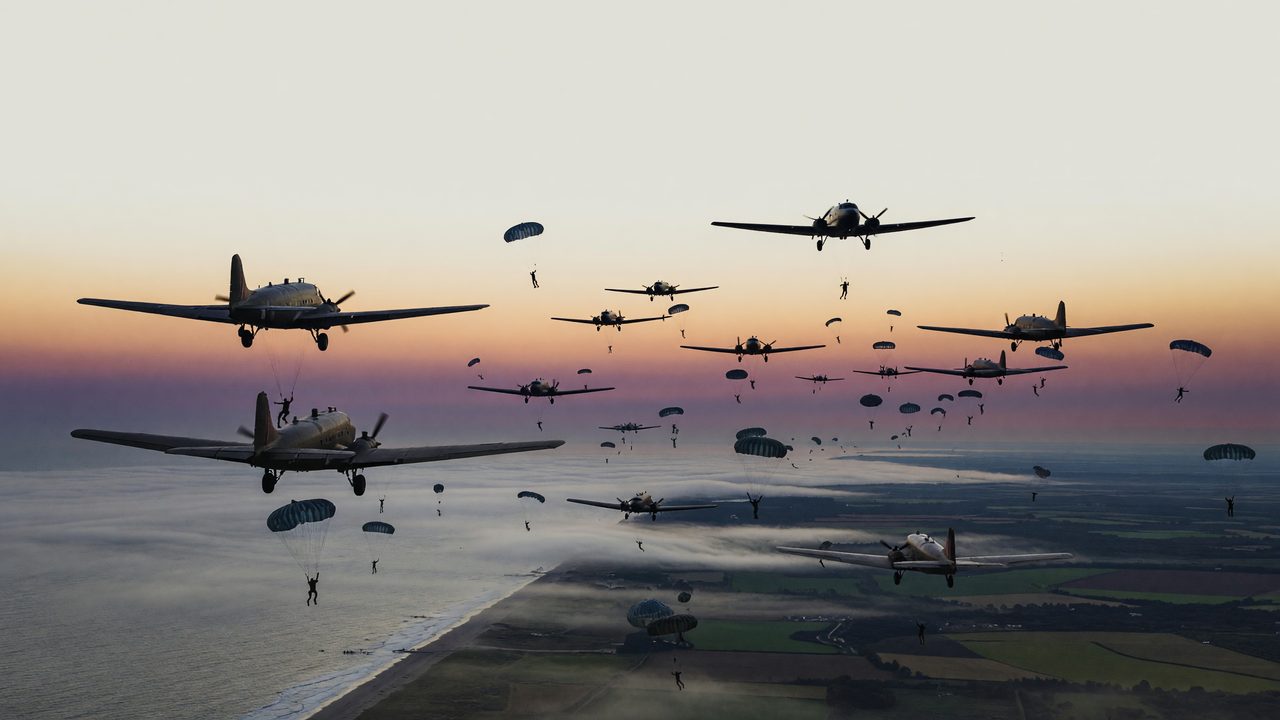
Before Eighth Air Force coastal bombing struck the beaches about 05:45–06:15, ahead of H-Hour at 06:30, the IX Troop Carrier Command executed one of the largest airborne operations in history. Field Order No. 1 and its air movement tables for Operation Neptune laid out four serial missions—Albany, Boston, Chicago, and Detroit—that would deliver more than 13,000 paratroopers of the 82nd and 101st Airborne Divisions into the Norman interior. C-47 Skytrains crossed the Channel in darkness, navigators threading corridors defined by electronic aids and disciplined timing.
The drop was messy in the way night combat always is. Units scattered across flooded fields and hedgerows, yet the strategic effect held: key bridges and crossroads were contested before German reserves could react. Pathfinders went first; main bodies followed in stacked formations that demanded radio discipline and strict airspeed control. For transport pilots, the mission was not dogfighting but precision under duress—holding course while tracers climbed from below and paratroopers depended on a steady platform at drop altitude.
Fighters, Deception, and Empty Skies
Simultaneously, Royal Air Force and Ninth Air Force fighters swept the skies and attacked command posts, bridges, and radar installations that could coordinate a counterattack. The fighter campaign aimed to blind and isolate the battlefield.
Equally important were the missions the enemy did see. In the days preceding H-Hour, Eighth Air Force bombers struck targets in the Pas-de-Calais, reinforcing the elaborate deception that the main landing might come at the shortest crossing. When assault waves moved inland from the beaches, Eisenhower reported that the invasion force encountered virtually no air opposition. Luftwaffe fighters, starved of fuel and overwhelmed by Allied numbers, could not contest a sky owned by coordinated planning.
Integration at H-Hour
What distinguished 6 June was not any single squadron’s heroism but the synchronization of roles: strategic bombers breaching fortifications, troop carriers inserting infantry, fighters maintaining air superiority, and deception operations fixing German attention elsewhere. The Combined Chiefs report treats airpower as inseparable from the naval and ground plan—each arm timed to the others.
For aviators reading the records today, the operational density is striking. Multiple commands, different aircraft types, and competing weather constraints had to converge on a single calendar day. When that convergence succeeded, soldiers on the beaches fought beneath an umbrella few invading armies have ever enjoyed.
Why it matters to you
The principles on display over Normandy still sit at the center of how rated pilots are trained to think: brief the weather honestly, fly the plan as written, and trust that your segment of the mission connects to someone else’s touchdown on the beach. Modern crew resource management, IFR cross-checks, and large-formation coordination all echo the same lesson Eisenhower’s air armadas proved at dawn on 6 June—operational success is rarely one spectacular maneuver. It is disciplined execution across an entire system, launched on a gleam of hope, with no air opposition left to chance.