Two Ships, One Orbit: Gemini VII and VI-A Make History
"No mission in the Gemini program better displayed America..."
Two Ships, One Orbit: Gemini VII and VI-A Make History
When an exploding target vehicle nearly grounded America’s rendezvous program, engineers rewrote the mission on the fly—and four astronauts proved that meeting another spacecraft in orbit was not theory but skill.
When the Plan Blew Up
In October 1965, Gemini VI was supposed to do something no American had yet attempted: chase down an Agena target vehicle in orbit and dock with it. Wally Schirra and Tom Stafford were strapped in at Cape Canaveral’s Launch Complex 19 when the unpiloted Agena destroyed itself seconds after liftoff. The rendezvous mission appeared dead.
What followed, as NASA historians have documented, was a pivot that defined the Gemini program. Walter Burke and John Yardley of McDonnell Aircraft—the company that built the Gemini spacecraft—recalled an earlier proposal from Martin, builder of the Titan II booster: launch two Geminis in quick succession. Gemini VII was already scheduled for early December, a grueling two-week medical flight to prove humans could endure an Apollo-length voyage to the Moon. Why not fly VII first, then send Schirra and Stafford in a renamed Gemini VI-A to rendezvous with Frank Borman and Jim Lovell already circling Earth? Pad crews would have to stow one spacecraft, launch the other, then rebuild the first on an unprecedented timeline. NASA accepted the gamble.
The Endurance Flight
On December 4, 1965, Borman and Lovell rode a modified Titan II into orbit aboard the heaviest Gemini yet flown—loaded with extra provisions and fitted with a radar transponder so VI-A could find them. Their assignment was endurance, not pursuit. For fourteen days they would live in a cabin roughly the size of a compact car’s front seats, testing whether the human body could survive the duration a lunar round trip would demand. At the time, it was the longest human spaceflight in history.
Eight days after VII’s launch, Schirra and Stafford returned to the pad. On December 12, their countdown reached zero, the Titan engines ignited—and shut down again after barely a second. In the cockpit the mission clock started and the abort alarm sounded. Protocol called for Schirra to pull the D-ring and eject both men from a fully fueled rocket. He refused. Drawing on his October 1962 Mercury-Atlas launch experience, he judged that the booster had never left the pad. He was right. A launch umbilical had separated prematurely, triggering the cutoff. Subsequent inspection found a plastic dust plug still lodged in an engine nozzle; a liftoff might have meant catastrophe. Schirra radioed calmly: “We’re just sitting here breathing.”
Closing the Gap
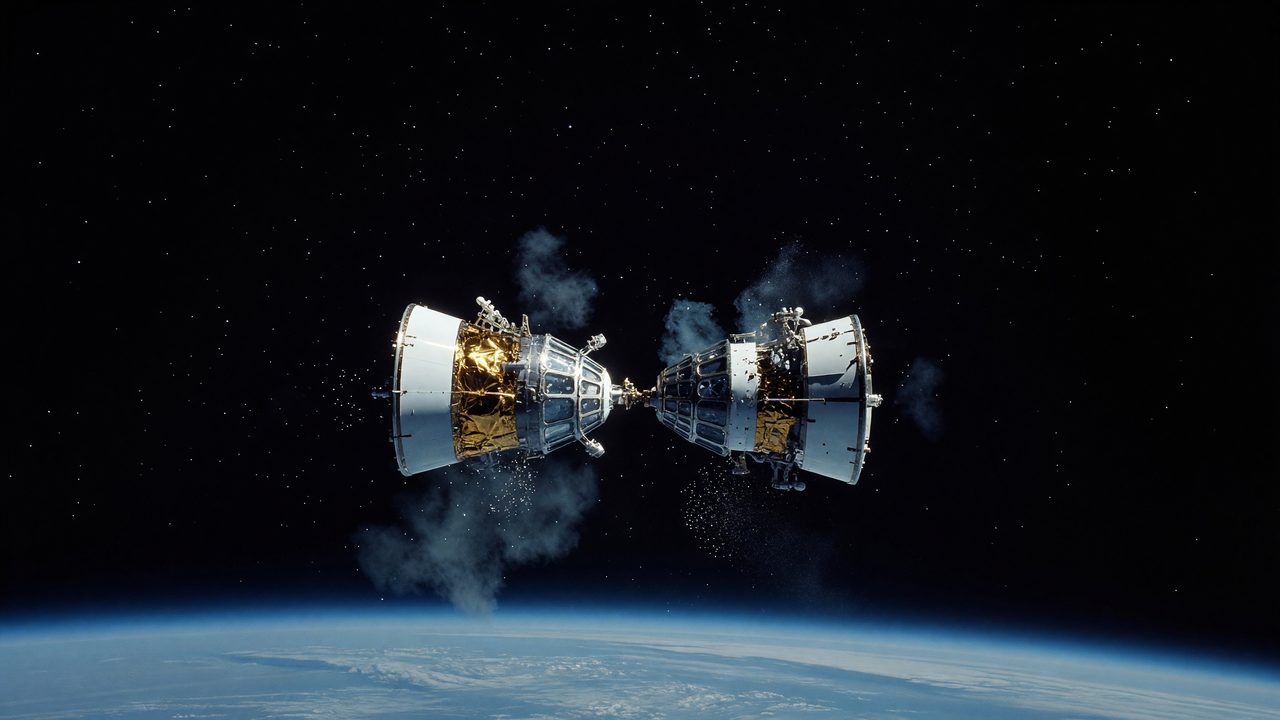
Three days later, on December 15, Gemini VI-A rose cleanly. Schirra and Stafford began a four-orbit intercept profile, firing their thrusters in a carefully calculated sequence to match Borman and Lovell’s altitude and orbital path. Ground computers supplied the geometry; onboard radar confirmed it as the range closed. Early that afternoon, VI-A slid up alongside VII—the first true rendezvous in space, achieved by the United States. Soviet Vostok flights had placed cosmonauts in nearby orbits years earlier, but those spacecraft could not maneuver; proximity without control is not rendezvous.
For roughly five hours, the two Geminis flew in formation, circling each other for three orbits. At times they held nose-to-nose, close enough that each crew could study the other’s spacecraft through the window. Schirra and Stafford, both Naval Academy men, held up a handwritten “Beat Army” sign for West Point graduate Borman—a moment of levity in an exercise of lethal precision. All four astronauts took turns at the controls, practicing the station-keeping that Apollo would require when a lunar module and command module had to find each other after separation.
Home, and What It Meant
Gemini VI-A splashed down in the Atlantic on December 16, completing what NASA records as the first computer-controlled precision landing in the program. The night before reentry, Schirra and Stafford had played “Jingle Bells” on a harmonica and bells for controllers and their companions in orbit—a December joke that survives today in the Smithsonian’s collection. Borman and Lovell endured two more days alone before their own recovery on December 18, completing the marathon flight that had served as rendezvous target and medical proving ground in one.
The dual mission cleared two Apollo prerequisites in a single December: long-duration flight and controlled orbital rendezvous. As the National Air and Space Museum notes in its account of the flight, the Moon suddenly seemed much closer.
Why it matters to you
No mission in the Gemini program better displayed American adaptability than the dual flight of VII and VI-A, and that legacy still shapes how pilots are trained. Rendezvous is intercept geometry at a different scale: you do not fly directly at your target—you manage energy, closure rate, and phase angle through a series of deliberate burns, the orbital equivalent of planning an intercept rather than chasing a tail number across the sky. Schirra’s abort decision on December 12 is a case study in disciplined judgment under pressure: when instruments and instinct disagree, the pilot who understands the vehicle lives to fly the mission. Formation station-keeping—holding precise relative position while another aircraft fills your windscreen—echoes in every traffic-pattern merge, aerial-refueling pre-contact, and formation checkout a flight instructor runs today. The Gemini crews showed that mastery of orbital mechanics was not a slide-rule abstraction but a hand-flying skill, built burn by burn. That is the same discipline your training demands: know the plan, adapt when the plan explodes on the pad, and close the gap with precision.