Two Pieces, One Orbit
"The largest international construction project in history..."
Two Pieces, One Orbit
In November and December 1998, the International Space Station began not on a construction site but with a rocket on the Kazakh steppe—and a shuttle launch two weeks later that proved engineers on opposite sides of the world had built pieces that fit.
The largest international construction project in history did not begin with a hammer. It began with fire on the steppes of Kazakhstan. On 20 November 1998, a Proton-K rocket lifted from Baikonur Cosmodrome carrying Zarya—the Functional Cargo Block whose Russian name means Sunrise. Built by Khrunichev in Moscow and funded by the United States, the 20-ton cylinder was the first piece of the International Space Station ever to reach orbit. Nine minutes after liftoff, Zarya unfurled its antennas and solar panels in the airless dark, a machine waking alone 220 miles above Earth.
For sixteen days, Zarya circled the planet as a solitary outpost. Conceived in the aftermath of the Cold War, the station program had drawn together former rivals: Canada, Japan, and the European Space Agency joined the effort in the 1980s; Russia brought decades of long-duration spaceflight experience and hardware originally intended for Mir-2. Zarya served as the station’s temporary brain—providing propulsion, power, and guidance until American modules could arrive. From control centers in Houston and Moscow, ground teams watched their first element hold position in low Earth orbit, waiting for its partner.
Unity Departs Florida
That partner launched on 4 December 1998. Space Shuttle Endeavour roared off Launch Pad 39A at Kennedy Space Center on mission STS-88, the first American flight dedicated to station assembly. In the payload bay rode Unity, Node 1—the first U.S.-built station component, fabricated by Boeing at NASA’s Marshall Space Flight Center in Huntsville, Alabama. Commander Robert Cabana, Pilot Frederick “Rick” Sturckow, Mission Specialists Nancy Currie, Jerry Ross, and James Newman, and Russian cosmonaut Sergei Krikalev had trained for a rendezvous no one could rehearse on Earth.
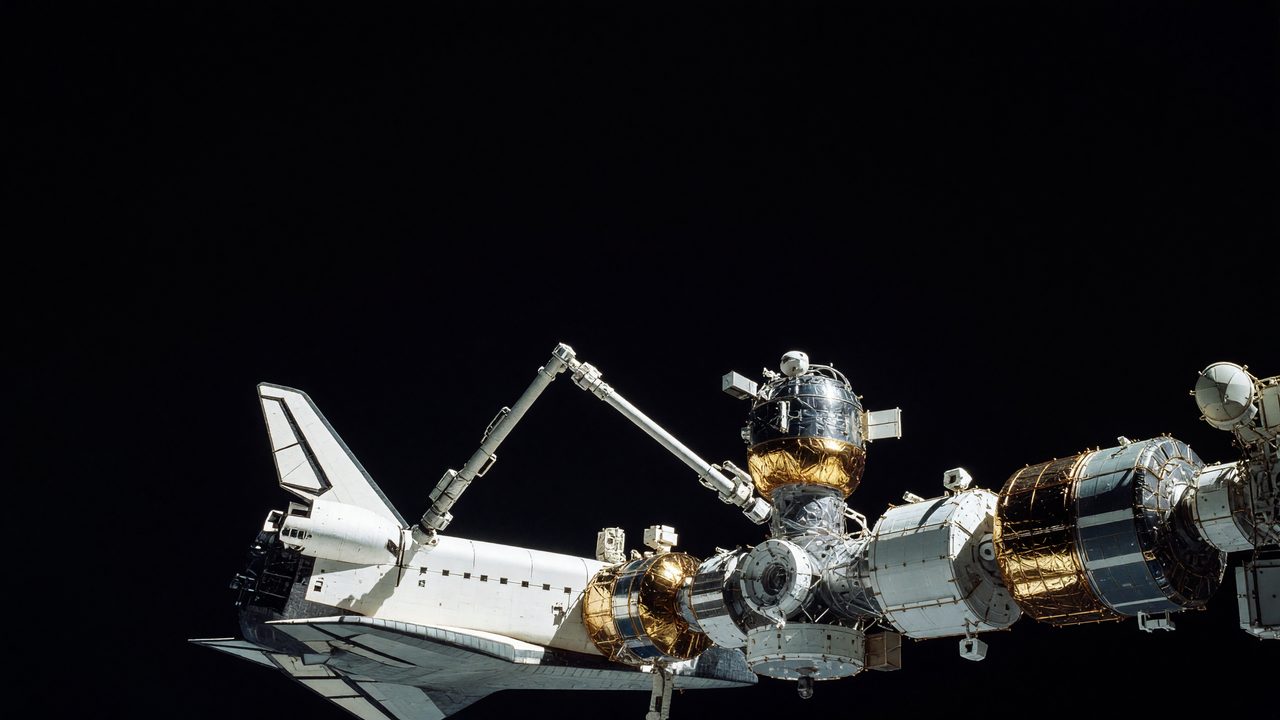
Two days after launch, on 6 December, Endeavour closed on Zarya. Currie took the controls of the shuttle’s 50-foot Canadarm robotic arm. Because Unity blocked the crew’s direct view of the Russian module, Cabana flew the final approach using television monitors and the Orbiter Space Vision System—an optical alignment aid tested on earlier shuttle missions. Cabana positioned Endeavour within about 10 meters (roughly 33 feet) of Zarya before capture. Currie grappled the Russian module and lowered it onto Unity’s Pressurized Mating Adapter. Engineers in Moscow and Huntsville had designed and built the two elements thousands of miles apart. They had never been joined on the ground. In orbit, they fit.
Three Spacewalks, One Foothold
The work was only beginning. Over the next several days, Ross and Newman conducted three spacewalks—one every other day—to transform two separate spacecraft into a single structure. On the first excursion, they attached umbilicals and connectors between the mating adapters, Unity, and Zarya. Ground controllers in Houston and Moscow verified command paths to the Russian module. On the second, the astronauts routed additional cabling and, for the first time, entered the linked modules through the orbiter’s docking mechanism, installing portable fans, lights, and components of the early communications system. The third spacewalk disconnected jumper cables, secured final connectors, and stowed toolboxes on Unity’s exterior for crews yet to come.
When Endeavour undocked, it left behind an embryonic station: less than 200 cubic meters of pressurized volume and a fraction of the electrical power that would one day flow through the completed truss. Yet the achievement was foundational. Two nations had launched the first elements of a permanent human outpost in space. Assembly would continue for thirteen more years and more than forty launches. In November 2000, Expedition 1—Shepherd, Krikalev, and Gidzenko—would arrive to begin continuous habitation. But the chain started here, in the last weeks of 1998, when Sunrise met Unity and the first link held.
Why it matters to you
The legacy of Zarya and Unity reaches into every cockpit where pilots train for precision under pressure. Cabana’s final approach to an unseen target, flown on instruments and verified cross-checks rather than direct visual contact, is the orbital equivalent of disciplined IFR flying: when the view through the window is inadequate, trust your procedures, your displays, and your crew. The STS-88 team split roles across commander, robotic-arm operator, and spacewalkers the way a well-run flight deck divides navigation, communication, and aircraft control. International partners who had once aimed missiles at each other now shared checklists and mission control loops—a lesson in crew resource management that translates directly to multi-crew operations in commercial and airline aviation. The largest international construction project in history began not with a hammer, but with the painstaking verification that separately built pieces would work as one system. That habit of assuming nothing until it is tested—on the ground, in the sim, or in the air—remains the standard every rated pilot carries forward.