Twenty-Six Hours Alone Over the North Atlantic
"August 20, 1998"
Twenty-Six Hours Alone Over the North Atlantic
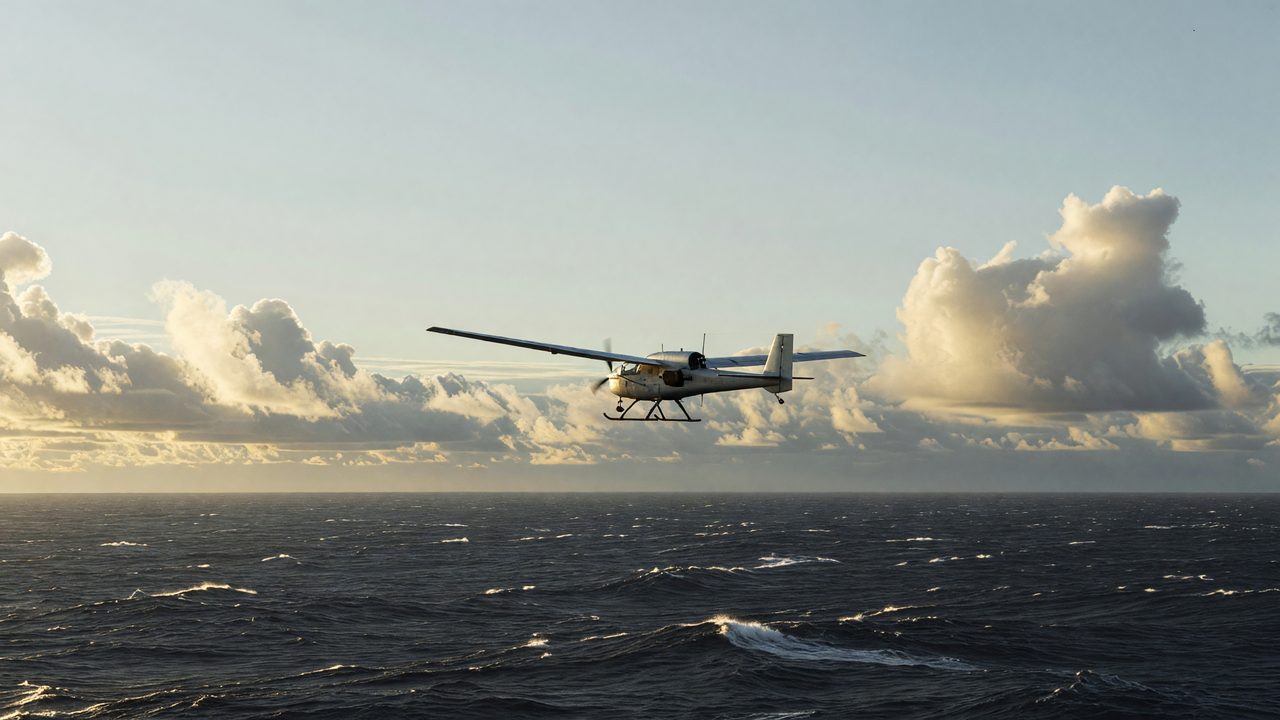
In August 1998, a 29-pound robot airplane named Laima crossed the ocean on GPS and autopilot—proving that long-range flight does not always require a cockpit.
The Aerosonde was never meant to carry a pilot. Developed over three years by The Insitu Group of Bingen, Washington, and Environmental Systems and Services of Melbourne, Australia, the aircraft was built under primary sponsorship from the Australian Bureau of Meteorology Research Center for meteorological research and long-range environmental monitoring. Field trials had already sent the small airframe off the coasts of Western Australia, Vancouver Island, and the South China Sea. By 1998, engineers believed the concept was ready for a harder test: the same cold, crowded airspace that had defined transatlantic aviation since Charles Lindbergh’s 1927 solo.
The machine that would make history was slight even by light-aircraft standards. Laima weighed 29 pounds, spanned 10 feet, and drew power from a single-cylinder piston engine. NASA’s later technical summary of the Mk 4.3 Aerosonde family notes that on the Atlantic crossing the aircraft burned only a fraction of its modest fuel load—roughly four kilograms from a five-kilogram tank, a consumption rate that would have been unthinkable in a manned crossing. The transatlantic demonstration itself drew support from Boeing, L-3 Communications, the U.S. Office of Naval Research, and weather agencies in Canada, Australia, Taiwan, and the United States, but the aircraft’s original purpose remained firmly rooted in science: gathering weather data where ships and crewed aircraft could not efficiently go.
Success did not come on the first attempt. According to the University of Washington’s contemporaneous account, two Aerosondes launched earlier in the week failed—one crashing within a minute of takeoff, another disappearing somewhere over the Atlantic. On the morning of August 20, 1998, a third aircraft took off from Bell Island Airport near St. John’s, Newfoundland, at 7:29 a.m. local time. University of Washington professor Juris Vagners had named this survivor Laima, after the Latvian goddess of good fortune. The nickname proved apt.
What followed was the part that should unsettle any pilot’s intuition about what “flying an airplane” means. Ground crews tracked Laima by computer for only about 25 miles along its northeasterly route before the aircraft passed beyond normal radio communication range. From that point until the Scottish coast, it was on its own. Onboard GPS and an autopilot steered the machine along a pre-programmed path toward the Benbecula Military Range in the Outer Hebrides. BBC reporting from the landing site described an average groundspeed near 76 miles per hour and a cruise altitude around 1,800 meters—high enough to reduce icing risk and stay clear of much manned traffic, low enough to keep a 29-pound airframe in workable air. For roughly 26 hours, Laima crossed roughly 2,000 miles of North Atlantic sky without a human hand on the controls.
Contact returned near the end. Engineers picked up Laima’s signal about 25 miles off the Scottish coast and assumed manual remote control, guiding the aircraft with a joystick much like a sophisticated radio-controlled model. Twenty-five minutes later, at about 1:40 p.m. local time on August 21, Laima settled into a grass field on South Uist. Insitu’s Bill Vaglienti told the BBC the arrival was on schedule and uneventful. The University of Washington announcement framed the achievement in blunt historical terms: the first transatlantic crossing by an unmanned airplane, and the smallest aircraft of any kind known to have made the passage.
The flight did not end debate about autonomous aircraft, nor should it have. Two sisters had already been lost. Regulatory officials, air traffic controllers, and meteorologists on both sides of the ocean had to clear a path for a machine that could not answer a radio call for most of a day. Yet the principle was established. Aerosonde project leaders argued that long-endurance, low-cost aerial platforms could extend weather reconnaissance beyond the limits of crewed flight. Within a year, collaborators planned Pacific Northwest demonstration flights aimed at improving forecasts. NASA’s archival aircraft record still cites the 1998 crossing as the first transatlantic UAV flight—autonomous guidance by autopilot and GPS across more than 1,700 nautical miles.
Why it matters to you
Laima’s Atlantic crossing is easy to file under “history” and forget in the pattern—but the operational logic behind it is the same logic you train for every time you brief a long cross-country. The aircraft did not wander; it followed a defined route, managed energy and altitude for weather and traffic, and operated for hours beyond direct human contact before handoff for arrival. Modern pilots still live inside that framework: precise navigation, disciplined fuel planning, altitude selection for conditions, and the moment when automation ends and a human assumes control for the landing phase. Whether you are hand-flying a Cessna, following a flight management system across an IFR airway, or monitoring a remotely piloted system from the ground, the lesson from 1998 holds. Reliable flight is less about romance and more about preparation, redundancy, and knowing exactly when the machine is flying the plan—and when you must take the stick.