Twenty-One Sorties — Or One Hundred Thirty-Seven
"Night hunter of the Reich"
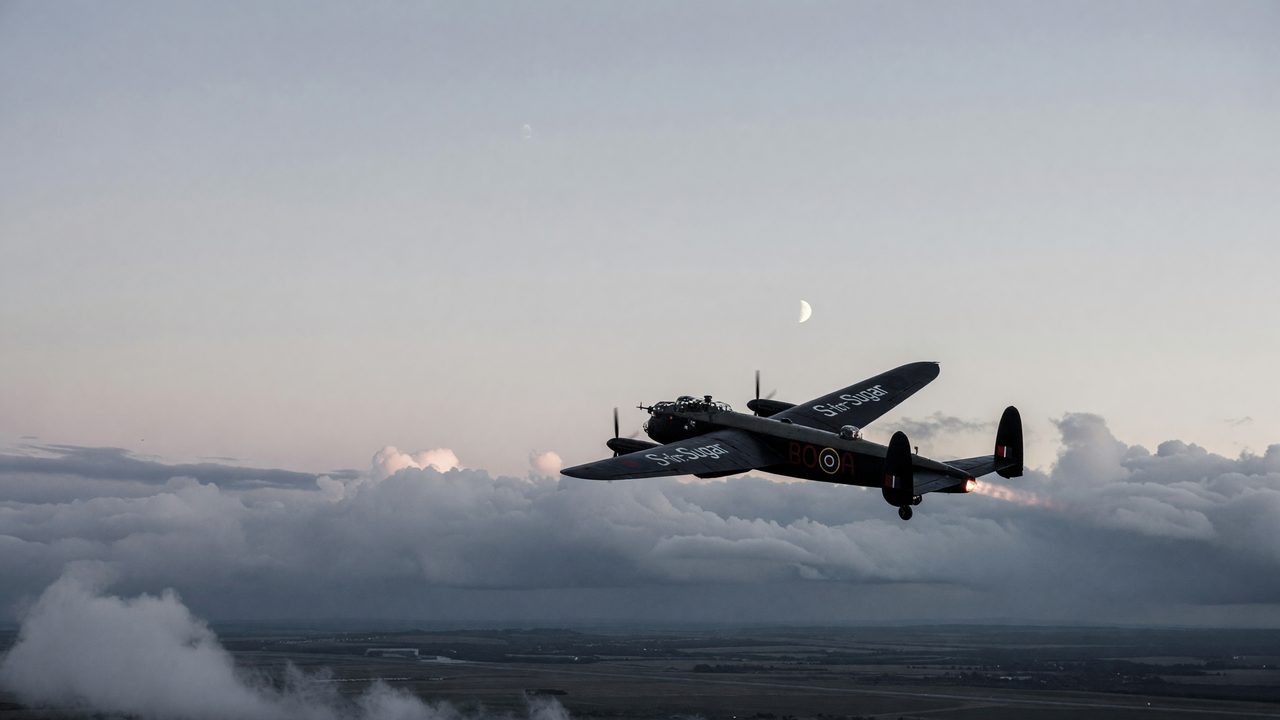
Twenty-One Sorties — Or One Hundred Thirty-Seven
Britain’s Avro Lancaster carried the night war deep into occupied Europe. One airframe outlived the grim arithmetic of Bomber Command by a factor of six — and still teaches pilots what endurance really means.
The Machine That Made the Night Offensive Possible
When aircrews spoke of “the Lanc,” they meant a purpose-built instrument of industrial warfare. Designed by A.V. Roe and built in factories including Metropolitan-Vickers, the Avro Lancaster B.Mk.I married four Rolls-Royce Merlin engines to an unusually spacious bomb bay. That bay could accept loads up to 22,000 pounds — enough to haul the standard “cookie” blockbuster, naval mines, conventional bomb loads, or Barnes Wallis’s cylindrical “Upkeep” mine, the weapon that bounced across the Ruhr reservoirs on the famous dam raids. Where earlier British heavies had been compromised by design compromises, the Lancaster was straightforward: a strong airframe, reliable power, and volume where it counted.
From 1942 onward, Lancasters became the backbone of RAF Bomber Command’s night offensive. They ranged from Wilhelmshaven on the North Sea coast to Berlin, Stuttgart, and Genoa; they struck submarine pens at Lorient and Saint-Nazaire and, as the invasion approached, targets along the Normandy coast. By the war’s end, thousands of Lancasters had contributed a substantial share of the command’s total bomb tonnage dropped on Germany and occupied territory. The type’s legend was earned in darkness, at altitudes where navigation, fuel discipline, and crew coordination mattered as much as raw courage.
Sugar’s Impossible Ledger
Statistics from the RAF Museum’s collections records tell the story in one brutal comparison: the average Lancaster survived roughly twenty-one operational sorties. Aircraft R5868, serial number 7325M, flew one hundred thirty-seven.
Delivered to No. 83 Squadron at RAF Scampton in June 1942, the bomber entered service as “Q for Queenie.” Its first operation came on 8 July against Wilhelmshaven. Three days later it participated in a raid on Danzig — then among the most distant targets Bomber Command had attempted. Over the following months Queenie raided cities whose names filled communiqués: Cologne, Stuttgart, Dortmund, Düsseldorf, Münster, Berlin. It struck French Atlantic ports and, on 6 November 1942, crossed the Alps to drop a 4,000-pound bomb on Genoa. Later, while assigned to the Pathfinder Force operating from RAF Wyton, it helped mark targets for the main force streaming in behind.
In late 1943, after overhaul, R5868 joined No. 467 Squadron, Royal Australian Air Force, at RAF Waddington and became “S for Sugar.” Crews rotated through the airframe; ground crews painted a bomb silhouette on the nose for each completed sortie, and pilot names accumulated on the engine cowlings. Beneath the port windows, someone inscribed Hermann Göring’s boast — that no enemy aircraft would fly over Reich territory — without comment, letting the tally of bombs speak for itself. The aircraft earned recognition for the aircrews who flew it: emblems for a Distinguished Service Order and three Distinguished Flying Crosses appear on its fuselage, according to museum and archive records.
Narrow Escapes and the Last Raid
Sugar’s survival was not a matter of avoiding combat. IBCC Digital Archive material compiled from squadron histories notes that enemy action caused only minor damage over the course of its career. Some of the worst moments came from chaos in the sky: on 14 September 1942, returning from Wilhelmshaven, gunfire from the rear turret of another four-engined bomber — almost certainly a friendly twin-fin heavy bomber such as a Handley Page Halifax, not a Lancaster — wounded the wireless operator. In November 1943, returning from Berlin, Flying Officer J.A. Colpus’s aircraft collided with another Lancaster; Sugar entered a severe diving turn before trim and control pressure restored level flight. The squadron diary reportedly quipped that in this kite, “the pilot and navigator go to sleep coming home, for it knows its own way back from almost any target.”
On 11 May 1944, Sugar completed its hundredth operation against Bourg Leopold in Belgium. Personnel at Waddington stayed up to toast the milestone. The celebration was nearly premature: in nine and a half minutes, two Junkers Ju 88 fighters pressed ten attacks. Coordinated evasive action brought the bomber home unscathed. Its final wartime sortie came on 23 April 1945 against shipping in Flensburg harbour; thick cloud prevented bomb release. Four months later, Bomber Command selected the aircraft for preservation — a rare honour for a type usually consumed entirely by the war.
Today R5868 hangs in the RAF Museum’s London site, one of the most significant survivors of the Second World War. Its individual history, documented in the museum’s collections file on Lancaster R5868, preserves not only metal and Merlins but the arithmetic of a command that measured success in tonnage and survival in sorties.
Why it matters to you
The gap between twenty-one sorties and one hundred thirty-seven is not explained by a single lucky charm. RAF Museum and IBCC records point to a combination modern flight training still emphasizes: meticulous maintenance that returned a repeatedly patched airframe to the line; crew resource management sharp enough to defeat ten fighter passes in minutes; disciplined navigation and recovery procedures that brought damaged aircraft home from Berlin and Wilhelmshaven; and the humility to treat friendly-fire near misses as lessons rather than anecdotes. Today’s pilots will never face flak over the Ruhr, but the same professional habits — knowing your aircraft’s systems, trusting your crew’s coordination, flying the procedure when the aircraft is trimmed wrong and the night is full of traffic — separate crews who merely complete a flight from those who bring an airplane back again and again. Sugar survived not because the Lanc was invulnerable, but because people treated every sortie as if the average still applied.