Twelve Seconds at Kitty Hawk, a Lifetime of Engineering
"December 17, 1903"
Twelve Seconds at Kitty Hawk, a Lifetime of Engineering
The photograph from December 17, 1903, fixed one moment in the American imagination. The Wright brothers’ real monument was the disciplined work that turned a proof of concept into a flying machine the Army could buy—and the hard lesson that followed when flight met failure.
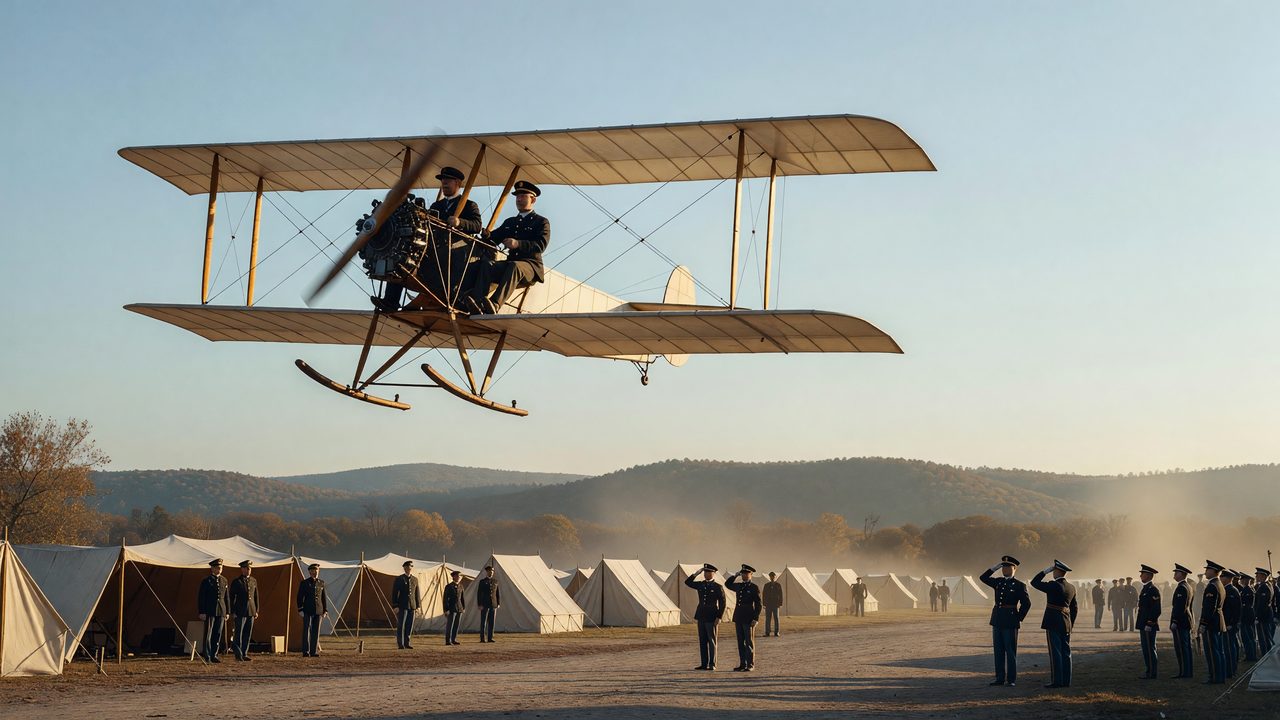
Most pilots know the image before they know the story. In the Library of Congress Wright Papers sits the original glass-plate negative of the first powered flight at Kitty Hawk, North Carolina, taken at 10:35 a.m. on December 17, 1903, and deposited in 1949. Orville lies prone at the controls of the 1903 Flyer; Wilbur runs at the wingtip, steadying the machine as it lifts into a headwind above the Outer Banks. The flight lasted twelve seconds and covered roughly 120 feet. It was not a stunt. It was the opening argument in a case the brothers would spend years proving in wind tunnels, on practice fields, and before skeptical military officers.
From Proof to Specification
Kitty Hawk answered whether a heavier-than-air machine could generate enough lift and control to fly under its own power. What remained was whether flight could be repeated, scaled, and sold. In December 1907, the U.S. Army Signal Corps issued Specification No. 486, later published in the Wright Brothers.org archives. The government wanted a flying machine that could carry two men, sustain flight for one hour, average forty miles per hour, and demonstrate a range of 125 miles. That document turned aviation from a coastal experiment into a procurement problem with measurable thresholds—speed, endurance, payload, and reliability.
Wilbur crossed the Atlantic to demonstrate in France while Orville brought the Wright Model A to Fort Myer, Virginia, in 1908. According to the U.S. Centennial of Flight Commission chronology for that year, the Fort Myer flights were the Wrights’ return to public demonstration and the direct fulfillment of Army requirements. Orville flew before crowds that had read newspaper accounts of European triumphs and still wondered whether American inventors could meet a written contract. On September 9, 1908, he set a world endurance record of more than one hour aloft—evidence that controlled flight was no longer a single lucky gust over sand but a sustained operational capability.
When Flight Became Operational—and Deadly
A week later, flight collided with its first fatality in a powered aircraft. On September 17, 1908, while Orville flew with Army observer Lt. Thomas E. Selfridge aboard, a propeller fracture led to a crash at Fort Myer. The U.S. Army’s “First United States Army Aircraft Accident Report” documents Selfridge’s death—the first person killed in a powered airplane—and Orville’s serious injuries. The machine that had satisfied endurance requirements one week earlier had failed in a way no specification fully anticipated: a structural fracture propagating through a rotating component under load.
The accident did not end Army interest. It forced the conversation from whether airplanes could fly to how they would be inspected, maintained, and flown when lives depended on every part. Selfridge’s death sits at the root of the modern safety culture pilots inherit: every preflight walkaround, every AD, every cautious reading of a trend in maintenance logs echoes a century-old propeller crack at an Army parade ground.
Two Brothers, One Method
Wilbur’s European demonstrations and Orville’s Fort Myer campaign shared a method the brothers had refined since their bicycle shop days in Dayton: define the problem, measure variables, build, test, revise. They did not treat Kitty Hawk as a finish line. They treated it as data. Wing warping gave way to more refined control systems; engine power increased; airframes grew strong enough for passengers and military observers. The legacy is not romantic daring alone. It is the insistence that flight must be demonstrated under stated conditions until observers who did not witness North Carolina in 1903 could still be convinced by repeatable results in Virginia in 1908.
Why it matters to you
When you brief a lesson or run a checklist before takeoff, you are standing in a line that runs from a grainy photograph on the Outer Banks to a specification written in Washington and a crash report filed at Fort Myer. The Wright brothers’ image endures because it is simple; their legacy endures because it was systematic. Modern training asks you to do what they did after December 17: treat the spectacular moment as the beginning of disciplined habit. Know your aircraft’s limits as plainly as Signal Corps Specification No. 486 stated them. Fly to performance standards, not to applause. And when something feels wrong—a vibration, a sound, a gauge trend—remember that the first Army aircraft accident report was written because a propeller failed in flight with an observer aboard. The photograph at Kitty Hawk belongs to aviation culture. The chronology of 1908, the contract requirements, and the accident report belong to you every time you decide whether the flight is still a go.