Through the Invisible Wall
"000 feet"
Through the Invisible Wall
On a cold Mojave morning in 1947, a wounded test pilot and a rocket plane named for his wife proved that Mach 1 was not a ceiling—but a doorway.
The Mojave Desert dawned bright and cold on October 14, 1947. At Muroc Army Air Field—today’s Edwards Air Force Base—the postwar American flight-test community had gathered around a problem that wartime engineering could describe but not yet solve. Compressibility, the stiffening of airflow as an aircraft approached the speed of sound, had killed pilots and destroyed prototypes during World War II. Propeller-driven fighters had hammered against aerodynamic limits in dives; captured German data hinted at swept-wing answers, but no Allied airplane had yet flown faster than sound in level, controlled flight. The Army Air Forces and the National Advisory Committee for Aeronautics had bet on a different approach: a purpose-built research aircraft, dropped from a bomber like a bomb, powered not by a piston engine but by rockets.
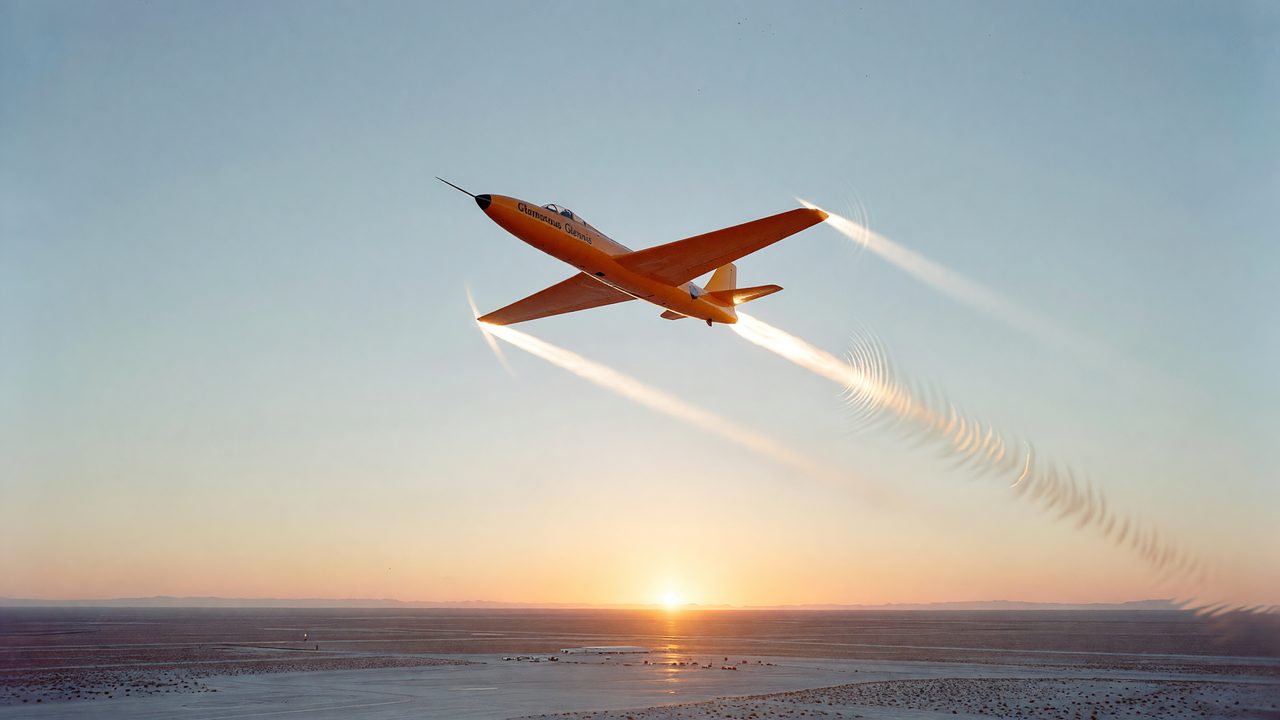
That morning, a small orange airplane—Bell’s XS-1, shaped like a .50-caliber bullet with thin straight wings—was hoisted into the bomb bay of a Boeing B-29. Captain Charles E. “Chuck” Yeager, a twenty-four-year-old West Virginia native who had shot down eleven enemy aircraft as a P-51 pilot in Europe, would fly it. Two days earlier he had broken two ribs in a horseback riding accident. He told almost no one. Only his friend and project engineer, Captain Jack Ridley, knew—and only Ridley would help him close the XS-1’s hatch, fashioning a broom handle so Yeager could latch the door with his injured side. Inside the cramped cockpit, Yeager settled into the ship he had named Glamorous Glennis for his wife.
The XS-1 carried a Reaction Motors XLR-11 rocket engine with four chambers. Earlier powered flights at Muroc, documented in Air Materiel Command summaries later analyzed by aeronautical historians and engineers, had exposed a terrifying pattern: as Mach 1 neared, shock waves forming over the horizontal tail rendered the elevator nearly useless. Pitch control—the pilot’s most basic authority over the aircraft—began to disappear. Many experts spoke of a “sound barrier,” as though some physical wall might shatter an airframe. Yeager and Ridley studied the data and proposed a practical workaround: ignore the elevator and fly the moveable horizontal stabilizer instead, trimming it in small, deliberate increments to maintain pitch without fighting the shock-induced blanking. It was not elegant theory. It was test-pilot engineering—born in briefing rooms and maintenance hangars, written into the aircraft’s operating logic.
At 10:26 a.m., Glamorous Glennis fell away from the B-29 at 20,000 feet. Yeager fired his rocket chambers and climbed. His own “Pilot’s Notes from the Ninth Powered Flight of the XS-1,” preserved at the National Archives and Records Administration, record the methodical discipline of the run: a steady push upward, chambers lit and shut down according to plan, the Machmeter’s needle advancing through the high subsonic band. He leveled near 42,000 feet and relit a third chamber. Ground and airborne voices—reproduced from the October 14 communications transcript held in the National Air and Space Museum’s X-1 files—tracked his progress in terse, professional cadence. The instrument read 0.98, then 0.99. At 43,000 feet the needle jumped past the end of its calibrated scale. Yeager had crossed into supersonic flight.
His reported top speed was Mach 1.06—about 700 miles per hour at that altitude. The event that engineers had feared might tear an airplane apart proved, on this flight, almost anticlimactic: no violent buffeting, no loss of control. The sky did not explode; the wings did not fold. NASA’s historical survey Research in Supersonic Flight and the Breaking of the Sound Barrier (SP-4219), drawing on contemporaneous Muroc Flight Test Unit reports, places the achievement inside a sustained research program—not a single lucky sprint, but the ninth powered flight of a methodical investigation. The world would not hear of it immediately. The flight remained classified until June 1948. When the Collier Trophy citation finally appeared, it called the feat “an epochal achievement in the history of world aviation—the greatest since the first successful flight of the original Wright Brothers’ airplane, forty-five years ago.”
Why it matters to you
The operational principles demonstrated that Mojave morning still shape how pilots are trained to think about control authority. Yeager did not wrestle a mythical barrier with brute force; he changed which surface he flew when the aerodynamic environment made the usual one unreliable. That is the same discipline you practice when you learn which control to lead with in different configurations—trimming for steady state, making small deliberate inputs rather than large reactive ones, and trusting instrumentation while cross-checking seat-of-the-pants feel. Compressibility is no longer a mystery to modern designers, yet the lesson of October 14, 1947, endures: at the edge of the envelope, precise aircraft handling and a clear understanding of why a control works—or suddenly does not—separate a manageable flight from a hazardous one. Every time you brief a high-altitude flight, study pitch stability, or practice recovering from an unusual attitude, you are standing in a lineage that began with a broom-handle latch, a horizontal tail used as a lifeline, and a cold desert dawn when Mach 1.06 rewrote what pilots believed possible.