Three Wings, One Urgent Answer
"Three wings, one legend, and a cockpit full of gyroscopic torque"
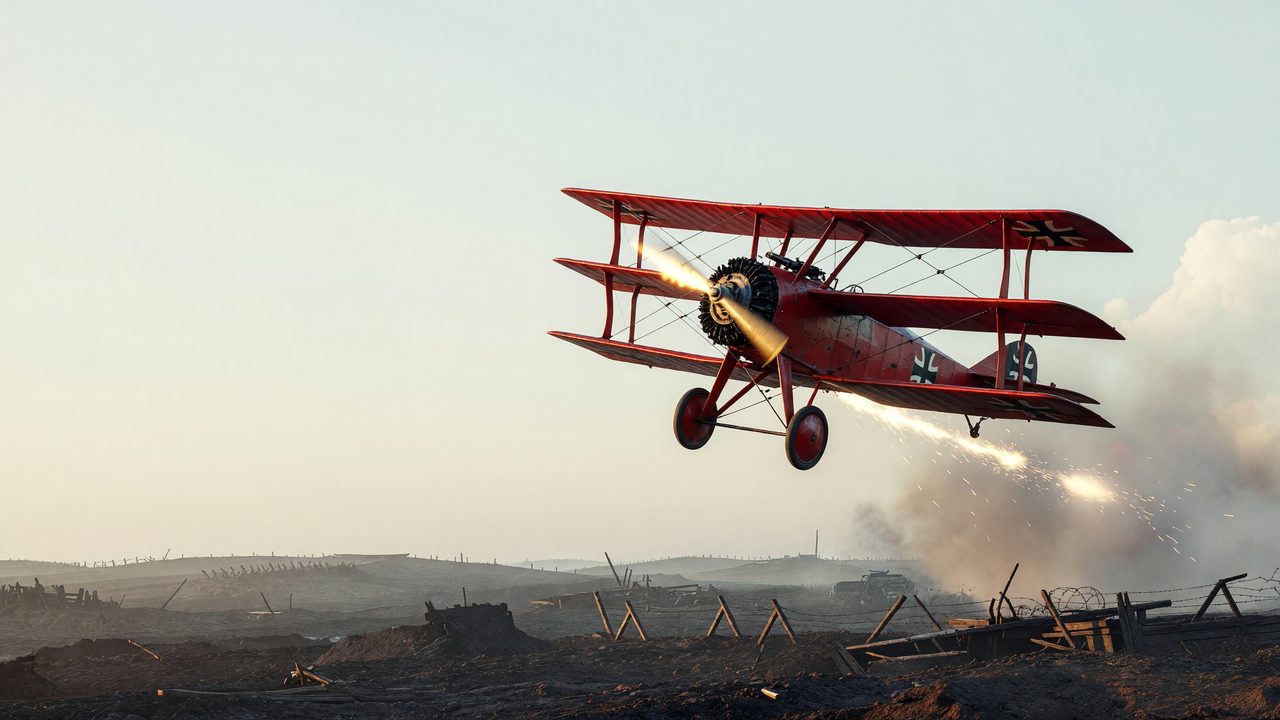
Three Wings, One Urgent Answer
When Allied triplanes seized the vertical battlefield in 1917, Anthony Fokker demanded a German reply—and Reinhold Platz delivered a machine so agile it would define the Red Baron’s final year, at a price measured in fractured spars and fallen pilots.
In April 1917, Royal Naval Air Service Sopwith Triplanes appeared over the Western Front and rewrote the geometry of air combat. German scouts that had held their own against British and French biplanes suddenly found themselves out-climbed and out-turned by aircraft that seemed to pivot on a pin. Pilots reported that the new enemy machines could hang above them, stall-turn into firing position, and vanish upward before a counter-attack could form. The tactical advantage of altitude—the currency of survival in 1917—had shifted overnight.
That same month, Anthony Fokker visited Jagdstaffel 11 and saw the problem firsthand. He returned to Schwerin with a blunt instruction to his chief designer, Reinhold Platz: build a triplane. What followed was not reverse engineering. Platz had never examined a Sopwith. Working from Fokker’s brief and his own engineering instincts, he produced an entirely original airframe. The prototype V.4 lifted off on 5 July 1917. After structural refinement, it emerged as the Dr.I—a compact rotary-powered fighter built around a welded steel-tube fuselage, horn-balanced ailerons, and a top wing of cantilevered plywood box-spar construction that eliminated the forest of bracing wires vulnerable to gunfire.
The first two pre-production aircraft, designated F.I, reached the front in late August. Manfred von Richthofen took up F.I 102/17 on 1 September and never looked back. Fellow pilot Werner Voss, flying another early machine, demonstrated the type’s ferocity almost immediately, claiming ten victories in six days that September. In the hands of skilled Jagdflieger, the Dreidecker climbed with startling authority and turned inside nearly everything it met. Twin synchronised Spandau machine guns gave it a concentrated forward punch. Richthofen later described it as climbing “like a monkey” and manoeuvring “like the devil.” Museum records and contemporary accounts agree: this was not a fast aeroplane in level flight, but in the close, swirling combat of 1917, vertical performance and agility were often worth more than top speed.
Yet the Dr.I carried a fatal contradiction in its structure. The same lightweight wing that made the triplane so responsive proved dangerously fragile. In late October 1917, Leutnant Heinrich Gontermann and Leutnant Pastor were killed when their upper wings stripped away in flight. The Inspectorate of Flying Troops grounded the entire type while Fokker investigated. Examination traced failures to inadequate rib construction and weak spar attachment at the wing roots—defects correctable through redesign and reinforcement, not fundamental aerodynamic flaws. Production resumed after strengthening, but only 320 Dr.Is had been completed by May 1918. The type never fully shook the shadow of those autumn deaths.
Richthofen scored nineteen of his final victories in the triplane before he was shot down and killed while flying one on 21 April 1918. By then the Dr.I’s moment had already passed. Faster Allied fighters were arriving in numbers, and the Oberursel rotary that powered most examples was nearing obsolescence. Franz Hemer, who flew the type operationally, recalled stunt-flying through loops and rolls with perfect confidence in its handling—then acknowledged why Germany moved on: it was magnificently manoeuvrable, but no longer fast enough. The Dr.I was a superb fighting machine in the climb and the turn, hesitant in the dive, and forever suspicious of its own wings.
Why it matters to you
The Dr.I’s month-long grounding in late 1917 is a case study in operational risk assessment that every pilot recognises in modern form. The Idflieg did not return a structurally troubled aircraft to combat because it ignored the danger. Fokker’s investigation identified specific, remediable failure modes—rib structure and spar attachment—and the factory implemented corrections before the type flew again. German commanders also faced a battlefield reality: without a high-climbing, highly manoeuvrable scout, Jagdstaffeln would continue losing the vertical fight the Sopwith Triplane had opened. The corrected Dr.I offered capabilities no contemporary German biplane could match, and experienced pilots like Richthofen and Voss had already proved what it could do. The decision was not blind optimism but a wartime calculation that verified fixes, imposed inspection regimes, and accepted residual risk in exchange for tactical necessity. Today, when you evaluate an aircraft’s airworthiness after a directive, a service bulletin, or a manufacturer’s recommended inspection, you are practising the same discipline: understand the failure mode, confirm the remedy, weigh remaining risk against operational need, and never confuse affection for an aeroplane with evidence that it is safe to fly.