Three Times Around: Glenn and Friendship 7
"4 hours"
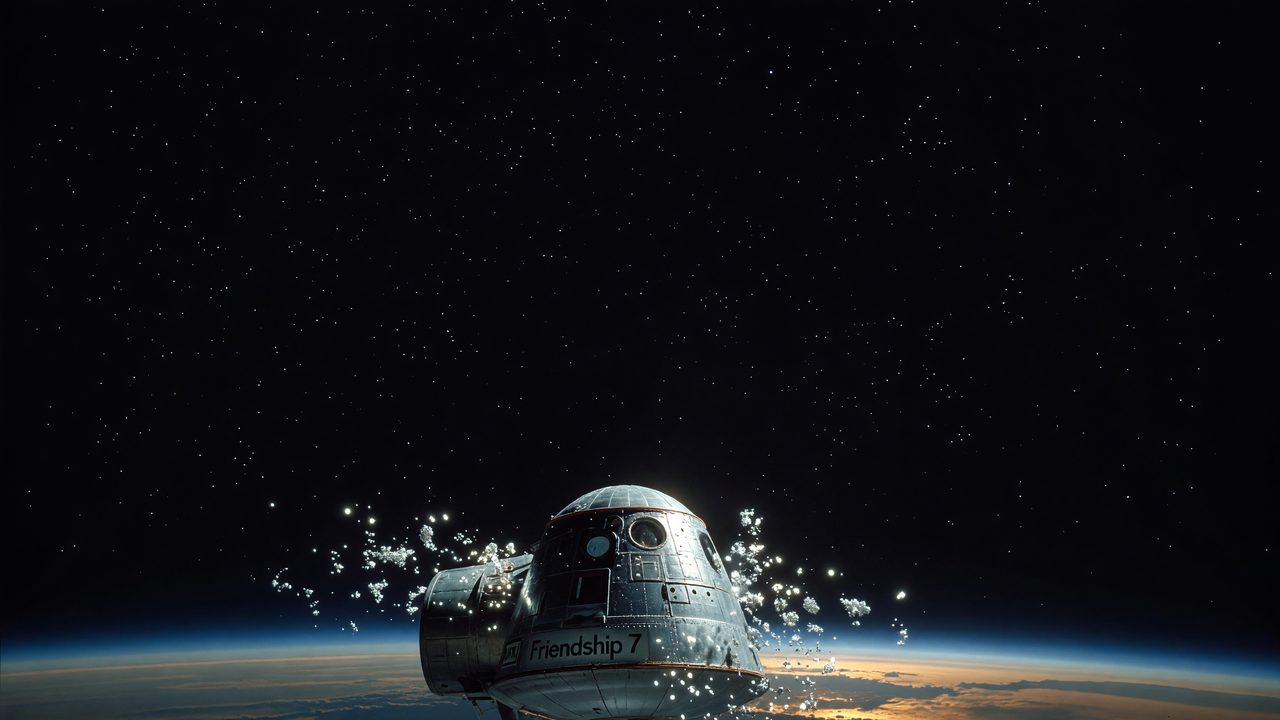
Three Times Around: Glenn and Friendship 7
On a February morning in 1962, a Marine test pilot strapped into a capsule no larger than a phone booth and proved that an American could not only reach orbit, but fly through it—and home again.
The Space Race was no longer theoretical when John H. Glenn, Jr. climbed aboard Friendship 7 at Cape Canaveral. The Soviet Union had already sent Yuri Gagarin around the world in April 1961. Alan Shepard’s suborbital hop the following month had shown American hardware could work, but it had not closed the orbital gap. Project Mercury existed to answer a harder question: could a pilot survive sustained weightlessness, operate a spacecraft across multiple orbits, and splash down where planners intended? Glenn, one of the original Mercury Seven, would be the man to find out.
Launch day tested patience before it tested skill. Weather and technical holds scrubbed earlier attempts. On February 20, Glenn entered the capsule well before liftoff and remained harnessed inside for nearly four hours while engineers worked through last-minute checks. At 9:47:39 a.m. EST, the Atlas booster beneath MA-6 finally ignited and Friendship 7 climbed into a sky that had made the nation wait. Within minutes, Glenn became the first American to orbit Earth.
The flight plan called for three circuits of the planet in 4 hours, 55 minutes, and 23 seconds. What NASA’s post-flight report documented was a pilot who remained alert, oriented, and useful in an environment no American had yet experienced. Glenn reported that weightlessness was not debilitating but exhilarating. He squeezed applesauce from a tube, monitored systems, and watched luminous particles drift past his window—ice crystals shed from the spacecraft, which he likened to fireflies. Below, continents and oceans swept past at roughly 17,500 miles per hour. Above, the black of space pressed against a thin, brilliant horizon. For the first time, a U.S. astronaut was not merely visiting the edge of space; he was living inside an orbit.
The mission’s drama arrived in two episodes that would define piloting under pressure for decades. During the first orbit, a yaw attitude-control jet failed, forcing Glenn to abandon automatic attitude control and fly manually using the capsule’s electrical fly-by-wire system. He held orientation with hand controller inputs while the automatic system he had trained to trust was, for that stretch, unusable. Later, a sensor indicated that the retropack clamp securing the heat shield might have released prematurely—a reading that, if true, could have doomed reentry. Mission controllers at Cape Canaveral, working through the Mercury Control Center network, instructed Glenn to retain the retropack through atmospheric entry so its straps might help hold the shield in place. Glenn complied. Post-flight analysis showed the heat shield had never been in jeopardy; the sensor had lied. The precaution was unnecessary, but it was exactly the kind of conservative call that keeps experimental flight programs alive.
Reentry brought deceleration, heat, and radio blackout. When Friendship 7 emerged from the plasma sheath and its parachutes deployed, the destroyer USS Noa reached the spacecraft 21 minutes after splashdown, roughly 800 miles southeast of Bermuda. Glenn was hoisted aboard, examined, and declared fit. With that recovery, Project Mercury achieved the goal stated at its founding: orbit a man, observe his performance, and return him safely to a predetermined point on Earth.
Why it matters to you
Glenn’s nearly four hours on the pad before launch is a lesson every pilot knows in smaller form: the hardest part of a flight is sometimes waiting while conditions, paperwork, or machinery refuse to cooperate. What mattered was that he stayed ready when the window finally opened. In the cockpit, his yaw-jet failure is the ancestor of every manual reversion you train for when autopilot, trim, or fly-by-wire protections stop behaving. You do not debate philosophy at 17,500 miles per hour; you fly the machine with the mode that works. The heat-shield scare is CRM and aeronautical decision-making in pure form—an ambiguous instrument indication, a calm voice from the ground proposing a backup plan, and a pilot who executed it without panic even though the alarm proved false. NASA’s Mercury-Atlas 6 summary and the Manned Spacecraft Center’s February 1962 flight results read less like space trivia than like a checklist for rated pilots: manage energy and attitude by hand when automation fails, treat sensors as hypotheses until confirmed, coordinate with the team you cannot see, and never confuse catching up with competing. After Friendship 7, American spaceflight was doing both.