Three Strikes, Then a Bullseye
"5 seconds"
Three Strikes, Then a Bullseye
Apollo 12 turned a lightning-scarred launch into proof that precision lunar navigation was repeatable—and that the first Moon landing was no one-time stunt.
Lightning at Liftoff
When Apollo 12 lifted off from Kennedy Space Center on November 14, 1969, rain slicked the pad and clouds hung low over the Florida coast. Thirty-six and a half seconds into the climb, the Saturn V punched through a charged layer of atmosphere and took two lightning strikes in rapid succession. Warning lights flooded the command module Yankee Clipper. Fuel cells dropped offline. Telemetry garbled. For a moment, the second crewed lunar landing looked ready to abort before it had truly begun.
In Houston, flight controller John Aaron recognized the signature of a familiar instrumentation failure. He relayed a terse instruction to Lunar Module Pilot Alan L. Bean: SCE to AUX—Signal Conditioning Equipment to auxiliary. Bean found the switch. Gauges stabilized. The stack kept climbing. What could have ended the mission instead became a case study in crew-resource management—clear diagnosis, immediate action, and trust between cockpit and control room under maximum stress. Commander Charles "Pete" Conrad Jr., Command Module Pilot Richard F. Gordon Jr., and Bean reached orbit and pressed toward the Moon.
A Target in the Ocean of Storms
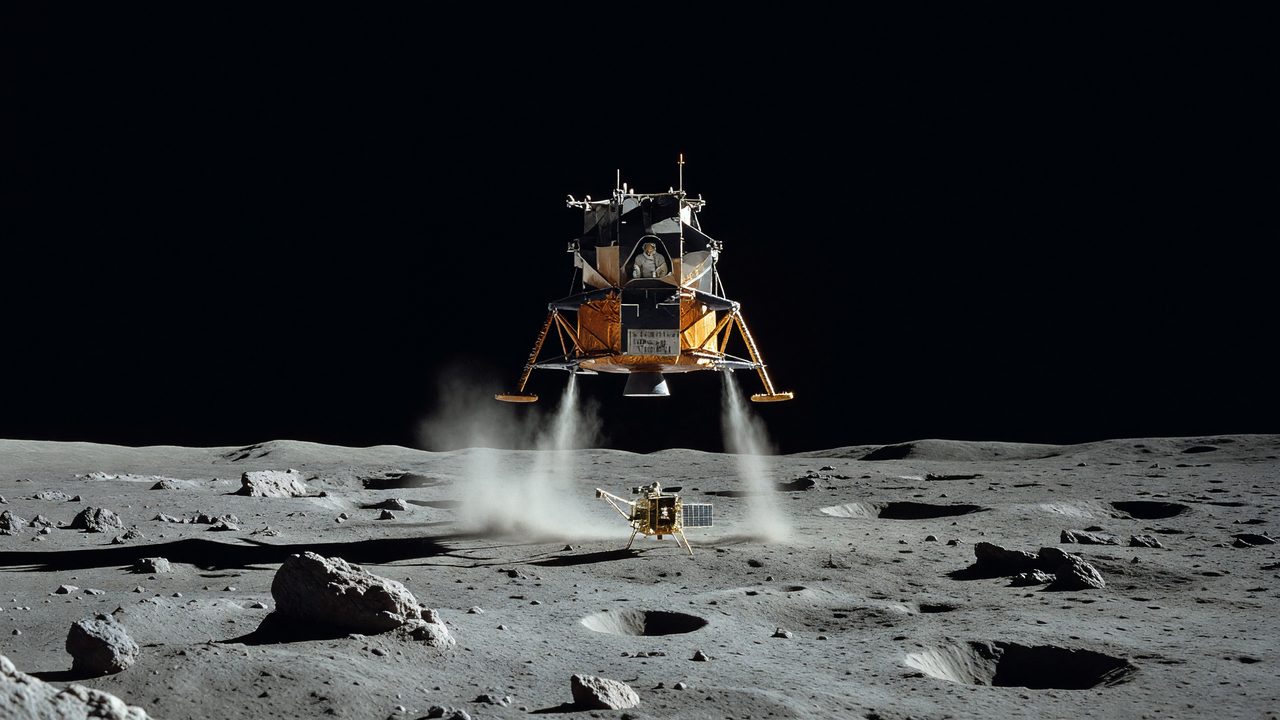
Four months earlier, Neil Armstrong and Buzz Aldrin had proved that humans could land on the lunar surface. Skeptics wondered whether Apollo 11's success owed more to luck than to repeatable technique. Apollo 12 was designed to answer that question with a harder assignment: set the Lunar Module Intrepid down beside a specific object on difficult terrain.
The target was Surveyor 3, an unmanned lander that had touched down in the Ocean of Storms in April 1967. Finding it meant navigating across a mare—one of the Moon's dark volcanic plains—using updated tracking, landmark sightings, and the lunar module's landing radar. On November 19, Conrad took manual control during the final descent, steering around a crater to find a safe patch of ground. When Intrepid settled, the distance to Surveyor 3 measured roughly 538 feet. NASA's Apollo 12 Mission Report, published by the Manned Spacecraft Center in March 1970, documented the result: a point landing close enough to walk to a pre-positioned spacecraft waiting in an alien desert.
Conrad's first words on the surface captured the mood: "Man, that may have been a small one for Neil, but that's a long one for me." The joke was vintage Conrad—light, confident, and grounded in the knowledge that he had just stuck a landing no one had attempted before.
Science on the Surface
While Gordon tended the command module and conducted orbital photography, Conrad and Bean completed two extravehicular activities totaling seven hours and twenty-seven minutes. They deployed the Apollo Lunar Surface Experiments Package (ALSEP)—a suite of geophysical instruments that would continue transmitting data until 1977, long after the crew had returned to Earth. They collected rock and soil samples, documented the mare geology, and photographed the landing site for planners charting future exploration.
On the second excursion, the astronauts crossed the gray dust to Surveyor 3 itself. They photographed the probe, cut away components, and stowed them for the voyage home. Those parts had endured thirty-one months of hard vacuum, temperature swings, and micrometeorite bombardment. Back on Earth, engineers would study how materials weathered in the lunar environment—a practical question for anyone designing hardware meant to survive far from home.
Home Again
Apollo 12 splashed down in the Pacific on November 24, 1969, landing less than four miles from the recovery ship USS Hornet. The precision that had characterized the mission from lunar descent to ocean arrival was no accident. As the NASA History Office noted in its retrospective on the flight, Apollo 12 demonstrated that the program could repeat what Apollo 11 had pioneered—and improve on it.
Why it matters to you
Apollo 12's legacy lives in every cockpit where pilots train to fly a planned profile under pressure. The lightning strike at liftoff was an unscripted emergency; Bean's response was the product of preparation, clear communication, and disciplined checklist discipline—the same triad that governs engine failures, electrical anomalies, and partial-panel approaches today. Conrad's final-phase lunar descent mirrors the piloting task of transitioning from automated guidance to manual control when the situation demands it: scan for obstacles, conserve energy, and put the aircraft—or lunar module—on a precise point. The mission proved that the first Moon landing was no fluke. For aviators, that is the deeper lesson: mastery is not one lucky arrival. It is the ability to reproduce accuracy on demand, in weather that strikes without warning, on terrain that offers no second chance.