Three Flights, Three Rovers, Seventeen Months of Engineering
"J-missions"
Three Flights, Three Rovers, Seventeen Months of Engineering
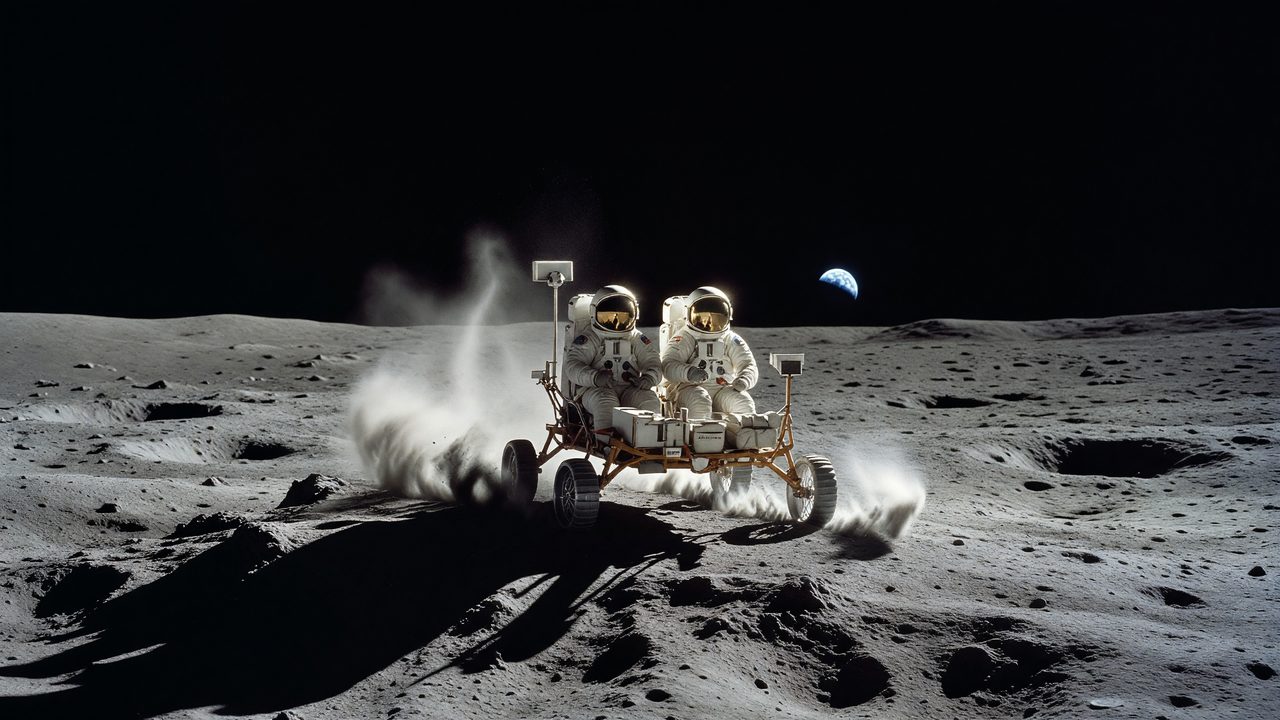
The Lunar Roving Vehicle turned the last Apollo landings from short walks into wide-area field geology—and proved that a machine built for vacuum, dust, and one-sixth gravity could do its job without a single failure.
When NASA redesigned the final Apollo lunar landings as “J-missions,” the objective shifted from simply reaching the Moon to working it. Apollo 15, 16, and 17 would carry more science, longer surface stays, and a vehicle that could carry two suited astronauts, their tools, and collected rock across ground that would have exhausted them on foot. That vehicle was the Lunar Roving Vehicle (LRV): a battery-powered, four-wheeled electric cart developed in roughly seventeen months and flown three times without a mission-ending fault.
Born for the Descent Stage
Boeing served as prime contractor; General Motors Defense Research Laboratories supplied the mobility system. NASA’s Goddard Space Flight Center/NSSDC documentation describes a machine engineered for hard vacuum, extreme temperatures, and lunar gravity—about one-sixth of Earth’s. Weight was the governing constraint. On Earth the rover weighed roughly 460 pounds; on the Moon it weighed about 76–77 lb empty but could carry a maximum payload of about 970 lb (including crew and cargo)—well over ten times its own lunar weight, or roughly twice its Earth weight.
The LRV had to leave Earth inside the Lunar Module’s descent stage, folded into a compact package no larger than the allotted bay. After landing, astronauts released pins and cables; springs and deployment hardware pushed the chassis onto the surface, where the crew unfolded wheels, seats, and controls by hand. NASA’s educational module Exploring the Moon: The Apollo Lunar Roving Vehicle walks through that sequence as a lesson in packaging, human factors, and mechanical reliability: every hinge and latch had to work once, in dust, under pressure, with gloved hands.
The National Air and Space Museum’s qualification test unit record underscores how seriously NASA took that one-shot deployment. The rover on display at the Smithsonian is not a flight article, but it preserves the same wire-mesh wheels, skeletal frame, and instrument console that Scott, Irwin, Young, Duke, Cernan, and Schmitt actually drove.
Driving Hadley, Descartes, and Taurus-Littrow
The first operational drive came on July 31, 1971, during Apollo 15 at Hadley-Apennine. Commander David Scott and Lunar Module Pilot James Irwin unfolded LRV-1 and began traversing the rim country above Hadley Rille—terrain that would have been unreachable in the walk-back limits of earlier missions. Their three excursions totaled about 17.25 miles of driving.
Apollo 16’s John Young and Charles Duke took LRV-2 across the Descartes highlands for roughly 16.5 miles, reaching stations on rugged slopes where core tubes and rake samples could be taken efficiently. On Apollo 17—the last lunar landing—Commander Eugene Cernan and geologist-astronaut Harrison Schmitt drove LRV-3 about 22.3 miles through the Taurus-Littrow valley, stopping at boulders, crater rims, and the Sculptured Hills to build a deep geologic record of a young mare and older highland material mixed together.
Each rover carried a navigation system that updated bearing and range from wheel odometry and a directional gyro, helping the crew find their way back to the Lunar Module across a landscape with few permanent landmarks. Hand controllers provided steering, motor power, and braking; a simple console displayed speed, distance, and heading. NASA’s mission summaries credit the LRV with multiplying the number of sampling stops per EVA and with letting astronauts work farther from their life-support base than ever before.
Eleven Miles Per Hour on Another World
Lunar driving was nothing like an Earth commute. Wheels rode on a wire mesh designed to bite soft regolith without collecting too much dust. Independent electric motors at each wheel delivered torque suited to low traction. Suspension arms allowed the frame to twist over rocks and small craters while keeping all four wheels in contact as often as possible.
Still, speed was modest. On Apollo 17, Cernan and Schmitt reached about 11.2 miles per hour—an unofficial lunar land-speed record, and fast enough that NASA cautioned crews about handling on loose soil. Dust sprayed in straight, low arcs in the absence of air; boulders that looked small from the LM could loom large at rover scale. Every mile driven consumed battery amp-hours and EVA timeline; every stop was a trade between geology, photography, and the walk-back clock implied by remaining oxygen and cooling water.
Across three missions, the rovers performed as designed. That reliability was not accidental. Seventeen months from contract to flight hardware left little margin for redesign; testing, redundancy in drive electronics, and conservative operating limits kept the crews mobile when the science depended on it.
Abandoned on Purpose, Still There
When each crew lifted off, they left their rover behind—too heavy to return, too valuable to regret. LRV-1 rests near Hadley Rille; LRV-2 stands in the Descartes region; LRV-3 remains in Taurus-Littrow, its odometer frozen where Cernan and Schmitt parked it. They are among the few machines humanity has placed on another world and then walked away from on purpose, still waiting in vacuum and sunlight more than five decades later.
Why it matters to you
The J-mission rovers embody systems thinking every pilot trains for: strict weight budgets, single-point procedures that must work the first time, navigation by dead reckoning when external references are thin, and conservative limits derived from test data rather than hope. The same discipline that kept astronauts from outrunning their walk-back constraints lives in your performance charts, fuel reserves, and diversion planning—engineering margins translated into crew decisions. You may never drive wire wheels across a mare, but every time you brief a route, manage energy, and preserve a safe return path, you are applying the lesson Apollo’s last three flights wrote in dust: mobility is only as valuable as the discipline that gets you home.