Three Dollars for Five Minutes in the Air
"Upside-Down"
Three Dollars for Five Minutes in the Air
After the Great War, surplus Jennys and unemployed aviators turned American pastures into the most democratic theater the sky had ever known.
The Government's Gift to the Gypsy Flyers
When the Armistice stilled the guns in November 1918, the United States owned an ocean of airplanes it no longer needed for battle. The Curtiss JN-4 "Jenny" had trained nearly every American military aviator of the war; built at roughly five thousand dollars apiece, it was suddenly surplus property. The federal government priced its stock for as little as two hundred dollars, and thousands of demobilized pilots—men who had learned to fly in uniform and had no wish to return to ordinary ground—bought the familiar biplanes with money borrowed, saved, or won at cards. Historians documenting the 1920s note that two forces converged: a flood of cheap hardware and a generation of pilots hungry to keep flying. With almost no federal regulation governing civil aviation, the postwar decade became an open road.
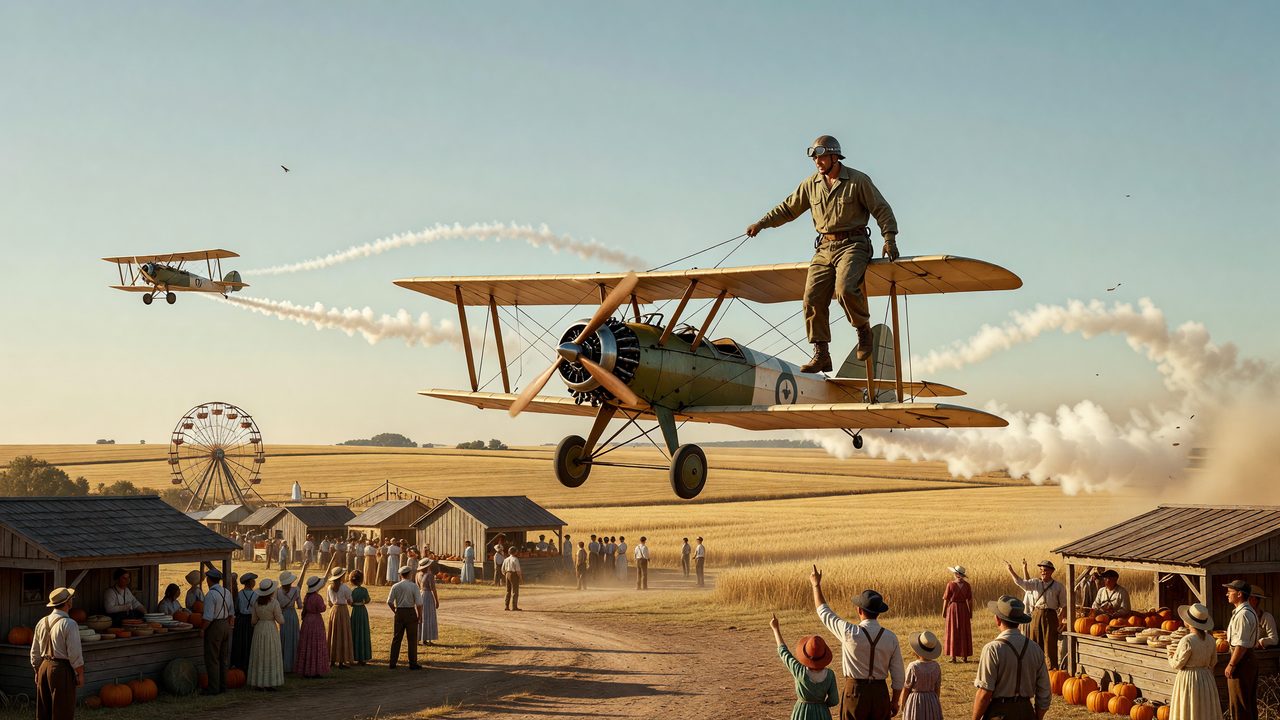
These were the barnstormers, itinerant aviators who treated the sky like a traveling circus. They followed the harvest south and the county fair east, buzzing farm towns from low altitude, negotiating with a farmer for the loan of a pasture, and sleeping beneath canvas wings when motels were scarce and cash was thinner. A typical show opened with a pass over the village, handbills promising loops, barrel rolls, and rides for a few dollars—usually between three and five for five minutes aloft. For many rural Americans, the appearance of a Jenny on the horizon shut down the ordinary business of the day. Entire towns turned out to watch strangers step from a machine most had previously seen only in photographs.
Stunts, Specialists, and the Language of Wonder
Barnstorming divided labor the way any circus does. Stunt pilots spun and dove; aerialists walked wings, hung from landing gear, and changed from one airplane to another in midair. Ormer Locklear, whose wing-walking exploits are preserved in period posters and in Art Ronnie's biography Locklear: the Man Who Walked on Wings, helped define the art before his death in 1920. Don Dwiggins, whose histories of the era remain standard references, described performers who played tennis on upper wings and jumped at night holding flashlights—feats that sound absurd until you remember that most spectators had never ridden in any machine faster than a Model T.
Charles Lindbergh entered this world before he entered history. In We, his 1927 account of the transatlantic flight, he describes leaving the University of Wisconsin in 1922 for Lincoln, Nebraska, and soon barnstorming southeastern towns with pilot E. G. Bahl after the instruction plane was sold. Lindbergh charged five dollars for short hops and began wing-walking; he learned parachute work from cables designed to break away under strain—skills he honed long before the Spirit of St. Louis ever left the ground. The barnstorming circuit was not romance alone. Aviator Jessie Woods, quoted in later memoirs cited by the Centennial of Flight Commission, remembered sleeping on the bottom wing and going days without rest. The wonder was real; so was the exhaustion.
The Gates Flying Circus
The largest operations professionalized the chaos. Promoters booked routes in advance, moved fleets of Jennys, and carried specialists from town to town. The Ivan Gates Flying Circus, operating from 1922 to 1928, toured widely and popularized the one-dollar joy ride—so successfully that pilot Bill Brooks once carried nine hundred eighty passengers in a single day at Steubenville, Ohio. Embry-Riddle scholarly surveys of 1920s aviation credit the Gates organization with carrying an estimated one million passengers in those years without a serious injury—a safety record that dwarfs what casual memory expects from daredevil shows.
Its star was Clyde Pangborn, known as "Upside-Down" for his inverted flying and celebrated for midair airplane changes, a stunt for which he held the world record. In 1924, when stuntwoman Rosalie Gordon's parachute tangled in his landing gear, Pangborn did not climb for altitude and hope; he maneuvered the Jenny to free her. Dwiggins and other historians have argued that the Gates troupe trained more famous pilots than the Army and Navy combined during the barnstorming years—a claim that reflects how completely the road, not the barracks, owned American aviation's imagination in the mid-1920s.
The Regulation That Closed the Tent
The era's success contained its ending. By 1927, Congress and the Department of Commerce had begun shaping civil aviation into an industry rather than a carnival. New safety rules—prompted by accidents and by complaints from local operators who resented barnstormers undercutting their business—required aircraft to meet stricter airworthiness standards that aging Jennys could not easily satisfy. Low-altitude aerobatics over paying crowds faced new limits. When the military stopped selling surplus trainers, the economics collapsed. The flying circuses folded. Barnstormers drifted into airline cockpits, Army flight schools, and the quiet seniority of instruction—carrying forward stick-and-rudder instincts forged in pastures.
They left something harder to regulate: the conviction, now embedded in aviation culture, that an airplane belongs not only to the military and the wealthy but to anyone willing to look up.
Why it matters to you
Every time you brief a passenger, volunteer for a Young Eagles day, or explain why a five-minute hop over familiar terrain still feels like magic, you are continuing what the barnstormers began. Modern training emphasizes regulations, risk management, and standardized maneuvers—exactly the framework that ended the flying circuses in 1927. Yet the cultural reason many of us fly at all is older than the Air Commerce Act: the barnstormers proved that wonder is a legitimate payload. When you fly precisely, speak plainly to nervous riders, and treat each landing as the show's final act, you practice the same skill the Gates pilots perfected a million times over—turning flight from a war machine into a ticket to the imagination of ordinary people. That is why the decade when the sky was a traveling circus remains a cornerstone of aviation culture, and why your certificate is as much a storyteller's license as a technical one.