The Zero's Bargain: Speed, Range, and Nothing Left for the Pilot
"It could out-climb, out-turn, and out-range anything in the sky. What it could not do was take a hit."
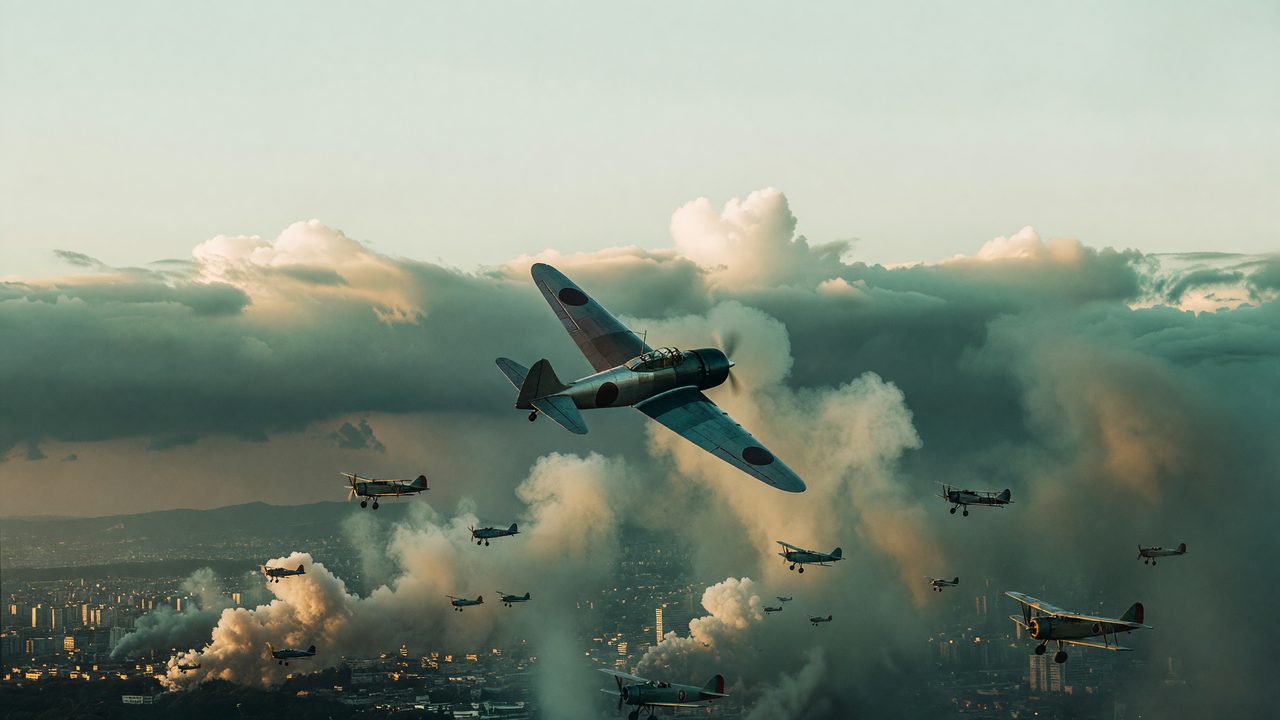
The Zero's Bargain: Speed, Range, and Nothing Left for the Pilot
Jiro Horikoshi built the Mitsubishi A6M to outfly every rival in the sky — and every ounce he saved in aluminum became a lesson in what fighter design must never sacrifice.
When the Imperial Japanese Navy issued its 十二試艦上戦闘機計画要求書 — the 12-shi Carrier Fighter Plan Requirements — in 1937, it asked for the impossible: a shipboard fighter that could climb fast, turn tight, cruise far, and still land on a carrier deck. Jiro Horikoshi, the young chief designer at Mitsubishi, answered with a philosophy that would define Japanese naval aviation for the entire war. In his memoir Reisen — literally "Zero Fighter" — Horikoshi described a relentless campaign against mass. Every structural member, every rivet, every ounce of equipment faced the same question: can we live without it?
The answer, repeatedly, was yes. Horikoshi specified extra-super duralumin, an aluminum alloy lighter and stronger than conventional airframe metal, then stripped away everything that conventional Western designers considered non-negotiable. The A6M carried no armor plate around the pilot or engine. Its fuel tanks did not self-seal when punctured. Even the wing — enormous by contemporary standards, spanning more than eleven meters — was sized not for high-speed stability but for low-speed lift and turning authority. The trade produced a machine of extraordinary grace. Early Zeros could reach roughly 2,200 kilometers on internal fuel, outrange any American carrier fighter of the day, and turn inside opponents so decisively that Allied pilots initially assumed Japan possessed a secret high-horsepower engine.
The Zero's combat debut confirmed that assumption in the worst possible way. In September 1940, thirteen A6M2s of the Imperial Japanese Navy's 12th Air Group flew escort over a raid on Chungking. In the melee that followed, they shot down twenty-seven Soviet-built Polikarpov I-15 biplanes and I-16 monoplanes. All thirteen Zeros returned. No Allied intelligence officer who read that report slept easily. For the next eighteen months, across China and then the Pacific, the Zero would make similar arithmetic look routine.
At Pearl Harbor, over the Philippines, and during the Malaysian campaign, Zero pilots exploited the aircraft's strengths with disciplined teamwork. They refused to be drawn into slow, turning dogfights on American terms when diving attacks served better — yet they could outturn a Curtiss P-40 or a Grumman F4F Wildcat whenever a turning fight suited them. The design philosophy that Horikoshi had pursued with such single-minded devotion had delivered exactly what the Navy demanded: temporary air superiority purchased at minimum industrial cost.
But the bargain was already written into the airframe. American pilots who survived their first encounter with a Zero began to notice what the design had given up. High diving speeds stressed the lightweight structure. A handful of .50-caliber hits could sever control cables, rupture unprotected fuel lines, or kill an engine. The Zero's legendary maneuverability required gentle, deliberate handling at the edge of the envelope — a quality Lieutenant Commander Eddie R. Sanders documented with clinical precision after the U.S. Navy recovered a largely intact A6M2 from Akutan Island in the Aleutians in 1942. Sanders's test report, flown at Naval Air Station Anacostia, quantified what combat veterans had been learning in blood: the Zero climbed and turned superbly, but it could not absorb punishment, and it lost advantage the moment an opponent converted altitude into speed and refused to stay in the turning fight.
Allied tacticians codified the countermeasure as dive-and-zoom: attack from above, fire a burst during the pass, and use excess energy to climb back out of the Zero's turning arc before the Japanese pilot could bring guns to bear. By 1943, newer American fighters — the F6F Hellcat, the F4U Corsair, the P-38 Lightning — arrived with armor, self-sealing tanks, and horsepower margins that made the tactic forgiving even for average pilots. Japan, meanwhile, could not retrofit the Zero into a survivable gun platform without destroying the very qualities that had made it formidable. Production records show 10,425 Zeros rolled off Mitsubishi and Nakajima lines before surrender — more than any other Japanese aircraft type — yet each successive variant gained weight and lost the purity of the original design. Navy camouflage directives, including the provisional Standard 117 color norms issued by Japanese Navy Air Command Headquarters in March 1944 and documented in Kugisho engineering reports, reflected an air force fighting for time it no longer possessed.
By 1945, the fighter that had once owned the Pacific morning now carried pilots on one-way flights. Stripped of armor it never had, laden with explosives instead of fuel for the return journey, the Zero ended the war as a kamikaze's coffin — the final proof that a design optimized exclusively for offensive agility could not adapt when the war demanded resilience.
Why it matters to you
Horikoshi's Zero is a case study every pilot encounters in training, whether the syllabus names it or not: design is the art of choosing what to sacrifice. The 12-shi requirements demanded range, climb, and turn radius simultaneously; Horikoshi met the brief by subtracting protection, and for two years the subtraction looked like genius. Modern flight instruction teaches the same tactical grammar Sanders verified in 1942 — energy management, hit-and-run passes, refusing to fight an opponent's strongest maneuver. When you practice converting altitude to airspeed, extending and climbing back above an adversary rather than accepting a low, slow turning match, you are applying the lesson Allied pilots learned against the Zero. The aircraft that once seemed untouchable in a turn was never invincible; it was optimized. Understanding that distinction — between what an airplane does brilliantly and what it cannot do at all — remains the difference between flying into someone's strength and dictating the fight on your terms.