The Whistle That Ended the Propeller Age
"372 mph"
The Whistle That Ended the Propeller Age
On a humid August morning in 1939, a propellerless prototype clawed off a Baltic airfield—and proved that sustained flight no longer required a spinning disk.
A Sound No One Had Heard Before
The Marienehe airfield near Rostock, Germany, belonged to Ernst Heinkel’s aircraft company, and on the morning of August 27, 1939, it offered the usual coastal stillness: grass, wind off the Baltic, the mechanical routine of a prewar test program. Then witnesses heard something new—a high, rising whistle that seemed to come from the machine itself rather than from the air rushing past it.
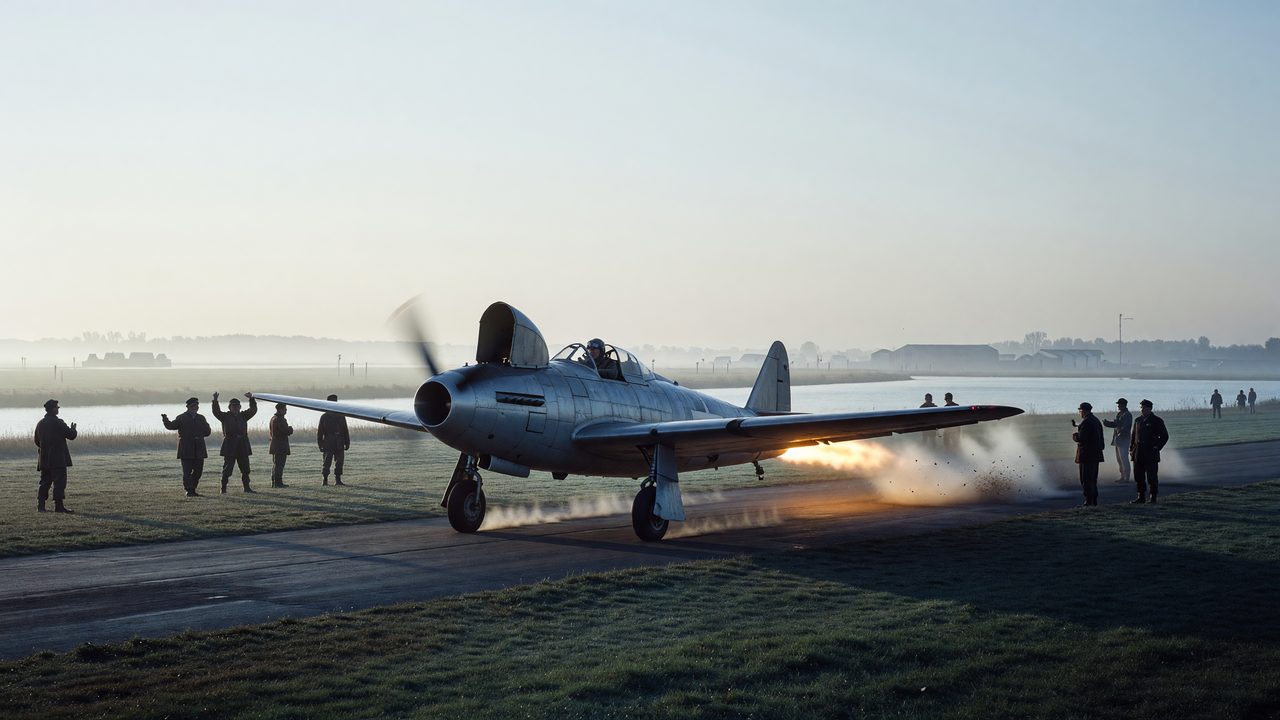
Rising from the runway was an aircraft with no propeller. Its nose was open to the oncoming air; its exhaust pipe thrust from the tailcone. At the controls sat Flugkapitän Erich Warsitz, one of Heinkel’s most experienced test pilots. He advanced the throttle of the Heinkel He 178, and the world’s first turbojet aircraft clawed forward across the grass.
The powerplant was the HeS 3, a centrifugal-flow turbojet burning gasoline, designed by Dr. Hans Joachim Pabst von Ohain and backed by Heinkel’s own funds when official interest lagged. Development records preserved by the company trace a difficult lineage: earlier HeS 1 experiments had proved the concept on the ground, but flight demanded an engine light enough, reliable enough, and responsive enough to trust with a human aboard.
Six Minutes That Rewrote the Equation
Three days earlier, Warsitz had made a brief hop—enough to confirm that the He 178 could leave the ground under jet thrust alone. The flight of August 27 was the true maiden voyage: six minutes aloft, a short circuit of the field, and a landing that would test any pilot’s composure.
In his first-hand account, reproduced in aviation histories including This Day in Aviation and Aviation-History.com, Warsitz described a machine that moved slowly at first, then gathered speed as the turbine howled. The rudder and flaps, he reported, worked almost normally—a reassurance that jet thrust had not stolen conventional control from the pilot. Only the landing proved demanding. The undercarriage failed to retract, adding drag and complicating the approach. Warsitz side-slipped the little aircraft down and touched down, by his own description, just short of the Warnow River with a wonderful touchdown—precision born of experience rather than luck.
The IET’s historical account of the dawn of the jet age quotes the same Rostock narrative and places it in context: this was not a publicity stunt staged for cameras. It was a company test flight on the eve of a continental war, conducted with the quiet urgency of engineers who understood that they were measuring the future.
Numbers That Failed to Convince Berlin
The He 178 was small, experimental, and limited. In subsequent testing it reached speeds reported at roughly 598 km/h (372 mph)—fast for 1939, yet not dramatically beyond what the best piston fighters could achieve. Endurance hovered near ten minutes. Fuel consumption and engine life remained practical problems that laboratory enthusiasm could not wish away.
When senior Nazi aviation officials Ernst Udet and Erhard Milch examined the program, they were unimpressed. Germany’s rearmament priorities favored proven piston engines, existing production lines, and fighters that could be fielded in months. A fragile prototype with minutes of fuel offered little to a ministry preparing for total war. Heinkel’s jet survived as a technical triumph more than a procurement success.
Yet the flight had opened the jet age regardless of official indifference. Aviastar.org’s chronology of experimental aircraft notes the consequence plainly: when Britain’s Gloster E.28/39 flew under Frank Whittle’s turbojet power on May 15, 1941, the He 178 had already been aloft for nearly two years. The propeller’s reign was ending whether procurement officers recognized it or not.
Two Roads to the Same Sky
Historians often frame the jet revolution as a race between von Ohain and Whittle. The comparison is fair but incomplete. Whittle’s axial-flow concept and von Ohain’s centrifugal-flow HeS series followed different engineering paths toward the same physical truth: a turbine could compress and ignite air-fuel mixture continuously, expelling a high-velocity jet that produced thrust without a propeller’s disk and shaft.
What Marienehe demonstrated in August 1939 was operational proof—the moment when abstract thermodynamics became an aircraft that a pilot could throttle, bank, and land. Warsitz’s log entries and Heinkel’s development records, cited in technical chronologies at Aviation-History.com, mark that transition with engineer’s precision: ground runs, hop, circuit, recovery. The jet age began not with a headline, but with a test pilot listening to a howl he had never heard before and choosing to stay airborne.
Why it matters to you
The operational principles Warsitz exercised that morning still shape how pilots are trained today. Jet thrust builds gradually compared with instant propeller bite; he reported slow initial acceleration before the He 178 gathered speed—a lesson every turbine pilot later learns as spool-up and energy management on takeoff. His assessment that rudder and flaps behaved “almost normally” reminds you that new powerplants do not suspend basic aircraft control, but they do change how aggressively you can rely on drag, flap, and sideslip during approach. When his undercarriage stuck down, Warsitz did not abandon the pattern; he used a side-slip to manage descent angle and touched down short of the Warnow with deliberate alignment—exactly the kind of energy-and-configuration problem you still solve in training, whether you fly a Cessna or a jet. The first jet flight was history; the piloting habits it demanded are still on your checklist.